- 24 Nov, 2026
Customer Acquisition Cost: Is Each Customer Profitable?
ADVERTISING ECONOMICS · E-COMMERCE
Imagine spending $2,000 on advertising and generating 100 new customers. Your campaign reports 100 conversions, your sales dashboard looks healthy, and your marketing team calls it a successful month.
But what happens when you subtract product costs, shipping, discounts, payment fees, refunds and the advertising expense? Suddenly, those 100 customers may not look nearly as valuable. This is where understanding customer acquisition cost becomes more important than simply counting conversions.
In short: Customer acquisition cost (CAC) measures how much a business spends to acquire one new customer. However, CAC alone does not reveal profitability. Advertisers must compare it with contribution margin, customer lifetime value, repeat purchases and the payback period to understand whether acquiring customers creates sustainable financial value.
Written by: The Adstork Ad Network advertiser team
Last updated: November 2026
Reading time: 10 minutes
Best for: E-commerce advertisers, performance marketers and businesses acquiring customers through paid advertising
THE REAL QUESTION
Are You Buying Customers or Buying Revenue That Cannot Cover Its Costs?
A business can increase its customer count while weakening its financial position. This happens when the cost of acquiring customers grows faster than the value those customers contribute.
To understand the difference, we need to look beyond the advertising dashboard and examine the economics of an individual customer.
Key Takeaways
- Customer acquisition cost should be measured against customer contribution, not just revenue.
- Repeat purchases can change the economics of an acquisition, but only when they generate additional profit.
- The payback period reveals how long advertising investments take to recover.
- A profitable acquisition model needs clear financial boundaries before campaign budgets increase.
1. What Does Customer Acquisition Cost Actually Measure?
Customer acquisition cost, commonly called CAC, measures the average amount a business spends to bring in one new paying customer. It connects marketing investment with an actual business outcome.
The basic formula is straightforward:
THE CAC FORMULA
CAC = Total Acquisition Cost ÷ New Customers Acquired
Use the same reporting period and consistent cost definitions.
However, what counts as acquisition cost depends on the financial question you are trying to answer. A narrow advertising CAC may include only media spending. A fully loaded CAC can also include creative production, agency fees, marketing software and other acquisition-related expenses.
Neither calculation is automatically wrong. The problem starts when a business compares two CAC figures that include different expenses without recognizing the difference.
IMPORTANT DISTINCTION
Advertising CAC vs. Fully Loaded CAC
Advertising CAC: Advertising spend divided by new customers attributed to advertising.
Fully loaded CAC: Acquisition-related expenses, including advertising and relevant operating costs, divided by new customers acquired.
For a broader understanding of how campaign costs are measured, explore CPM vs. CPC vs. CPA and their different pricing models.
2. Why Revenue Can Give You a False Sense of Profitability
Revenue is what customers pay your business. Profit is what remains after the costs of generating and fulfilling those sales are considered. Confusing the two can make an expensive acquisition strategy look successful.
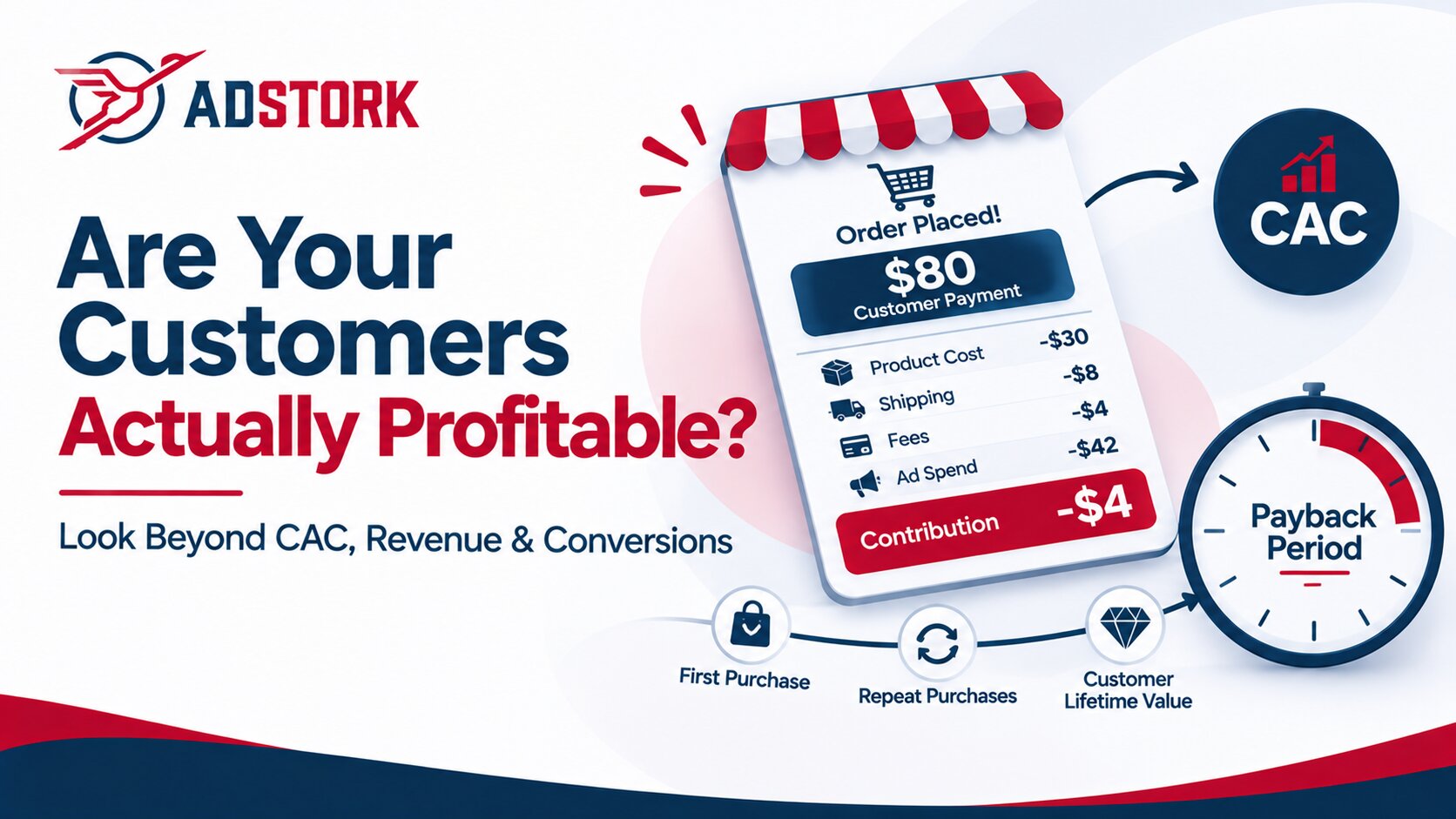
Consider an e-commerce business selling a product for $80. An advertiser might see an $80 conversion and assume the campaign has generated enough revenue to justify the acquisition. But the business still has several expenses to account for.
The following numbers are illustrative and made up to demonstrate the calculation.
The business has $38 remaining before advertising costs. If it spends $42 to acquire that customer, the first order produces a negative contribution of $4. The $80 sale was real, but the acquisition was not profitable on that order.
Pro tip: Use contribution margin rather than total revenue when deciding how much you can afford to spend acquiring a customer. Include variable costs that are directly associated with fulfilling the order.
3. How Does Customer Lifetime Value Change the Equation?
A customer does not necessarily generate value through one purchase. Some customers return, purchase additional products, upgrade their orders or maintain a subscription. Their total economic contribution can therefore extend beyond the first transaction.
This is where customer lifetime value, or CLV, becomes useful. It estimates the value a customer generates throughout the relationship with a business.
For acquisition decisions, contribution-based lifetime value is more useful than simply adding up all customer payments. It accounts for the costs associated with delivering those purchases.
A SIMPLE WAY TO THINK ABOUT CLV
Customer Lifetime Contribution = Total Customer Revenue - Variable Customer Costs
For a more complete model, account for the expected customer relationship period, refunds, servicing costs and the uncertainty of future purchases.
Let's continue with an illustrative example. Assume the first purchase generates $38 in contribution, and the same customer later makes two additional purchases, each generating $30 in contribution.
FIRST PURCHASE
$38
Contribution
SECOND PURCHASE
$30
Contribution
THIRD PURCHASE
$30
Contribution
TOTAL CUSTOMER CONTRIBUTION
$98
If acquisition cost is $42, the customer generates $56 in contribution after acquisition costs across these three purchases, before other fixed overhead and any additional costs not included in the example.
This is the important distinction: a customer who is unprofitable on the first purchase may become profitable over time. However, future purchases should never be treated as guaranteed income. Use actual repeat-purchase behavior, cohort data and realistic assumptions.
The relationship between customer value and acquisition spending is also useful when scaling an advertising campaign without losing ROI.
4. What Is the Customer Payback Period, and Why Does It Matter?
Profitability tells you whether an acquisition can generate enough value. The payback period tells you how long it takes to recover the acquisition investment.
This matters because a business might have positive lifetime economics but still struggle with cash flow if customers take a long time to generate enough contribution to cover their acquisition costs.
THE PAYBACK QUESTION
How Quickly Does Customer Contribution Recover CAC?
For a simplified model with stable monthly contribution:
Payback Period = CAC ÷ Monthly Contribution per Customer
This simplified formula assumes a consistent monthly contribution. Actual payback should use the timing of customer cash flows and contribution, not just a lifetime average.
Illustrative example: A business spends $60 to acquire a customer who generates $20 in contribution per month.
ACQUISITION COST
$60
MONTHLY CONTRIBUTION
$20
PAYBACK PERIOD
3 Months
In this simplified example, the business needs three months of contribution to recover its acquisition investment. The business still needs to consider fixed overhead, customer retention, payment timing and the possibility that customers stop purchasing.
A shorter payback period can make a business easier to fund and scale, but the ideal period depends on its cash reserves, business model, margins and financial obligations.
5. The Customer Economics Scorecard: Is Your Acquisition Model Healthy?
Before increasing advertising expenditure, evaluate the entire customer economics model. A single CAC figure cannot answer every financial question.
Use this scorecard to review the information your team should have available before committing to a larger acquisition budget.
How Should You Interpret the Results?
HEALTHY ECONOMICS
Value Exceeds Cost
Contribution-based customer value exceeds acquisition cost, and the payback period fits the business's cash flow.
NEEDS REVIEW
Narrow Margin
The economics are positive but leave little room for refunds, rising costs or weaker repeat-purchase behavior.
UNSUSTAINABLE MODEL
Cost Exceeds Value
Customer contribution cannot recover acquisition costs under realistic assumptions. Revisit the offer, pricing and acquisition strategy.
This is a decision framework, not a universal profitability benchmark. Each business has different margins, operating costs, customer behavior and cash requirements.
6. How Can Advertisers Build a More Reliable Acquisition Model?
Once the financial model is clear, the next challenge is turning it into a practical advertising decision. The goal is not to find the cheapest traffic at any cost. It is to identify traffic and customer segments that can support the business's economics.
Separate new customers from returning customers.
A returning customer should not automatically be counted as a new acquisition. Separate first-time purchases from repeat orders to avoid overstating campaign performance.
Compare customer economics by acquisition segment.
Review countries, devices, formats and placements separately where the data supports it. An overall average can conceal differences between customer groups.
Track the complete conversion journey.
Check whether recorded conversions represent actual customers, whether duplicate orders are excluded and whether cancellations or refunds are reflected in the final business records.
Test offers against contribution, not order volume.
A discount might increase the number of orders but reduce the contribution from each one. Calculate the economics of the discounted offer before increasing its advertising budget.
Increase spending only when the evidence supports it.
A campaign that acquires a few profitable customers has not necessarily proven that the same economics will hold at higher spending levels. Expand gradually and keep checking the actual customer contribution.
For a deeper look at measurement and campaign quality, read how to identify ad fraud and invalid traffic before it affects your budget.
7. Your Customer Acquisition Planning Sheet
Before your next advertising campaign, use this worksheet to document the financial assumptions behind your acquisition target. It is designed to make important decisions visible before the budget is committed.
8. Where Does Adstork Fit In?
Understanding customer economics is one part of advertising. The other is knowing where your campaign results are coming from. Advertisers need visibility into performance segments rather than relying entirely on an overall campaign average.
Adstork provides reporting by country, device, format and placement, giving advertisers additional dimensions to examine when evaluating their campaigns. Its self-serve platform includes guided onboarding and live chat, with optional account manager support. You can learn more about the advertising platform and available options.
9. What Are the Honest Limits of Customer Acquisition Economics?
Reality check: Customer acquisition models are decision-making tools, not guarantees of future profitability.
First, historical repeat purchases do not guarantee that new customers will behave the same way. Customer cohorts can differ by product, season, offer, country and acquisition source.
Second, average customer lifetime value can hide substantial differences between customers. Some purchase repeatedly, while others never return. Averages can therefore create overly optimistic acquisition assumptions.
Third, attribution is not always straightforward. A customer may interact with multiple marketing channels before purchasing. Assigning the entire acquisition to one campaign can distort the economics.
The practical solution is to use conservative projections, separate customer cohorts, define attribution rules and regularly compare forecasts with actual contribution. Include refunds, discounts and customer servicing costs rather than assuming every recorded sale represents permanent value.
10. What Comes Next for Customer Acquisition Measurement?
As customer journeys become more complex, advertisers need better ways to connect campaign activity with actual business outcomes. Platform-level conversions are useful, but they do not always tell the complete story of customer profitability.
First-party customer records, cohort analysis and more consistent conversion measurement can help businesses understand what happens after the initial click or purchase. Better measurement also makes it easier to distinguish new customer acquisition from repeat business.
Automation can help organize large amounts of campaign data, but automated decisions are only as useful as the definitions and financial assumptions behind them. Businesses still need to decide what a valuable customer means and how much they can afford to invest in acquiring one.
Quick Recap
Customer acquisition cost tells you what it takes to win a customer, but customer contribution, lifetime value and payback period tell you whether that investment makes financial sense. Before increasing advertising expenditure, understand the complete economics of the customer, validate your assumptions and measure what happens beyond the first conversion.
Final Word: Make Every Acquisition Count
Growing a customer base is important, but sustainable growth comes from acquiring customers whose contribution supports the business. When your financial model, campaign measurement and acquisition strategy work together, you can make advertising decisions with greater confidence. Adstork Ad Network provides advertisers with campaign reporting across key performance dimensions to help examine where their results come from. Start with a clear financial target and build your next campaign around evidence rather than conversion volume alone.
Frequently Asked Questions
1. What is customer acquisition cost (CAC)? Customer acquisition cost is the average amount a business spends to acquire one new paying customer. It is calculated by dividing the relevant acquisition expenses by the number of new customers acquired during the same period.
2. How do I calculate customer acquisition cost? Add the acquisition expenses included in your chosen calculation and divide that total by the number of new customers acquired. Keep the reporting period and expense definitions consistent.
3. What is the difference between CAC and customer lifetime value? CAC measures the cost of acquiring a customer, while customer lifetime value estimates the value generated throughout the customer relationship. Comparing CAC with contribution-based lifetime value helps evaluate acquisition economics.
4. Can a business lose money on the first purchase but still have a profitable customer? Yes. If future purchases generate enough additional contribution to recover the acquisition cost and other relevant expenses, the customer may become profitable over time. However, repeat purchases must be supported by realistic evidence.
5. What is a customer payback period? It is the time required for a customer's accumulated contribution to recover the cost of acquiring that customer. A shorter payback period generally means the business recovers its acquisition investment sooner.
6. Should I use revenue or profit when calculating customer lifetime value? For acquisition decisions, contribution-based customer lifetime value is generally more informative than revenue alone. It accounts for the variable costs associated with generating customer purchases.
7. Why does customer acquisition cost differ between advertising channels? Different channels can attract customers with different purchase intentions, conversion behavior, product preferences and repeat-purchase patterns. Compare acquisition costs alongside customer contribution and attribution rules rather than judging channels by CAC alone.
8. When should a business increase its customer acquisition budget? Increase spending when customer economics are supported by reliable conversion data, sustainable contribution margins and an acceptable payback period. Expand gradually and monitor whether those economics remain consistent as spending grows.
Keep Reading
Explore these related advertiser guides to build a stronger acquisition and measurement strategy.
Adstork Ad Network
Make informed advertising decisions. Measure what matters. Build sustainable growth.
Leave a Comment