- 20 Nov, 2026
How to Test a New Ad Network for a Client: A 14-Day Plan
A client asks whether push or native could work, and the agency has budget for one shot. Two weeks later the report says "some clicks, unclear results," and the next client call is awkward. The network may have been fine. The test had no pass line, too many changes, and nobody agreed what success meant.
In short: To test a new ad network for a client, agree a written test charter first, run a small budget for 14 days with one or two formats and countries, score the network on measurement, traffic quality, cost per result, support, moderation, control, and terms, and give the client a one-page verdict. Judge by cost per result, not clicks.
Written by: The Adstork Ad Network advertiser team
Last updated: November 2026
Best for: Agencies, freelancers, and in-house teams trying a new traffic source
Key Takeaways
- Write the pass line before spending, with the client's sign-off.
- Change as little as possible so the result has one clear cause.
- Check the network's reports against your client's own data.
- A clear failed test with a written reason is still a useful result.
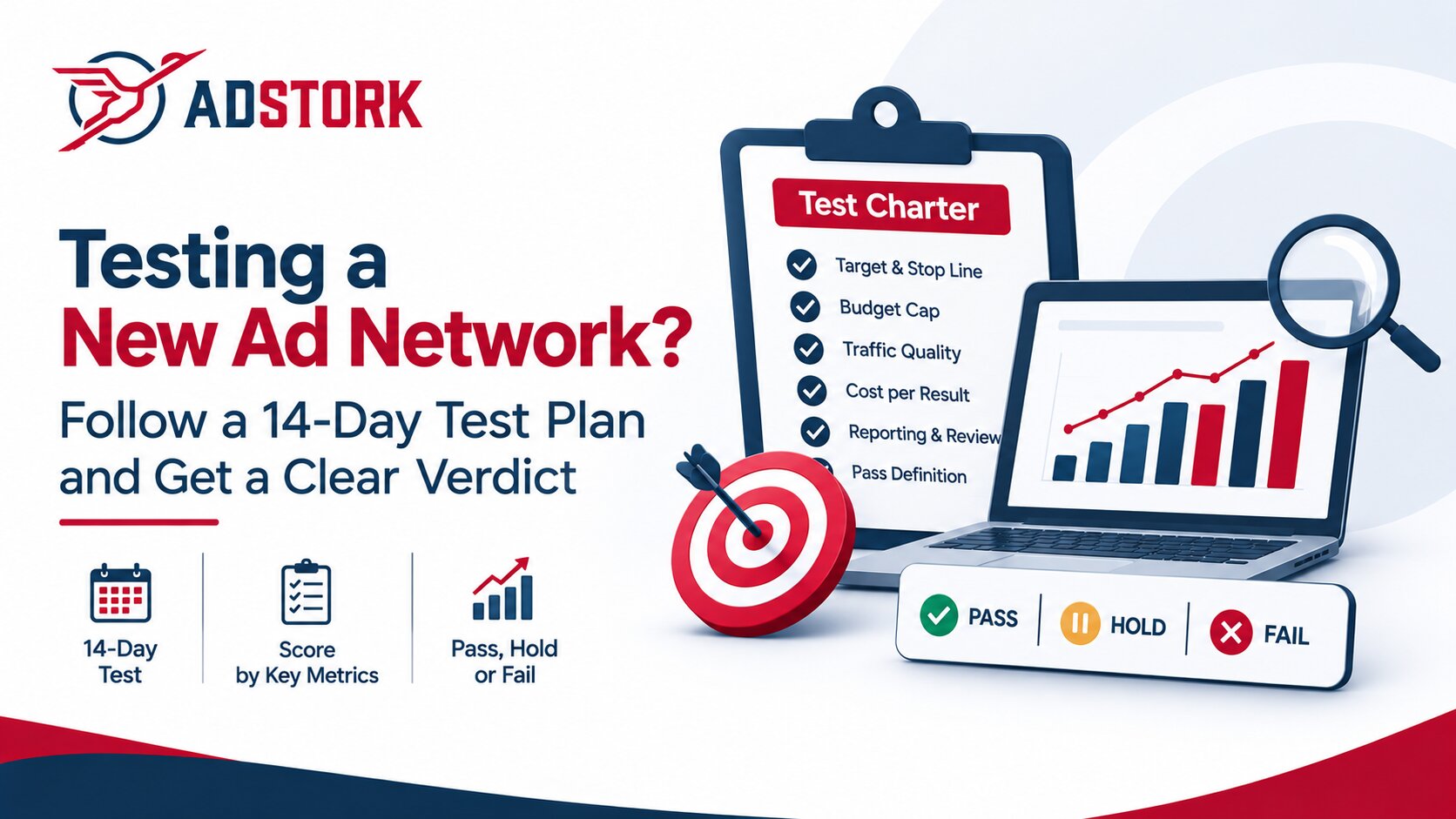
What Goes in a Test Charter?
Fill this in and get the client's agreement before any money moves. One published approach, from the growth team at Ramp, sets aside a fixed experimental share of spend (they mention about 5%) or a flat amount, and tests with two existing creatives plus three new ones made for the platform.
How Do You Run the 14 Days?
Sign the charter. Ask the network your questions in writing (see below).
Tracking test. Complete a test conversion and confirm it appears in the network's reports and the client's records.
Approvals and soft launch. Note how long review took and how clear any feedback was.
Run it. Check once a day. Change nothing except stopping a segment that crosses the stop line.
Read by segment. Split results by country, device, format, and placement, and look for invalid traffic signs.
Reconcile. Compare the network's numbers with the client's own sales or lead data.
Score and report. Give the client the verdict on one page.
How Do You Score a Network?
Score each line from 1 (missing or evasive) to 5 (specific and proven in your test). The weights are our suggested starting point. Change them to fit the client.
25
Measurement and reporting. Tracking works, reports split by segment, and numbers reconcile with the client's data.
20
Traffic quality. Few signs of invalid traffic, and a clear process when you report a problem.
20
Cost per result. Against the target, on enough conversions to trust.
10
Support and communication. A named contact, fast and specific answers.
10
Moderation clarity. Reasonable review time, and clear reasons if something is rejected.
10
Control. Budget caps, pausing, and the ability to cut segments or sources.
5
Commercial terms. Deposit, fees, and refund rules that match what you were told.
Multiply each score (out of 5) by its weight, divide by 5, and add them up. Here is an illustrative comparison. The numbers are made up to show the math.
Network A
79/100
Network B
48/100
What Counts as a Pass, a Hold, or a Fail?
These are starting rules. Agree your own with the client in the charter.
PASS
Score of 70 or more, cost per result under target on enough conversions, and numbers that reconcile. Plan a larger second test.
HOLD
Score of 50 to 69, or cost close to target. Run one more week changing one thing, such as the creative or country.
FAIL
Score under 50, cost clearly above target, or a 1 on measurement or traffic quality. Stop and write down why.
What Should the Client Update Say?
We tested ________ (network and formats) in ________ (countries) for 14 days.
We spent ________ and got ________ results at ________ each, against a target of ________.
What worked: ________
What did not: ________
Verdict: Pass, hold, or fail, with the score and one sentence why.
Next step: ________ (budget, change, or stop).
What Should You Ask the Network First?
- Who owns the account and the data, and can we export reports?
- Can we manage several clients, with separate billing and user permissions?
- How long does creative review take, and how are rejections explained?
- How do we report invalid traffic, and what happens next?
- Who is our contact, and how fast do they reply?
Where Does Adstork Fit In?
A test is only as good as the data it produces. Adstork provides reporting by country, device, format, and placement, runs banner, native, push, popunder, and video from one platform, and screens ad quality and traffic integrity. Agencies can start through the self-serve platform with live chat, or work with an account manager. Ask us the five questions above before you test, including how we handle several clients, billing, and permissions. Our 12 questions guide goes further.
What Are the Honest Limits?
Reality check: Fourteen days is a short window and a small budget gives noisy results, so a pass is a reason to test bigger, not a final answer. A failed test can come from the offer, creative, or tracking, not the network. If you test during the Black Friday weeks, costs and shopper behavior are distorted, so compare carefully or wait until December.
Quick recap
Write a charter the client signs, run 14 quiet days, score the network on seven weighted lines, reconcile with the client's data, and report a clear pass, hold, or fail on one page.
FAQs
How long should I test a new ad network? Fourteen days is a practical first read. Run longer if volume is low, since you need enough conversions to judge cost per result.
How much budget should a test use? Agree a cap with the client that you can afford to lose and that still buys a readable number of results. Some teams use a fixed share of spend or a flat amount.
Which metrics matter most in a network test? Cost per result against target, reconciled with the client's own data, plus segment quality signals such as time on page and conversion rate by country and device.
What if the test fails? Write down the likely cause (offer, creative, tracking, or traffic) and retest only one variable. A documented failure is useful to the client.
How does Adstork support agencies? Through a self-serve platform with live chat, an account manager, five ad formats, and reporting by country, device, format, and placement. Ask about multi-client setup, billing, and permissions.
Keep Reading
Comments (0)
Latest Blog


.jpg)
Leave a Comment