- 18 Nov, 2026
The Lead Acceptance Contract: A Better Way to Measure B2B Advertising
Your advertising report says 240 leads were generated. Your agency says the campaign is performing. Your sales team says most of those contacts will never become customers. All three statements can be true.
This disagreement is common in B2B lead generation because the advertiser, agency and traffic partner may be measuring different things. One counts form submissions. Another measures cost per lead. The sales team cares about qualified prospects and actual opportunities.
The solution is not simply to demand cheaper leads or increase campaign volume. Before launching, create a shared Lead Acceptance Contract: a short operating agreement that defines which leads count, how they are checked, what gets rejected and how the results are reported back.
The central idea: A lead should not be judged only by the moment someone submits a form. Advertisers need a shared way to evaluate what happens after that submission, from contact validation to sales qualification.
Written by: The Adstork Ad Network advertiser team
Last updated: November 2026
Best for: B2B advertisers, SaaS companies, business-service providers, lead-generation agencies and media buyers
The Problem Is Often a Difference in Definitions
Imagine a software company running a campaign to attract businesses interested in its product. The campaign generates enquiries, but the sales team later discovers that many contacts are students, job seekers, individuals outside the target market or companies that cannot afford the service.
The advertising platform may have recorded every form submission correctly. The problem is that a recorded conversion and a commercially useful lead are not the same thing.
| Team | What it may call success | What it needs to know |
|---|---|---|
| Advertiser | A lead that can become a customer | Does the contact fit the target market and have genuine buying intent? |
| Agency | A campaign meeting its agreed performance targets | Which sources, creatives and audiences produce accepted leads? |
| Ad network or traffic partner | Traffic and conversions recorded under the agreed tracking setup | Which campaign identifiers and conversion events can be verified and returned? |
The disagreement becomes expensive when nobody defines the difference before the campaign starts. The advertiser may reject leads that the agency counted as conversions, while the traffic partner may have no information about what happened after the visitor reached the advertiser's website.
Build a Lead Acceptance Contract Before Launch
Think of this as a one-page campaign agreement, not a legal document. Its purpose is to make the campaign measurable in the same way for everyone involved.
The five fields every agreement should contain
01 — Target customer
Specify the companies or people the campaign is intended to reach. Include relevant industry, location, company size, role or other genuine eligibility criteria.
02 — Valid lead
Define the minimum requirements for a submission to count: a working contact method, a completed form, a relevant enquiry and no duplicate record within the agreed period.
03 — Qualified lead
Specify the additional conditions that make a valid lead suitable for sales follow-up. For example, the company fits the target market and the contact has a relevant business need.
04 — Rejection reasons
Agree on a short list of rejection categories, such as invalid contact details, duplicate submission, outside target geography, irrelevant enquiry or spam.
05 — Feedback and review
Decide who checks the leads, how quickly the CRM is updated, how often the agency reviews results and what information can be shared with the traffic partner.
These definitions should be specific enough that two different people reviewing the same lead would reach broadly the same decision. Avoid vague descriptions such as "high-intent customer" unless you explain exactly what demonstrates that intent.
Follow the Lead Beyond the Form
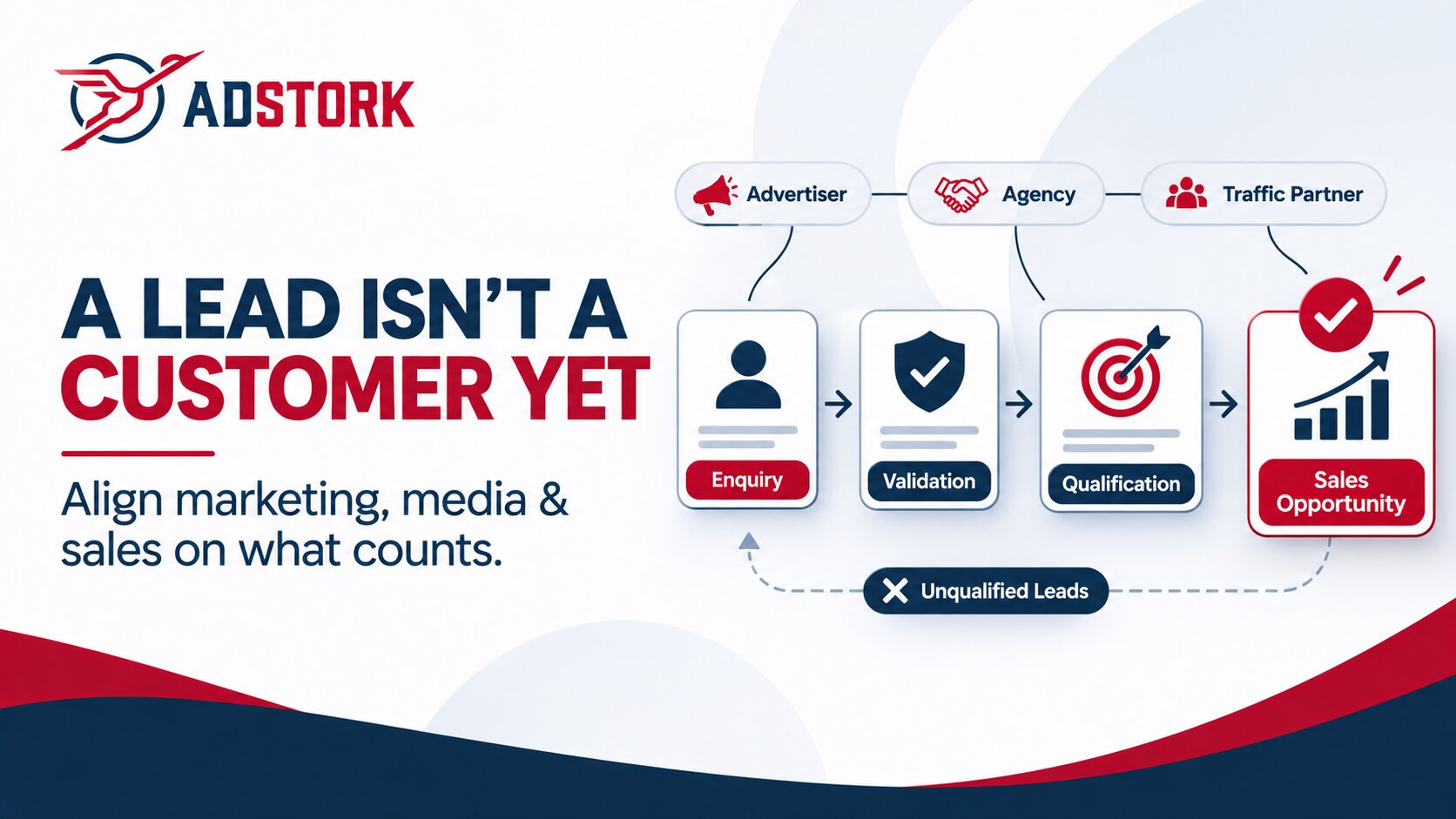
A useful B2B campaign measurement process follows the contact through several stages. The names and number of stages will differ between businesses, but the principle is to keep the original enquiry connected to its later outcome.
STAGE 1
Enquiry
A visitor submits a form or requests contact.
STAGE 2
Validation
The team checks contact details, duplicates and relevance.
STAGE 3
Qualification
The contact is assessed against the agreed customer criteria.
STAGE 4
Opportunity
Sales confirms a genuine opportunity to discuss the product or service.
STAGE 5
Outcome
The opportunity is won, lost or remains open.
The important detail is that each stage should be recorded against the same lead record or a reliable identifier. Otherwise, the marketing team may know how many forms were submitted but cannot reliably connect those submissions to later sales outcomes.
The Data Connection: What Needs to Travel Back?
This is where campaign tracking becomes more than a dashboard exercise. The advertiser needs a way to connect the original advertising interaction with the later CRM event.
A typical setup may preserve a click identifier or another permitted attribution identifier when someone visits the landing page. The website stores that identifier with the lead record. When the sales team updates the CRM, the advertiser can use an appropriate integration to send selected offline conversion events back to a compatible advertising platform.
An illustrative data flow
- An ad click carries a campaign or click identifier.
- The landing page records the identifier alongside the enquiry, where the setup and consent allow.
- The CRM stores the lead and records its status as it moves through the sales process.
- The advertiser sends eligible conversion events to the relevant platform or measurement system using a supported integration.
- The agency reviews campaign and source performance against the agreed lead stages.
For example, Google Ads supports enhanced conversions for leads using first-party customer data and offline conversion information. Its guidance recommends using qualified-lead or converted-lead goals when measuring offline lead-generation outcomes. Meta's Conversions API also supports multiple event sources, including offline events. These are platform-specific capabilities, so implementation requirements must be checked for the system being used.
A postback is another mechanism used in performance advertising to communicate a conversion event between systems. However, a postback does not automatically know whether a lead is commercially valuable. The advertiser still needs to define the event, preserve the right identifiers and send accurate information.
What the Agency Should Bring to the Table
Agencies often sit between the advertiser's sales operation and the media partners buying traffic. That makes them important owners of the feedback process—not just the people responsible for launching ads.
A useful agency review should connect three views:
- Media view: Spend, clicks, impressions, campaign identifiers and recorded conversions.
- Lead view: Valid submissions, rejected leads, qualified leads and reasons for rejection.
- Business view: Sales opportunities, pipeline value, closed deals and revenue where available.
The agency should also document changes. If a campaign begins generating more enquiries but fewer qualified leads, the team should be able to identify whether the change followed a new creative, landing page, audience, placement or traffic source. Without that record, optimization becomes guesswork.
Stop Reporting Only Cost per Lead
Cost per lead is useful, but it cannot tell the entire story. A B2B advertiser should compare the cost of leads at different stages of the sales process.
| Metric | Calculation | Question it answers |
|---|---|---|
| Cost per lead | Ad spend ÷ recorded leads | How much does each recorded enquiry cost? |
| Cost per qualified lead | Ad spend ÷ qualified leads | How much does it cost to attract a lead that meets the criteria? |
| Cost per opportunity | Ad spend ÷ sales opportunities | How much does it cost to create a genuine sales opportunity? |
| Customer acquisition cost | Acquisition costs ÷ new customers | What does it cost to acquire a paying customer? |
These metrics should be compared over consistent periods and with clearly defined cost boundaries. For example, decide whether agency fees, sales costs and software expenses are included. Otherwise, two reports may use the same metric name but calculate it differently.
A Simple Example: Two Campaigns, Different Outcomes
Consider an illustrative B2B software advertiser with two traffic sources. Both campaigns spend the same amount, but the leads progress through the sales pipeline differently.
| Measurement | Campaign A | Campaign B |
|---|---|---|
| Ad spend | $1,000 | $1,000 |
| Recorded leads | 100 | 50 |
| Qualified leads | 10 | 20 |
| Sales opportunities | 3 | 8 |
| Cost per qualified lead | $100 | $50 |
Illustrative figures only. They are not Adstork campaign results or industry benchmarks.
If the advertiser looks only at the cost per recorded lead, Campaign A appears cheaper: $10 per lead compared with $20 for Campaign B. But after qualification, Campaign B produces twice as many qualified leads for the same spend. Its cost per qualified lead is half as much.
This is why a campaign should not be declared successful or unsuccessful using a single early-stage metric. The later outcome changes the interpretation of the earlier numbers.
The Weekly Review: What Each Party Should Check
Advertiser
- Are leads reaching the right sales team?
- Are rejection reasons recorded consistently?
- Are qualified leads progressing?
Agency
- Which campaign segments generate accepted leads?
- Are changes affecting lead quality?
- Are reporting windows consistent?
Traffic partner
- Are the agreed tracking parameters being passed?
- Can the agreed conversion events be matched?
- Is there enough information to investigate a source-level issue?
Do not expect every traffic partner to receive or process CRM-level sales information. Capabilities differ by platform and agreement. Decide what can be shared, what can be tracked and what each partner is actually responsible for before treating the feedback loop as operational.
Four Mistakes That Break the Process
- Changing the definition after launch. If the advertiser changes what counts as a qualified lead halfway through a campaign, earlier and later results may no longer be comparable. Record the change and its effective date.
- Rejecting leads without a reason. A label such as "bad lead" gives the agency and traffic partner almost nothing to investigate. Use consistent rejection categories.
- Sending incomplete or duplicated events. Missing identifiers, inconsistent timestamps and duplicate records can distort reporting. Test the data flow before relying on it.
- Judging a long sales cycle too early. B2B prospects may take time to qualify, evaluate and purchase. Compare cohorts with enough time to mature rather than treating every recent lead as a final outcome.
Keep Customer Data and Consent in the Process
Connecting advertising and CRM data involves personal information in many cases. Advertisers should collect and share only what is necessary, use approved integrations, apply appropriate access controls and follow the privacy and customer-data requirements that apply to their markets and platforms. Hashing an email address does not, by itself, remove every privacy or compliance obligation.
Where an Ad Network Fits
An ad network is one part of the acquisition process. It can provide access to advertising inventory and campaign traffic, while the advertiser remains responsible for defining the target customer, maintaining the landing page and CRM process, and deciding which business outcomes matter.
Before testing a new traffic source, advertisers should explain their offer, target audience, conversion action and measurement requirements. They should also confirm which formats and tracking arrangements are supported rather than assuming every network can receive downstream CRM events.
Adstork offers banner, native, push, popunder and video advertising options. The right format and campaign structure depend on the audience, offer and landing-page experience. Discuss the campaign requirements before launch so the proposed setup matches the actual objective.
Explore Adstork for Advertisers
The Better Campaign Starts Before the First Click
A campaign should not have to wait until the sales team complains to discover that everyone has been measuring success differently. Define the target customer, agree on what makes a lead acceptable, preserve the information needed to follow its progress and review outcomes with the people responsible for each stage.
The Lead Acceptance Contract gives advertisers, agencies and traffic partners a common starting point. It does not guarantee better leads, and it cannot fix a weak offer or an unsuitable audience. But it can make campaign results easier to interpret—and make the next decision more informed.
FAQs
What is B2B lead quality?
B2B lead quality describes how closely an enquiry matches the advertiser's target customer and how suitable that contact is for a genuine sales conversation. It is more than whether someone completed a form.
What is the difference between a raw lead and a qualified lead?
A raw lead is a recorded enquiry or contact. A qualified lead has also met the advertiser's agreed criteria, such as relevant business needs, target-market fit or purchasing suitability.
Why should agencies receive CRM feedback?
CRM feedback helps agencies understand which campaigns and traffic sources produce leads that progress beyond the initial form submission. It supports more meaningful evaluation than lead volume alone.
Can an ad network track whether a B2B lead becomes a customer?
That depends on the network's tracking capabilities, the advertiser's CRM setup and the integrations agreed between the parties. A recorded click or form conversion does not automatically reveal a later sales outcome.
What is a postback in advertising?
A postback is a server-to-server message that communicates a conversion event between compatible systems. It can help connect an advertising interaction to a later event when the required identifiers and tracking setup are in place.
Which metric matters most for B2B lead-generation campaigns?
There is no universal answer. Cost per qualified lead, cost per opportunity and customer acquisition cost can provide a more useful business view than cost per raw lead alone. Choose metrics that match the sales process and campaign objective.
Keep Reading
- How to Launch Your First Ad Campaign: A Step-by-Step Guide for Advertisers
- How to Write Ads That Work in Banner, Native, Push, Popunder, and Video
- How to Scale a Winning Ad Campaign Without Losing Your ROI
```
Comments (0)
Latest Blog

.jpg)

Leave a Comment