- 05 Nov, 2026
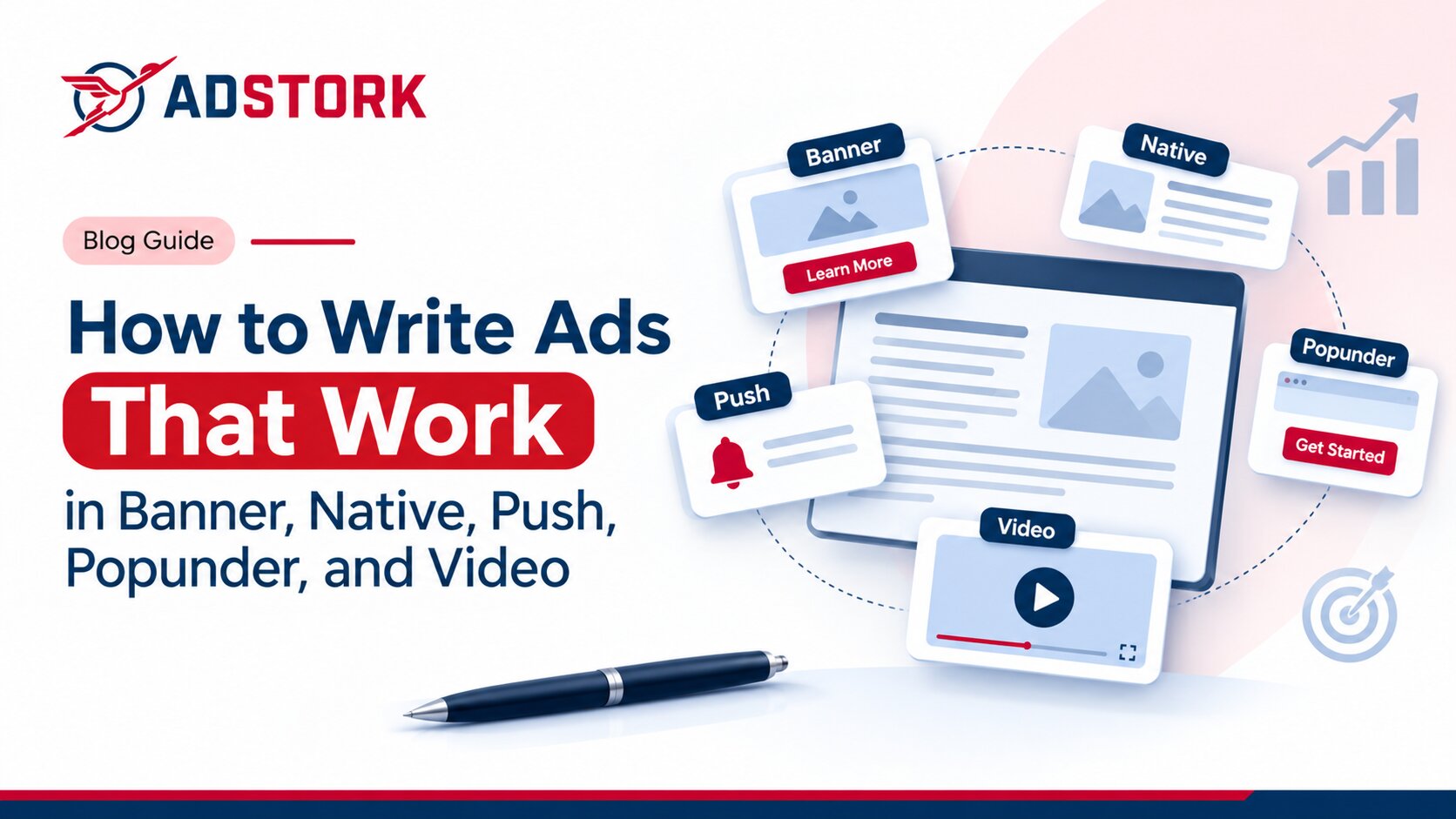
How to Write Ads That Work in Banner, Native, Push, Popunder, and Video
An advertiser has one strong offer and one finished creative, so the same ad goes everywhere. The banner looks fine. The push notification is cut off mid-sentence. The native version looks like an ad in a place where readers expect an article. Three formats, three weak results, and the conclusion is that the offer does not work.
The offer may be fine. Each format reaches a person in a different moment, and a message that works in one moment can fall flat in another. Writing for the format is often the cheapest improvement you can make.
In short: Write each ad for the moment the viewer is in. Banners need a clear visual and one idea, native ads need to read like useful content, push needs a short hook and an honest promise, popunders need a landing page that explains itself fast, and video needs to deliver its point early. Test each format on its own, not as a copy of the others.
Written by: [Author name], [Job title] at Adstork Ad Network
Reading time: 7 minutes
Best for: Advertisers adapting one offer to several formats
Key Takeaways
- The same offer needs a different creative in each format.
- Every ad has the same four parts: a hook, a promise, proof, and a next step. The format decides how much room each one gets.
- An honest ad that matches its landing page beats a clever one that does not.
- Check each format's current size and text limits with your account manager before you design.
What Does Every Good Ad Have in Common?
Before looking at formats, get the basic anatomy right. Every ad that works carries four things, in some form.
How Should You Write for Each Format?
These are starting points to test, not rules. Results depend on your offer, country, and audience.
Banner
The viewer is reading something else and glances over.
DO
- Lead with one clear image and one short line
- Make the button text say what happens next
- Keep text readable at a glance on a phone
DON'T
- Crowd several messages into one small space
- Use a fake close button or anything that tricks a tap
Native
The viewer is reading or browsing and expects something useful.
DO
- Write a headline that promises useful information
- Use a real, relevant image, not an abstract graphic
- Send readers to a page that continues the same story
DON'T
- Use shock or exaggeration the page cannot back up
- Hide that it is an ad
Push
The viewer sees a short message arrive and decides in a second.
DO
- Put the hook in the first few words, since the rest may be cut off
- Keep it short and specific, with one benefit
- Test several versions, because small word changes matter
DON'T
- Imitate a message from a person or a system warning
- Promise something the landing page does not show right away
Popunder
The viewer finds your page later, with no ad text to guide them.
DO
- Treat the landing page as the entire ad
- State the offer in the headline and the first screen
- Load fast on mobile and show one clear action
DON'T
- Assume the visitor knows why they are there
- Bury the offer under a long introduction
Video
The viewer may watch without sound and may leave quickly.
DO
- Show the key point in the first few seconds
- Make it understandable with the sound off, using clear visuals and captions
- End with one next step on screen
DON'T
- Start with a slow logo animation
- Rely on audio alone to carry the message
Pro tip: Read each ad out loud, then ask one question: "Would the landing page confirm exactly this?" If the answer is no, the ad is promising more than the page delivers, and the visitor will leave.
What Does One Offer Look Like Across Formats?
Here is an illustrative example. The offer and wording are made up to show the method. Imagine a budgeting app offering a free first month.
THE LAZY VERSION
The same line in every format: "Try our budgeting app today!"
THE FORMAT-AWARE VERSION
Banner: One image of a calm monthly summary plus "See where your money goes. First month free."
Native: "5 Small Spending Habits That Quietly Cost You Each Month" leading to a short helpful page with the offer.
Push: "Know where your money goes. Try it free for 30 days."
Popunder: A page whose first screen reads "Track every expense in minutes. First month free" with a single sign-up button.
Video: Open on a messy bank statement, cut to the app tidying it up, end on "Start your free month."
Notice that the offer never changes. What changes is how much room the hook gets, how the promise is phrased, and where the viewer lands. The lazy version treats all five formats as the same moment, which is exactly why it underperforms in most of them.
Where Does Adstork Fit In?
Writing for each format is only worth it if you can test and compare. Adstork lets advertisers run banner, native, push, popunder, and video from one platform, with reporting by country, device, format, and placement, so you can see which version wins in which setting instead of guessing.
Advertisers can launch through the self-serve platform with guided onboarding and live chat, or work with an account manager who can review creatives before launch. Ask your account manager for the current size, text length, and creative review rules for each format before you design.
What Should a Simple Creative Brief Include?
Fill this in once per offer. It keeps every format's creative pointed at the same promise.
What Are the Honest Limits?
Reality check: No writing advice replaces testing, and a good creative cannot rescue a weak offer. Formats and creative rules change, and each network reviews ads against its own policies, so a creative that works in one place may need edits in another. Always keep your claims truthful and your landing page consistent with the ad.
Treat every format's first round as a set of small experiments, not a finished campaign.
What Comes Next for Ad Creative?
Tools that draft headlines and generate image and video variations are making it faster to produce many versions. That speeds up testing, but it also floods viewers with similar-looking ads. Advertisers who start from a clear promise and real proof, and then use the tools to explore variations, will stand out more than those who generate volume alone.
Quick recap
Keep one offer and one promise, then write each format for the moment the viewer is in. Banners need a clear image, native needs useful content, push needs a fast hook, popunders need a self-explaining page, and video needs its point early. Test three versions per format and let the data pick the winner.
Final Word
The best creative is not the cleverest one. It is the one that fits the moment, keeps its promise, and makes the next step obvious. At Adstork Ad Network, five formats on one platform, reporting by country, device, and format, and hands-on account support help advertisers test each version and keep what works.
Ready to put the right message in front of the right moment? Partner with Adstork Ad Network today.
FAQs
Can I use the same creative in every ad format? You can, but it usually underperforms. Each format reaches people in a different moment and offers different space, so the hook, length, and landing page should be adapted to each one.
How do I write a good push notification ad? Put the hook in the first few words, keep it short and specific, promise only what the landing page shows right away, and test several versions, since small wording changes can change results.
What makes a native ad work? A headline that promises useful information, a relevant image, clear labeling as an ad, and a landing page that continues the same story the headline started.
Why does the landing page matter so much for popunder ads? The visitor sees your page without any ad text to guide them, so the first screen has to explain the offer on its own and show one clear action.
How many versions of each ad should I test? Three is a practical starting point per format. Keep the promise the same and change one element, such as the hook, so you can tell what caused any difference.
Which formats does Adstork support? Banner, native, push, popunder, and video, with reporting by country, device, and format and optional account manager support for reviewing creatives.
Leave a Comment