- 29 Oct, 2026
How to Scale a Winning Ad Campaign Without Losing Your ROI
The test worked. One campaign is bringing customers at a cost well under target, and the temptation is obvious: triple the budget and collect three times the results. A week later the cost per result has crept past the target, and the profit that made the campaign exciting has quietly disappeared.
Scaling is not the same as winning. A campaign that works at a small budget has only proven it works for the easiest audience. Growing it means finding out, step by step, where that stops being true.
In short: To scale an ad campaign without losing ROI, confirm the result is stable, raise the budget in small steps, watch cost per result after each step, expand to new segments separately, and step back when the cost passes your target. Scaling is a series of small tests, not one big jump.
Key Takeaways
- A small win is a direction, not a proof. Confirm it holds before adding money.
- Costs usually rise as spend grows, so plan for it and set a hard limit in advance.
- Change one thing per step so you know what caused any shift.
- Stepping back is part of scaling, not a failure.
Why Does Cost per Result Rise When You Scale?
A budget increase does not just buy more of the same traffic. It reaches further down the list of possible visitors, and that list is ordered by how likely people are to respond. These are the usual reasons the cost climbs.
Audience Runs Thin
The most responsive people see your ad first. More spend means reaching people who are less interested.
Creative Wears Out
The same ad shown to the same people again and again gets ignored, so response falls over time.
Competition Shifts
Other advertisers change budgets too, and seasonal demand can lift prices even when your campaign has not changed.
Is Your Campaign Ready to Scale?
Before adding budget, check that every item below is true. If one is missing, fix it first.
Results have held for several days. One good day can be luck. A steady pattern is a signal.
You have enough conversions to trust the number. A handful of sales can swing the cost per result wildly.
Tracking has been double checked. Platform results match what your own records show.
The winning segment is clear. You know which country, device, and format produced the result.
Your landing page and offer can handle more visitors. Stock, support, and page speed will not break under volume.
You have written down your stop line. Decide in advance the cost per result at which you pause, before emotion gets involved.
What Does Scaling Look Like Step by Step?
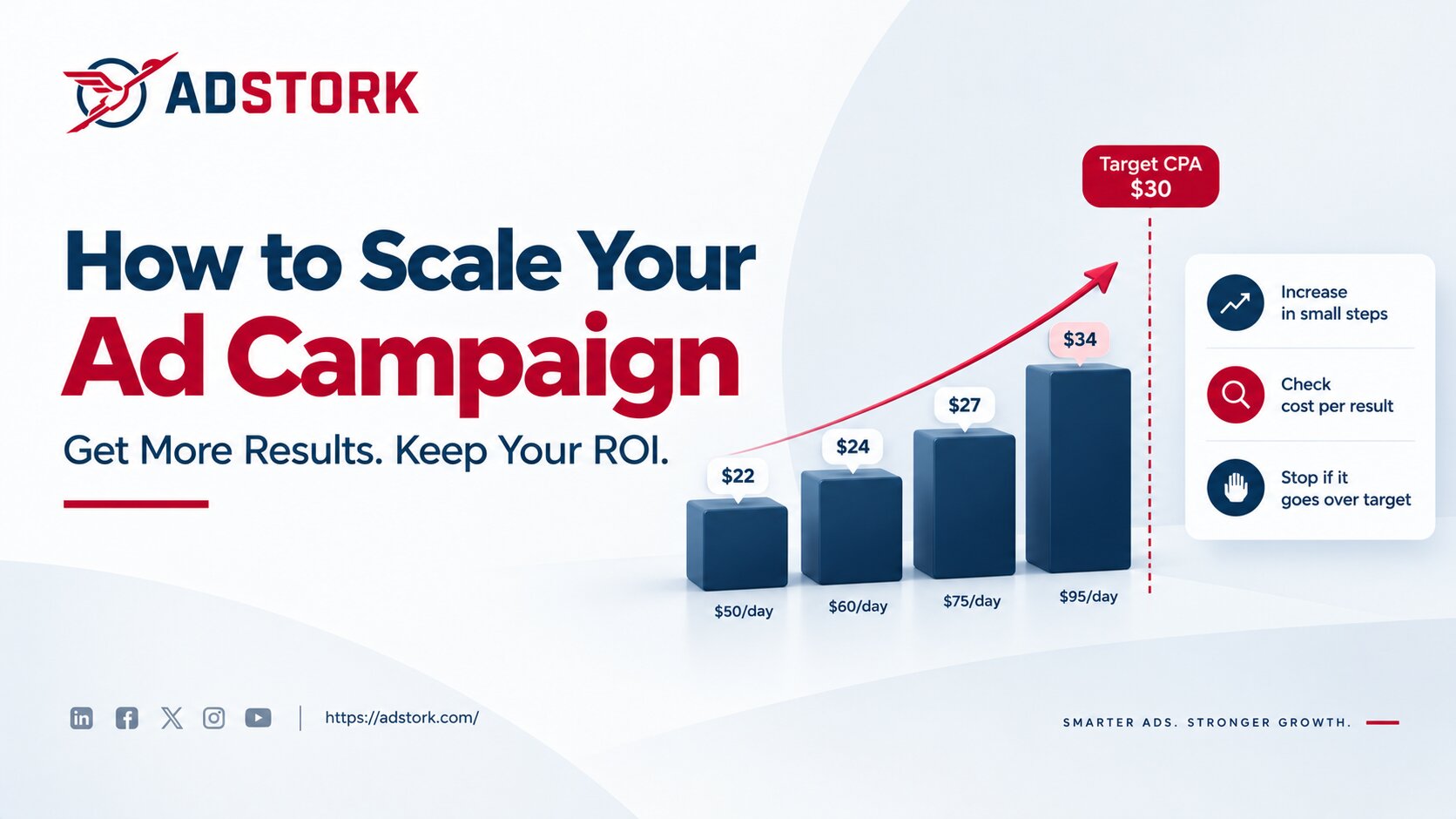
Here is an illustrative ladder. The numbers are made up to show the method, not benchmarks. The target cost per result is $30, shown by the vertical line. Each bar is the cost per result after a budget step.
$50 per day
$22
$60 per day
$24
$75 per day
$27
$95 per day
$34
The first three steps stayed under target, though the cost rose a little each time. The fourth crossed the line. The right move is to drop back to the previous budget, not to push on and hope. The bar shows why small steps matter: each one gave a clear reading, so the point where the campaign stopped paying was easy to see.
How Do You Decide to Go, Hold, or Stop?
After each budget step, give the campaign a few days, then compare the new cost per result with your target and your stop line.
GO
Cost per result is under target and stable. Take the next step up.
HOLD
Cost is close to target or still settling. Wait a few more days before changing anything.
STOP
Cost has passed your stop line. Go back one step, refresh the creative, or pause the weakest segment.
Where Does Adstork Fit In?
Scaling only works when you can see which part of the campaign is carrying the result. Adstork provides transparent reporting by country, device, and format, so you can raise spend on the winning segment instead of the whole campaign. Advertisers can also test the same winning offer in another of the five formats, banner, native, push, popunder, or video, without moving to a new platform.
An account manager can review your numbers with you before a big step, and the self-serve platform lets you keep each step small. Ask your account manager about budget and pacing controls so you know how quickly changes take effect.
What Should You Do in Common Scaling Situations?
"My cost jumped right after I doubled the budget."
Go back to the last budget that worked and rise in smaller steps. A big jump gives you a result, but no way to tell what caused it.
"Results were great, then slowly faded."
Suspect creative wear. Introduce a fresh version with the same offer and compare it against the old one.
"I want to add new countries."
Treat each new country as its own small test with its own budget. A country that worked at home may not work elsewhere.
"One placement carries everything."
Scale it carefully but do not depend on it. A single source is a risk if its quality changes.
What Are the Honest Limits of Scaling?
Reality check: Every offer has a ceiling, and no method removes it. Some campaigns stop paying well before the budget feels large, because the real audience for the offer is small. Seasonal swings can also move your costs without any change on your side, so compare against the same period when you can.
Finding that ceiling cheaply is a success, because it tells you when to put the next budget into a new offer instead.
What Comes Next for Campaign Scaling?
Automated budget tools are getting better at pacing spend and shifting money toward what works. They still need a clear target and a stop line from you. Advertisers with clean first-party conversion data and a written scaling rule will get the most from them, since the tool can only optimize toward a goal you have defined well.
Final Word
Scaling is a patient process: confirm the win, step up slowly, read the cost after every move, and be willing to step back. At Adstork Ad Network, reporting by country, device, and format, five ad formats, and hands-on account support help advertisers grow a winning campaign with their margins intact.
Ready to grow a campaign that already works? Partner with Adstork Ad Network today.
FAQs
How do I scale an ad campaign without losing ROI? Confirm the result is stable, raise the budget in small steps, check cost per result after each step, and go back a step if the cost passes your target.
How much should I raise my budget at a time? There is no single right size. Smaller steps give clearer readings, so start modest and let your own results show how much change the campaign can absorb.
Why does my cost per result go up when I spend more? More spend reaches less responsive people, repeated ads lose impact, and competition for the same audience can change. These effects are normal, which is why a stop line is needed.
When should I stop scaling a campaign? When cost per result passes the stop line you set in advance and stays there after a few days. Step back to the last budget that worked.
Should I scale by raising budget or by adding new segments? Both can work. Raise the budget on the proven segment gradually, and test any new country, device, or format as a separate small experiment.
How does Adstork help advertisers scale? Through reporting by country, device, and format, access to five ad formats, a self-serve platform for small steps, and an account manager who can review results before larger changes.
Leave a Comment