- 06 Nov, 2026
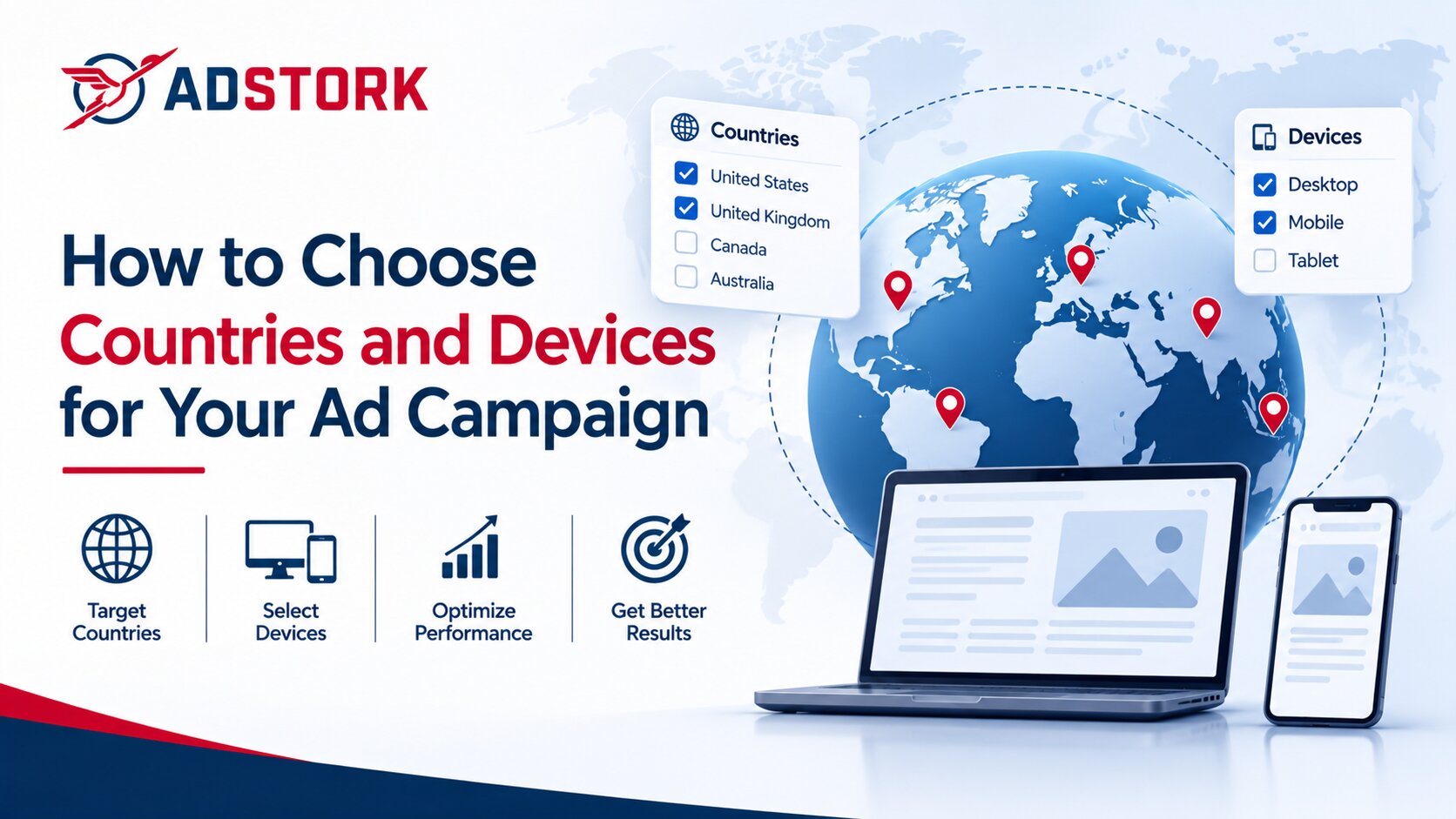
How to Choose Countries and Devices for Your Ad Campaign
A new advertiser sets the targeting to "worldwide" because more reach sounds better. The budget spreads across dozens of countries, the cost per click looks wonderfully low, and a week later the report shows plenty of traffic and almost no customers. The cheap clicks came from places where the offer could never work.
Where your ad appears, and on which device, can matter as much as the ad itself. Picking those two settings carefully is one of the cheapest ways to protect a first budget.
In short: To choose countries and devices for an ad campaign, shortlist a few countries where customers can actually buy your offer, test each one separately on mobile and desktop with a small budget, and compare them by cost per result instead of cost per click. Scale the segments that beat your target and drop the rest.
Written by: [Author name], [Job title] at Adstork Ad Network
Reading time: 6 minutes
Best for: Advertisers planning their first or next campaign targeting
Key Takeaways
- Cheap traffic is not cheap if it never converts. Judge every segment by cost per result.
- Start with a short list of countries, not the whole world.
- Test mobile and desktop separately, since people behave differently on each.
- Widen only after a segment has proven itself.
Why Do Country and Device Matter So Much?
Two things change from place to place and screen to screen: what traffic costs, and whether the visitor can act on your offer. A visitor who cannot pay in your accepted method, does not read your language, or cannot use your product is worth nothing to you, however little the click cost.
Devices work the same way. A long sign-up form that is fine on a laptop can be painful on a phone. Treating all visitors as one group hides these differences and makes the average look worse than your best segment really is.
How Do You Decide Which Countries Make the Shortlist?
Run each candidate country through five yes or no questions. A single "no" is usually enough to leave it off the first test.
Can customers there actually buy or use it?
Check availability, delivery, accepted payment methods, and the currency you can charge. If the answer is no, skip the country.
Does your page speak their language?
A translated headline helps, but the whole path to sign-up should make sense. If it does not, either localize it or leave that country for later.
Does your price make sense locally?
If a typical customer there would find the price out of reach, expect low conversion no matter how good the ad is.
Is your offer and creative allowed there?
Advertising rules differ by country and by industry. Confirm what applies to your offer before spending.
Is there enough traffic to learn from?
Very small markets may not deliver enough volume to read a result. Ask your account manager about expected volume for each format.
Pro tip: Make a separate campaign for each country. When countries share one campaign, a strong market can hide a weak one, and you cannot move budget between them without guessing.
How Should You Think About Mobile and Desktop?
These are starting points to test, not rules. Your own results should decide.
Mobile
Often suits: Quick decisions, simple offers, short sign-ups.
Watch for: Slow pages, tiny buttons, and long forms that lose people.
Check first: Open your landing page on a real phone and complete the action yourself.
Desktop
Often suits: Research-heavy offers, longer forms, higher-consideration purchases.
Watch for: Smaller volume in some markets, so tests can take longer to read.
Check first: Whether your page makes good use of the extra space.
Format Fit
Why it matters: Some formats behave differently by device, such as how push or popunder appears on a phone versus a computer.
Check first: Ask which formats and devices your account manager recommends for your offer.
What Does a Targeting Test Look Like in Practice?
Here is an illustrative case. The numbers are made up to show the method, not benchmarks. An advertiser sets a target cost per result of $30 and gives three countries the same small budget, each as its own campaign.
Country C had the cheapest clicks and the worst outcome, which is exactly the trap the "worldwide" setting hides. The sensible move is to put the next budget into country A, run a better test in country B, and drop country C. With only a handful of results per country, treat this as a direction to confirm, not a final verdict.
Where Does Adstork Fit In?
A country and device test only works if you can see the result for each segment. Adstork provides transparent reporting by country, device, format, and placement, so a strong market and a weak one do not blur into one average. Campaigns can run across banner, native, push, popunder, and video, and the self-serve platform makes it practical to keep each country as its own small campaign.
An account manager can help you choose a starting shortlist and explain expected volume. Ask which targeting options are available for each format, and confirm minimum budgets before you plan how many countries to test at once.
How Do You Widen Targeting Safely?
PHASE 1: START NARROW
Two or three countries, each as its own campaign, with mobile and desktop reported separately. Keep the creative the same so only the location changes.
PHASE 2: CUT AND CONCENTRATE
Pause segments that clearly miss your target. Move that budget to the ones under it, and give borderline ones one improvement, such as a translated page.
PHASE 3: ADD ONE NEW SEGMENT AT A TIME
Test a new country or device as a separate small campaign. A country that works nearby does not guarantee the next one will.
What Are the Honest Limits?
Reality check: General patterns about countries and devices are only starting hypotheses. Costs and results shift with season, offer, and competition, and a small test can give a noisy answer. Rules about what you may advertise differ by country, so confirm them yourself rather than assuming.
Let your own tracked results make the final call.
What Comes Next for Ad Targeting?
As privacy changes limit detailed personal tracking, broad signals such as country, device, and page context are becoming more important, not less. Advertisers who learn which of these basics work for their offer now will be better prepared as finer targeting gets harder.
Quick recap
Shortlist a few countries using five yes or no questions, give each its own small campaign, and report mobile and desktop separately. Judge by cost per result, not cost per click. Cut what misses your target, concentrate on what beats it, and widen one segment at a time.
Final Word
Good targeting is mostly good filtering: fewer places, tested one at a time, judged by what they actually deliver. At Adstork Ad Network, reporting by country, device, and format, five ad formats, and hands-on account support help advertisers find the segments that pay and stop funding the ones that do not.
Ready to put your budget where your customers are? Partner with Adstork Ad Network today.
FAQs
How do I choose which countries to target? Shortlist countries where customers can actually buy your offer, read your language, afford your price, and where your ads are allowed. Test each as a separate small campaign and compare cost per result.
Is it better to target one country or many? Start with a few. Targeting many countries at once hides which ones work and spreads a small budget too thin. Widen only after a segment has proven itself.
Why are clicks cheap in some countries but results poor? Low click prices often reflect lower competition or lower purchasing power. If visitors cannot buy, understand the page, or afford the offer, cheap clicks still produce no customers.
Should I run mobile and desktop in the same campaign? You can, but reporting them separately is more useful. People behave differently on each, and a strong device can hide a weak one in a combined average.
How much should I spend per country on a first test? Enough to collect a meaningful number of results at your target cost per result. Ask the network for a realistic range and start with an amount you can afford to lose.
How does Adstork help with country and device targeting? Through reporting by country, device, format, and placement, five ad formats on one platform, and an account manager who can help plan a starting shortlist.


Leave a Comment