












Adstork is a cutting-edge online marketplace designed to connect advertisers with publishers in a seamless and efficient manner. Whether you’re an advertiser looking to reach your target audience or a publisher aiming to monetize your platform, Adstork provides the tools you need. Advertisers can easily submit their ads, configure target audiences, and set budgets through a user-friendly Advertiser Account.

Our ad network ensures precise targeting, connecting advertisers with high-quality publishers to maximize engagement and drive exceptional results.


Adstork is the ideal platform for posting your advertisements and connecting with publishers, whether you're an individual, a group, or an organization. Adstork has evolved into a global movement, uniting activists from all corners of the world.
Adstork uses anti-fraud algorithms to ensure ad safety and quality traffic.
Our platform offers custom targeting and creative templates to boost ad impact and results.
Make data-driven decisions with Adstork’s analytics tools and performance insights.

Adstork delivers 5B+ daily impressions globally for unmatched reach.
Adstork offers CPA Goal and auto-rules for precise, automated campaign management.
Our expert team is available 24/7 to optimize campaigns and monetize traffic.

Adstork streamlines digital advertising by linking advertisers with leading publishers. Our platform utilizes advanced targeting to ensure your ads reach the ideal audience.

Begin your journey by creating an account. Sign up to access a world of advertising opportunities with Adstork.

"Make a deposit that aligns with your advertising goals."

Jumpstart your advertising success. Set up your campaign by defining your target audience, budget, and schedule to maximize reach.

Present your brand to the world. Launch engaging ads that capture attention and boost interaction.

Track your campaign's impact in real-time. Monitor performance, analyze data, and adjust strategies for the best results.

Begin your journey by creating an account. Sign up to access a world of advertising opportunities with Adstork.

Add your website to get started.

Jumpstart your advertising success. Set up your campaign by defining your target audience, budget, and schedule to maximize reach.

Present your brand to the world. Launch engaging ads that capture attention and boost interaction.

Track your campaign's impact in real-time. Monitor performance, analyze data, and adjust strategies for the best results.

Start by requesting XML / RTB access. Our team verifies your platform, traffic quality, and compliance to enable integration.

Provide your RTB endpoint or XML feed details, including bid request format, macros, floor price, and supported ad sizes.

Integrate with our RTB / XML infrastructure. We support OpenRTB standards for seamless, low-latency bidding.

Once approved, traffic goes live. Advertisers bid in real time, ensuring competitive CPMs and maximum fill rates.

Track bid responses, win rates, revenue, and traffic quality in real time. Optimize floors, formats, and demand sources for better yield.
Real voices, real results. Go beyond the numbers and experience the passion. Unlock your potential—we believe in you.




“Adstork played a key role in helping us scale our ad operations without sacrificing user experience. Their smart optimization and premium demand sources delivered sustainable growth. We see them as a long-term strategic partner.”
“Reliability and transparency are critical in ad tech, and Adstork excels at both. Payments are always on time, traffic quality is well maintained, and communication is clear. It’s refreshing to work with an ad network that truly values partnerships.”
“Adstork provides us with high quality inventory and excellent campaign performance. Their targeting capabilities and optimization support helped us achieve better ROI compared to other networks. The team understands advertiser needs and delivers results efficiently.”
"Working with Adstork Ad Network has been a truly rewarding experience. Their platform delivers consistent performance, transparent reporting, and high quality demand that maximizes our revenue without compromising user experience. The Adstork team stands out for their responsiveness, technical expertise, and deep understanding of the digital advertising ecosystem"
Get Latest Update from Advertising Industry
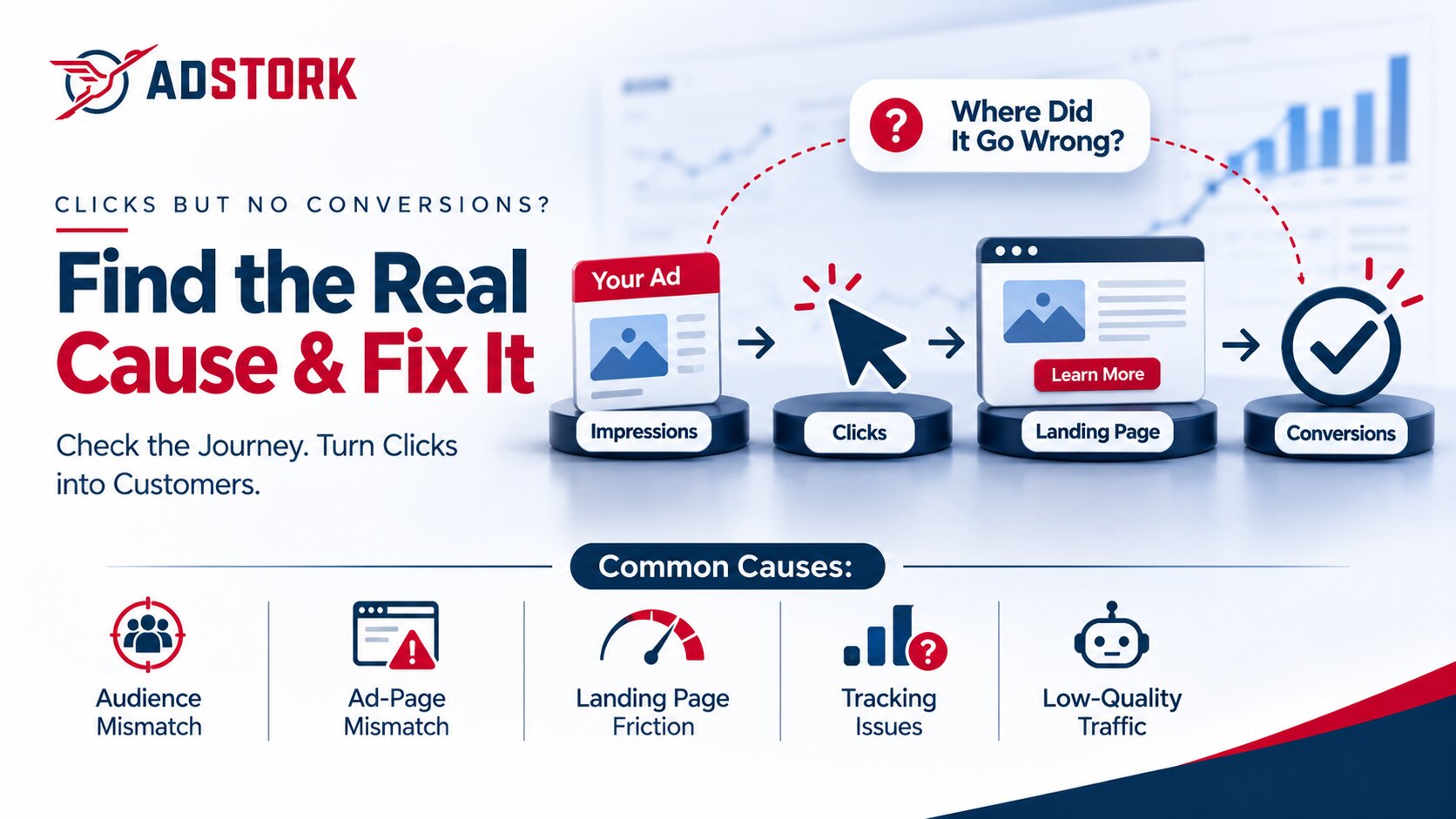
The dashboard looks healthy. Impressions are rising, clicks are coming in at a fair price, and the click-through rate is better than expected. Then the conversion column shows zero, or close to it. The budget is going out and nothing is coming back.Most advertisers react by changing the creative or switching networks. Both are guesses. A click is only the first step of a longer path, and the problem usually sits at one specific point along it.In short: Clicks without conversions usually come from one of four causes: traffic that does not match your offer, an ad that promises something the page does not deliver, a landing page that loses visitors, or tracking that fails to record real conversions. Checking each stage in order is faster and cheaper than changing everything at once.Key TakeawaysA click shows interest in the ad, not intent to buy. Many problems start with who is clicking, not what they see afterward.Always rule out broken tracking first. It is the cheapest fix and the most common false alarm.Break results down by country, device, and format before judging a campaign as a whole.Change one thing at a time, so you know which change caused the improvement.1. Why Do Campaigns Get Clicks but No Conversions?Think of the path as a chain: the right person sees the ad, the ad sets an honest expectation, the page meets that expectation, and the conversion is recorded. A break at any link produces the same symptom on the dashboard, which is why the cause is easy to misread.Audience mismatch. The ad is reaching people who are curious but have no use for the offer, or who sit in a country where the offer does not apply.A gap between promise and page. The ad suggests one thing and the landing page shows another, so visitors leave within seconds.Landing page friction. A slow load, a long form, a confusing layout, or a page that works poorly on phones.Tracking gaps. Conversions happen but are never recorded, so the campaign looks like a failure when it is not.Low-quality traffic. Accidental clicks, automated visits, or incentivized traffic that has no real interest in the offer.2. How Do You Find Where Visitors Drop Off?Work through the chain in this order, stopping when you find the break.Test your own tracking. Complete a conversion yourself and confirm it appears in your reports. If it does not, fix this before touching anything else.Compare clicks to landing page visits. A large gap means visitors leave before the page loads, which points to slow pages or accidental clicks.Check time on page and bounce rate. Visits of a few seconds suggest a mismatch between ad and page, or low-intent traffic.Segment by country, device, and format. A campaign that fails overall often works well in one segment, and that segment is where to scale.Look at the step after the click. If visitors reach the form or checkout and stop, the offer or the page is the issue, not the traffic.3. What Should You Fix First?Tracking, then targeting. Confirm conversions are recorded, then narrow countries, devices, and placements to the segments that show any sign of response.Make the ad and page say the same thing. The headline, offer, and visual on the page should match what the ad promised.Shorten the path. One clear action per page, fewer form fields, and a fast load on mobile.Try a different format. The same offer can behave very differently in native, push, popunder, banner, or video, because each reaches people in a different frame of mind.Pause what clearly fails. Cutting the worst placements frees budget for the ones that show promise.4. Where Does Adstork Fit In?Diagnosing a campaign needs visible data and a clean traffic source. Adstork gives advertisers transparent reporting by country, device, and format, so the weak segment can be found and cut rather than guessed at. Ad quality and traffic integrity are screened, which reduces the share of clicks coming from visitors who were never going to convert. Advertisers can launch through the self-serve platform with guided onboarding and live chat, or work directly with an account manager who can review a campaign that is not converting and suggest what to test next. Confirm your conversion tracking setup with the team before launching, so results are recorded correctly from day one.5. What Are the Honest Limits?Sometimes the traffic and the page are fine and the offer simply does not suit the market, or the price is wrong. No network can fix that. Small tests can also mislead, since a campaign with a handful of conversions gives a noisy picture. Give each test enough volume to read before declaring a winner, and accept that some offers need several rounds before they work.Symptom and Likely CauseWhat You SeeLikely CauseFirst FixClicks but zero conversions recordedTracking is brokenTest a conversion yourselfMany clicks, few page visitsSlow page or accidental clicksSpeed up the page, review placementsVisitors leave within secondsAd and page do not matchAlign headline and offerVisitors stop at the formToo much frictionCut fields and stepsOne country or device converts, others do notAudience mismatchNarrow targeting to the winnerWhat Comes Next for Conversion Tracking?Privacy changes are making third-party tracking less reliable, so advertisers are moving toward first-party conversion data and cleaner measurement on their own sites. Building that foundation now makes every future campaign easier to read and easier to trust.Final WordClicks without conversions are a symptom, and the cause is almost always findable. Check tracking, then traffic, then the page, and change one thing at a time. At Adstork Ad Network, transparent reporting and hands-on account support help advertisers find the break in the chain and fix it faster.Ready to turn clicks into customers? Partner with Adstork Ad Network today.FAQsWhy am I getting clicks but no sales? The usual causes are traffic that does not match the offer, a landing page that does not match the ad, page friction, or conversion tracking that is not recording sales. Check tracking first, then work through the path from click to conversion.How do I know if my conversion tracking is broken? Complete a conversion yourself and see whether it appears in your reports. If it does not, tracking is the problem and no other change will help until it is fixed.What is a good conversion rate for ads? It varies widely by offer, price, country, and format, so there is no single good number. Compare each segment against your own target cost per result instead of an industry average.Could bad traffic be the reason my campaign is not converting? Yes. Accidental clicks, automated visits, or low-intent visitors can inflate clicks without adding customers. Segmenting by placement and country usually reveals where the weak traffic sits.How long should I run a test before changing it? Long enough to collect a meaningful number of conversions per variation. Changing too early makes results look random, and changing several things at once hides what worked.How does Adstork help advertisers whose campaigns are not converting? Through reporting by country, device, and format, screening for ad quality and traffic integrity, and access to an account manager who can review the campaign.Suggested Internal LinksCPM vs. CPC vs. CPA: Which Pricing Model Fits Your Campaign Goal?How Does an Ad Network Match Your Website With Advertisers?What Makes a Website Valuable to Advertisers? 7 Key Factors
Read more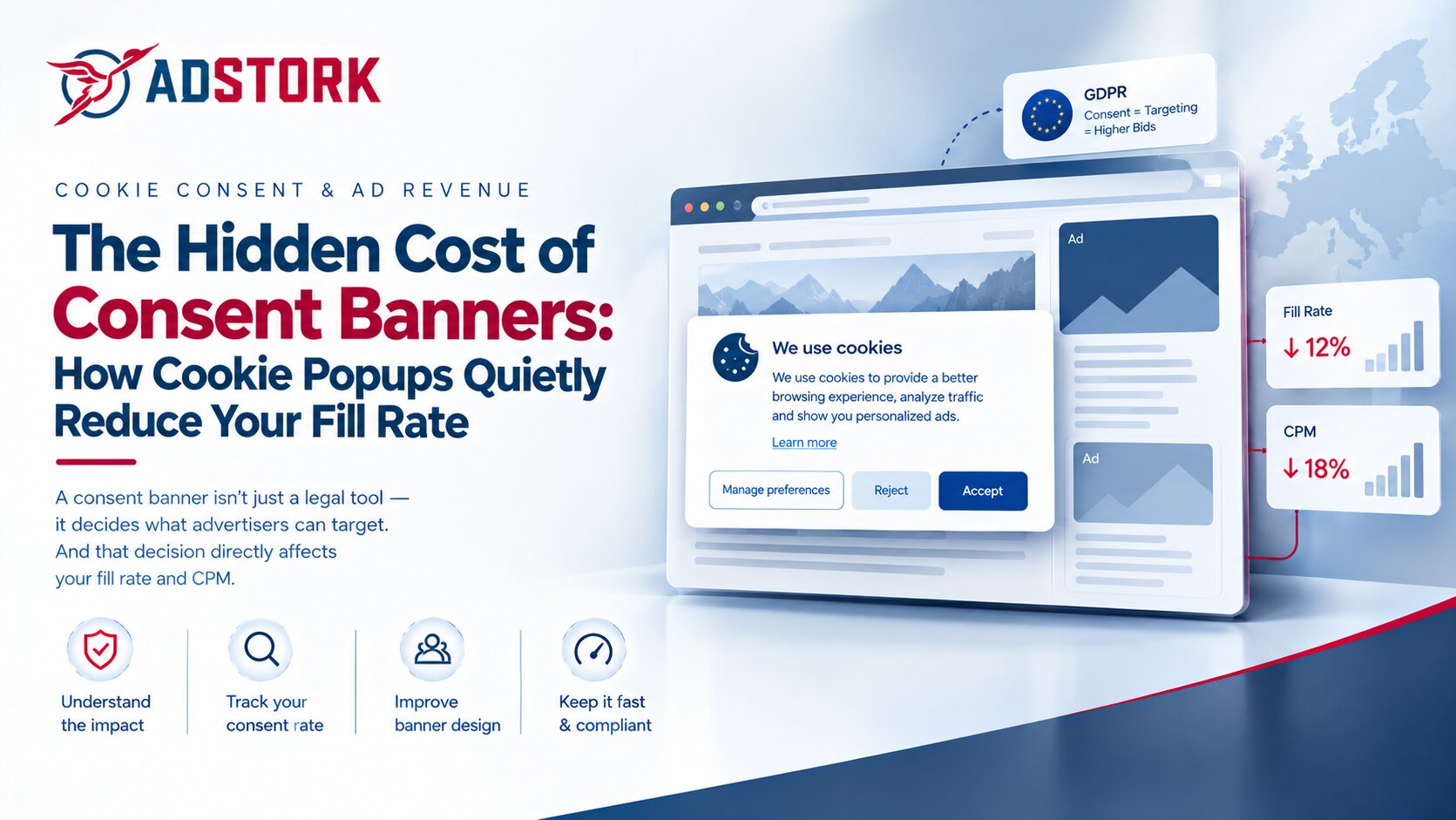
A publisher adds a cookie banner to stay compliant, and a few weeks later European revenue looks softer than it should. Traffic is steady and content is unchanged, yet fill rate and CPM for those visitors have slipped. Almost nobody connects the two events, because the banner is filed under legal, not revenue.The connection is real. The consent banner decides what advertisers are allowed to know about each visitor, and that decides how much they will bid.In short: A consent banner controls whether advertisers can use cookies and personal data to target a visitor. When a visitor declines or ignores the banner, ads are usually served without personalization, which attracts fewer bidders and lower CPMs. A well-designed, compliant consent setup can recover a meaningful share of that lost revenue.Key TakeawaysConsent affects revenue because advertisers pay less for impressions they cannot target.Consent rates vary widely between sites, and banner design is one of the biggest reasons.Banners can also slow the page and shift the layout, which hurts viewability on top of consent loss.The goal is a clear, honest banner that earns consent, not one that tricks visitors into it.1. Why Does a Consent Banner Affect Ad Revenue?In regions covered by privacy laws such as GDPR in Europe and the UK, a site generally needs a visitor's permission before advertisers can use cookies or identifiers to target them. Without that permission, the impression can still be sold, but only as a contextual or non-personalized ad. Many buyers bid less for those impressions or skip them, so competition drops and the price falls with it.There is also a technical side. Many demand sources only bid when the page passes a valid consent signal. If the consent tool is missing, misconfigured, or slow to load, requests can go out with no signal at all, and some buyers will not respond. The result is lower fill rate on exactly the traffic that should be easy to sell.2. How Can Publishers Tell if Consent Is Costing Them Money?Compare regions. If revenue per session in regulated regions is much lower than in similar unregulated ones, consent is a likely factor.Check your consent rate. Most consent management platforms report how many visitors accept, reject, or ignore the banner.Look at fill rate by country. A sharp gap between regulated and other countries points to a consent or signal problem.Test the load order. Confirm the consent tool loads before ad requests fire, so the signal is present when buyers look for it.3. What Can Publishers Do to Improve Consent Without Cutting Corners?Use a reputable consent management platform that supports the industry's standard consent framework, so demand sources can read the signal correctly.Explain the value plainly. Short, honest wording about how ads keep content free tends to perform better than dense legal text.Make choices equally easy. Accept and reject should both be clear. Regulators have taken action against banners that make refusing deliberately hard.Reserve space for the banner. A banner that pushes content down causes layout shift, which hurts both user experience and viewability.Keep contextual value high. Clear, well-categorized content helps non-consented impressions sell better, since advertisers can still target the topic of the page.4. Where Does Adstork Fit In?Impressions without consent still have value, but only if enough buyers compete for them. Adstork connects publishers to multiple demand sources across banner, native, push, popunder, and video formats, so non-personalized traffic is still matched against real competition rather than a single fixed rate. Transparent reporting by country and format also lets publishers see where consent-related revenue gaps sit and measure whether a banner change actually helped.5. What Are the Honest Limits?Consent is a legal requirement in many regions, not an optimization lever to push as far as possible. Some visitors will always decline, and no design should hide that choice. The realistic aim is to remove avoidable losses, such as slow loading, broken signals, and confusing wording, while respecting each visitor's decision. Rules also differ by country and change over time, so publishers should confirm their obligations with a qualified adviser.Consented vs. Non-Consented ImpressionsFactorConsented VisitorNon-Consented VisitorTargetingAudience and contextContext onlyBidder interestBroadNarrowerTypical CPMHigherLowerBest leverClear, honest consent flowStrong contextual signals and competing demandWhat Comes Next for Consent and Advertising?Privacy rules are expanding to more regions, and advertisers are leaning harder on contextual signals and first-party data. Publishers with logged-in or email-subscribed audiences, who have given clear consent directly, will hold an advantage over those relying on anonymous traffic.Final WordA consent banner is a compliance tool and a revenue factor at the same time. Getting it right protects both. At Adstork Ad Network, competing demand and transparent reporting help publishers keep non-personalized traffic earning and see exactly where consent is affecting results.Ready to find the revenue your consent setup might be hiding? Partner with Adstork Ad Network today.FAQsDo cookie consent banners reduce ad revenue? They can. When visitors decline or ignore the banner, ads are typically served without personalization, which draws fewer bidders and lower CPMs. The size of the effect depends on the site, region, and banner design.What is a consent management platform? A tool that shows the consent banner, records each visitor's choice, and passes that choice to advertising partners in a standard format.Can I still show ads to visitors who decline cookies? Generally yes, as contextual or non-personalized ads, though they usually earn less than personalized ones.Can a consent banner hurt page speed? Yes. A heavy or late-loading banner can slow the page and cause layout shift, so choose a lightweight tool and reserve space for it.Is it acceptable to make the reject button harder to find? No. Regulators have acted against banners that steer visitors toward accepting, and honest design is both safer legally and better for trust.Suggested Internal LinksCore Web Vitals and Ad Revenue: How Page Speed Quietly Caps Your CPMWhy Your Highest-Traffic Country Isn't Always Your Highest-Revenue CountryWhat Makes an Online Audience Valuable to Brands?
Read more
Most sites now get the majority of their visits from phones, yet many publishers still design their ad setup on a desktop screen. The layout looks balanced in the browser on a laptop, then reaches the reader on a small screen where it behaves like a different product.That mismatch is one of the most common and least visible reasons a site earns less than its traffic suggests.In short: Mobile and desktop traffic earn differently because screen size, scrolling behavior, available formats, and advertiser demand all differ by device. Desktop often earns a higher rate per impression, while mobile delivers more volume and more scroll depth. Setting up and measuring each device separately is the most reliable way to raise total revenue.Key TakeawaysDevice mix changes revenue even when total traffic stays the same.Desktop often pays a higher rate per impression, and mobile often makes up the difference through volume and scrolling.Ad density that suits a wide screen can overwhelm a small one.Reporting by device is the only way to see which side needs work.1. Why Does the Same Audience Earn Differently on Mobile and Desktop?A desktop screen has room for several ad units to be seen at once, including larger banner sizes. A phone shows one screen at a time, so each placement competes with the content for the reader's full attention. Mobile readers also tend to scroll further down a page, which can raise the number of impressions per session even when each one pays less.Demand differs as well. Some advertisers build campaigns specifically for one device, and many still pay more for desktop placements. The gap has narrowed over time, but it rarely disappears, which is why a blended average hides what is really happening.2. What Should Publishers Do Differently on Mobile?Use mobile-friendly banner sizes. Wide desktop banners get scaled down or fail to fill on small screens. Choose sizes built for phones.Place ads between content blocks. In-content placements fit the way people scroll on a phone and tend to hold attention better than crowded edges.Test native and push. Native units blend into a feed-style layout, and push can reach returning visitors on mobile without taking up page space.Watch density closely. Too many units on a small screen slow the page and push readers away faster than on desktop.Protect speed. Mobile connections are less forgiving, so lazy loading and reserved ad space matter even more.3. What Should Publishers Do Differently on Desktop?Use the extra space carefully. A sidebar and larger banner sizes can lift revenue, but stacking too many units hurts viewability and trust.Try video where content supports it. Longer sessions on desktop suit video placements on pages where readers stay.Keep floors realistic. Desktop demand often supports a higher floor price, but a floor set too high lowers fill rate.4. Where Does Adstork Fit In?Tuning by device only works if the numbers are visible. Adstork's transparent, real-time reporting breaks fill rate, CPM, and revenue down by device, country, and format, so publishers can see whether mobile or desktop is the weaker side. With banner, native, push, popunder, and video all available, each device can run the mix that suits it, backed by competing demand sources instead of one fixed buyer.5. What Are the Honest Limits?Device rates are averages, and results vary a lot by niche, country, and audience. A news site and a tool site can see very different gaps between devices. Treat the patterns here as starting hypotheses to test on your own data rather than fixed rules, and change one thing at a time so the result is clear.Mobile vs. Desktop at a GlanceFactorMobileDesktopTypical traffic shareUsually the majoritySmaller shareRate per impressionOften lowerOften higherScroll depthDeeper, one screen at a timeShallower, more visible at onceBest focusPlacement, speed, densityFormat mix, floors, viewabilityWhat Comes Next for Device Monetization?Mobile share keeps growing, and advertisers continue to close the pricing gap as measurement improves. Publishers who treat mobile as the primary experience, not an afterthought, will be better placed as that gap narrows.Final WordMobile and desktop are two different monetization environments sharing one website. Measuring and tuning each separately is a low-cost way to lift total revenue. At Adstork Ad Network, device-level reporting and a full format lineup help publishers do exactly that.Ready to see how each device is really performing? Partner with Adstork Ad Network today.FAQsDoes mobile traffic earn less than desktop? Per impression it often does, but mobile usually brings more visits and deeper scrolling, so total revenue can be comparable or higher depending on the site.How many ads should a mobile page have? Fewer than a desktop page of the same length. Start low, place units between content blocks, and add more only if speed and engagement hold steady.Which formats work best on mobile? Mobile-sized banners, native units, and push are common starting points. Test each on your own audience, since results vary by niche.Should I set different floor prices for mobile and desktop? Often yes, since demand differs by device. Review fill rate and revenue by device before and after any change.How do I see revenue by device? Use your ad network's reporting, filtered by device type, and compare it against analytics sessions for the same period.Suggested Internal LinksHow Many Ads Should a Website Have?Core Web Vitals and Ad Revenue: How Page Speed Quietly Caps Your CPMThe RPM Benchmark Report: What Publishers Actually Earn by Niche
Read more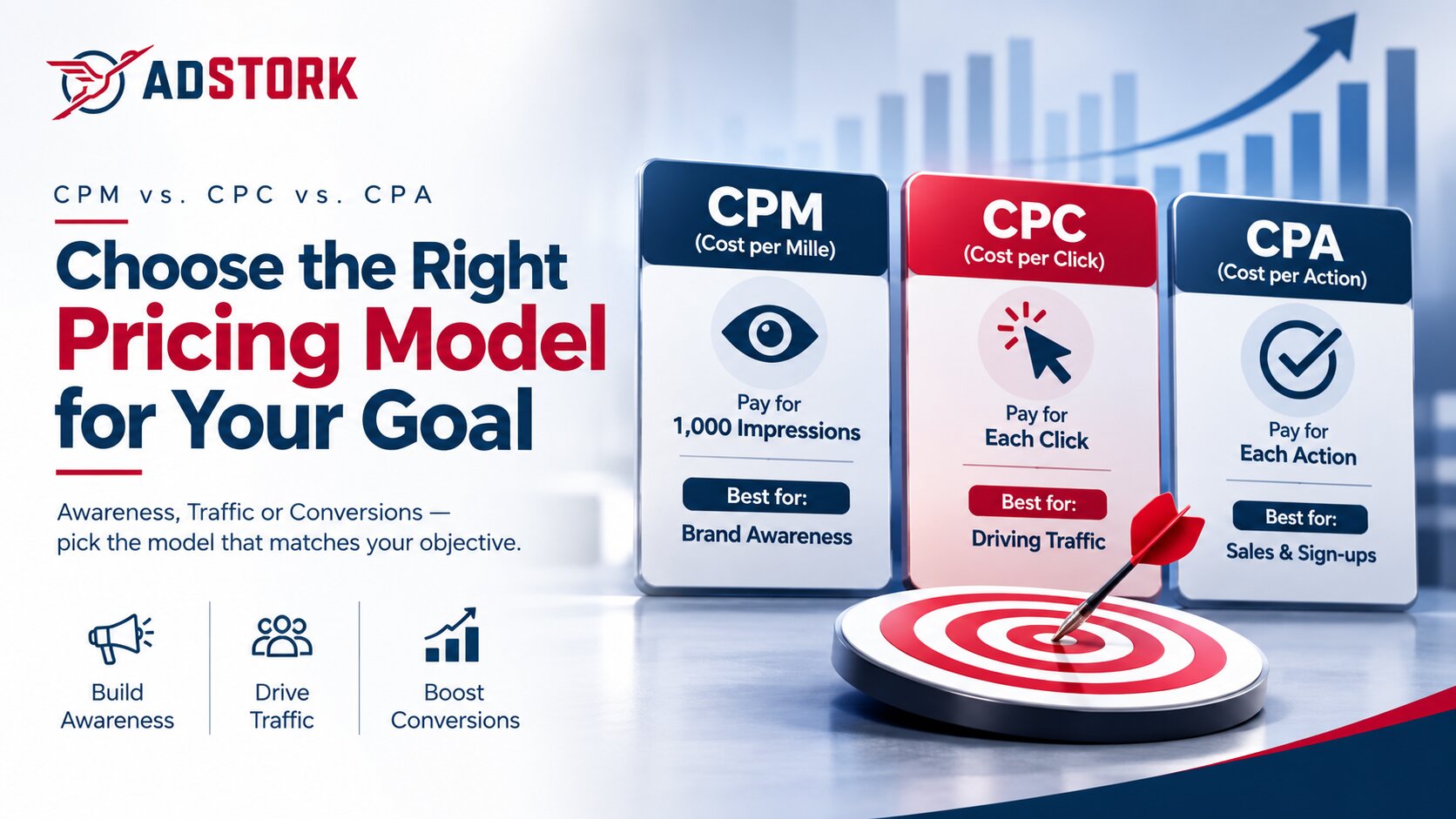
Two advertisers launch campaigns on the same traffic with the same budget. One pays per thousand impressions and the other pays per action. A month later, one report says the campaign was a bargain and the other says it was a waste. Neither advertiser made a mistake with the creative. They chose different pricing models for goals that did not match.The pricing model decides who carries the risk, what the platform optimizes for, and which numbers will tell you whether the campaign worked. It is one of the first decisions in a campaign and one of the most often rushed.In short: CPM charges per 1,000 impressions and suits awareness goals. CPC charges per click and suits traffic goals. CPA charges per completed action, such as a sign-up or sale, and suits conversion goals. The right model is the one that matches the outcome you can actually measure.Key TakeawaysEach pricing model moves risk to a different party. CPM puts it on the advertiser, CPA puts more of it on the platform and publisher.Match the model to the goal: awareness, traffic, or conversions.Compare models by cost per result, not by the headline rate, since a low CPM can still be an expensive way to get a customer.Reliable conversion tracking is a requirement for CPA, and a weak setup is the most common reason CPA campaigns fail.1. What Do CPM, CPC, and CPA Actually Mean?CPM (cost per mille): You pay for every 1,000 times your ad is shown, whether or not anyone clicks.CPC (cost per click): You pay only when someone clicks your ad.CPA (cost per action): You pay only when a defined action is completed, such as a registration, install, or purchase.2. Which Pricing Model Fits Which Goal?Start from what you want to learn at the end of the campaign, then pick the model that makes that number easiest to read.Brand awareness or a product launch: CPM. You are buying reach and repetition, and clicks are not the point.Driving visits to a page or offer: CPC. You pay for the visit and can judge the quality of the landing page separately.Sales, sign-ups, or installs: CPA, once you know your target cost per customer and can track conversions accurately.3. Why Is the Cheapest Rate Not Always the Cheapest Result?A $2 CPM sounds cheap until it delivers no customers. A $0.05 click sounds cheap until none of those visitors buy. The useful comparison is cost per result. If 1,000 impressions at $2 produce no conversions and 40 clicks at $0.50 produce two sales, the second option cost $10 per sale. Anchoring on the rate you see first is how advertisers drift into models that look efficient and perform poorly.Before choosing, write down a target cost per result you can afford. Every pricing model can then be judged against the same yardstick.4. How Should Advertisers Test Without Wasting Budget?Start small and split the test. Run a modest budget across two models for the same offer and compare cost per result after enough conversions to be meaningful.Test one variable at a time. Change the pricing model or the creative, not both, so you know what caused the difference.Set conversion tracking up first. Confirm that actions are recorded correctly before spending, since bad tracking can make a good campaign look like a failure.Check by country and format. A model that wins in one country or format can lose in another, so segment the results before scaling.5. Where Does Adstork Fit In?Choosing a pricing model is easier when the platform lets you test it cleanly. Adstork offers a self-serve platform with guided onboarding and live chat, and advertisers who prefer hands-on help can work directly with an account manager. Campaigns can run across banner, native, push, popunder, and video formats, with transparent reporting by country, device, and format so cost per result is visible rather than estimated. Ad quality and traffic integrity are screened, so the spend you test with is reaching real users. Pricing options can vary by format, so confirm which models apply to your campaign with your account manager before you launch.6. What Are the Honest Limits of Each Model?CPM: You pay whether or not anyone responds, so weak creative or poor targeting is costly.CPC: Clicks are not customers. Accidental or low-intent clicks can inflate cost without adding value.CPA: It needs accurate tracking and enough volume to optimize, and publishers may be less willing to run offers they expect to convert poorly.CPM vs. CPC vs. CPA ComparedFactorCPMCPCCPAYou pay for1,000 impressionsEach clickEach completed actionBest goalAwareness and reachTrafficSales, sign-ups, installsWho carries the riskAdvertiserSharedMostly platform and publisherMain requirementStrong creative and targetingA landing page that convertsAccurate conversion trackingWatch out forPaying for impressions that do nothingLow-intent clicksTracking gaps and limited volumeWhat Comes Next for Advertiser Pricing?Automated optimization is making outcome-based buying easier, and privacy changes are pushing advertisers toward first-party conversion data and contextual signals. Advertisers who build clean tracking and a clear cost-per-result target now will be able to use these tools well as they mature.Final WordThere is no best pricing model, only the best match for a goal you can measure. Decide the outcome first, pick the model that makes it readable, and judge every campaign by cost per result. At Adstork Ad Network, self-serve tools, hands-on account management, and transparent reporting help advertisers test with confidence and scale what works.Ready to launch a campaign you can actually measure? Partner with Adstork Ad Network today.FAQsWhat is the difference between CPM, CPC, and CPA? CPM charges per 1,000 impressions, CPC charges per click, and CPA charges per completed action such as a sign-up or sale.Which pricing model is best for beginners? CPC is a common starting point because it ties spend to visits and is easy to read, while CPA suits advertisers who already track conversions reliably.Is CPA always cheaper than CPM? No. A CPA rate looks safer because you only pay for results, but it can carry a higher cost per action and may attract less publisher supply. Compare cost per result across models.How do I calculate cost per result? Divide total spend by the number of results, such as sales or sign-ups. This gives one comparable number across CPM, CPC, and CPA campaigns.How much budget do I need to test pricing models? Enough to collect a meaningful number of conversions for each model, which depends on your conversion rate and target cost. Start small and scale the winner.How does Adstork help advertisers test campaigns? Through a self-serve platform with guided onboarding and live chat, optional account manager support, five ad formats, and transparent reporting by country, device, and format.Suggested Internal LinksHow Does an Ad Network Match Your Website With Advertisers?What Happens Between an Ad Request and an Ad Appearing?What Makes a Website Valuable to Advertisers? 7 Key Factors
Read more
A publisher launches a site, uses AI tools to produce a few hundred articles in a month, and applies to an ad network expecting quick approval. A week later comes a short rejection email. The content was fine on the surface, so the confusion is understandable.AI-assisted publishing is now common, but the rules around monetizing it are poorly understood. The line most publishers worry about is not where the real line sits.In short: AI-generated content can be monetized with ads, but ad networks and search engines evaluate the value and originality of what a site publishes, not the tool that wrote it. Sites that publish AI content at scale with little human review, original insight, or real audience value are the ones that struggle with approval, rankings, and advertiser demand.Key TakeawaysUsing AI to help produce content is not automatically a policy violation. Publishing low-value content at scale is the actual risk.Ad networks review sites for originality, depth, and audience value, so thin AI output often fails the same checks thin human content fails.Human editing, original data, and real expertise are what separate monetizable AI-assisted content from content farms.Policies differ between networks and change often, so reading each network's current content rules matters more than assumptions.1. Is AI-Generated Content Allowed to Earn Ad Revenue?Generally yes, with a condition. Search engines and ad networks have both moved toward judging content by its quality and usefulness rather than by how it was produced. A well-edited article that began as an AI draft and was reviewed, fact-checked, and improved by a knowledgeable person is treated very differently from hundreds of near-identical pages generated and published without review.The practical concern is scale without value. Google's spam policies, for example, target content produced primarily to manipulate rankings rather than help readers, regardless of whether a person or a tool produced it. Ad networks apply a similar logic to their own approval standards.2. Why Do Sites With AI Content Get Rejected or Demonetized?Thin or repetitive pages. Content that restates widely available information without adding anything new looks like low-value inventory to a reviewer.Factual errors. Unreviewed AI output can include confident but wrong claims, which damages trust and raises brand safety concerns for advertisers.No visible authorship or expertise. Sites with no author information, no About page, and no sign of a real person behind the content are harder to approve and rank.Unnatural publishing patterns. Hundreds of pages appearing overnight on a brand-new domain is a pattern review systems are built to notice.Weak engagement. Content that readers leave within seconds sends the same low-quality signal to advertisers that it sends to search engines.3. How Can Publishers Use AI Without Hurting Monetization?Treat AI as a drafting tool, not a publisher. Every article should be reviewed, fact-checked, and rewritten where needed by someone who knows the subject.Add what a tool cannot. Original data, firsthand experience, screenshots, quotes, and real examples make a page worth citing and worth advertising next to.Publish at a sustainable pace. A steady, consistent schedule looks like a real editorial operation. A sudden flood of pages does not.Show who is behind the site. Author bios, an About page, and clear contact information support both approval and long-term trust.4. Where Does Adstork Fit In?Adstork evaluates traffic quality and site value, not just the tools behind the content, and the approval process is built to be fast and clear. Publishers whose AI-assisted content is genuinely edited and useful can monetize across banner, native, push, popunder, and video formats. Publishers who are unsure whether their site qualifies can talk directly to an account manager rather than guess from a generic rejection notice.5. What Are the Honest Risks?Even well-edited AI-assisted content carries some risk, because search and ad policies keep changing and no one can guarantee how a given approach will be judged next year. A site that depends entirely on AI-produced pages for its traffic is more exposed to a single policy or algorithm shift than one with a mix of original reporting, expert input, and other traffic sources. The safest position is content that would still be worth reading if nobody asked how it was made.Monetizable vs. Risky AI-Assisted ContentFactorMonetizable ApproachHigh-Risk ApproachHuman reviewEvery article edited and fact-checkedPublished as generatedOriginal valueAdds data, experience, or expertiseRestates what already existsPublishing paceSteady and sustainableHundreds of pages at onceSite transparencyClear authorship and contact detailsAnonymous, no About pageWhat Comes Next for AI Content and Advertising?As AI-written pages become easier to produce, the premium on genuinely original material rises. Advertisers and search engines are both looking harder for signals of real expertise, first-party audiences, and trustworthy sourcing. Publishers who build those signals now will hold an advantage over sites competing on volume alone.Final WordAI is a legitimate tool for publishers. What gets monetized, ranked, and approved is value to the reader, and that has not changed. At Adstork Ad Network, publishers get a clear approval process and direct access to an account manager who can say plainly where a site stands.Ready to monetize content built to last? Partner with Adstork Ad Network today.FAQsCan I monetize a website with AI-generated content? Yes, if the content is genuinely useful, reviewed by a person, and adds value beyond what already exists. Low-value content published at scale is what causes approval and ranking problems.Do ad networks reject AI-written sites automatically? Not simply for using AI. Networks review content quality, originality, and traffic quality, and thin or repetitive pages tend to fail those checks whoever wrote them.Does Google penalize AI-generated content? Google's stated focus is on content created mainly to manipulate rankings rather than help people. Helpful content is not penalized for being AI-assisted, but low-value scaled content can be.How much human editing is enough? Enough that a knowledgeable person would stand behind every claim and the page offers something a generic summary does not, such as original data, firsthand experience, or expert input.What should I do if my site was rejected? Audit thin pages, add author and contact information, improve depth on key pages, and reapply after a stable period. An account manager can often clarify what to fix.Suggested Internal LinksWhat Makes a Publisher Valuable to an Ad Network?Why Ad Networks Reject Publishers (And What to Fix Before You Reapply)What Makes an Online Audience Valuable to Brands?
Read more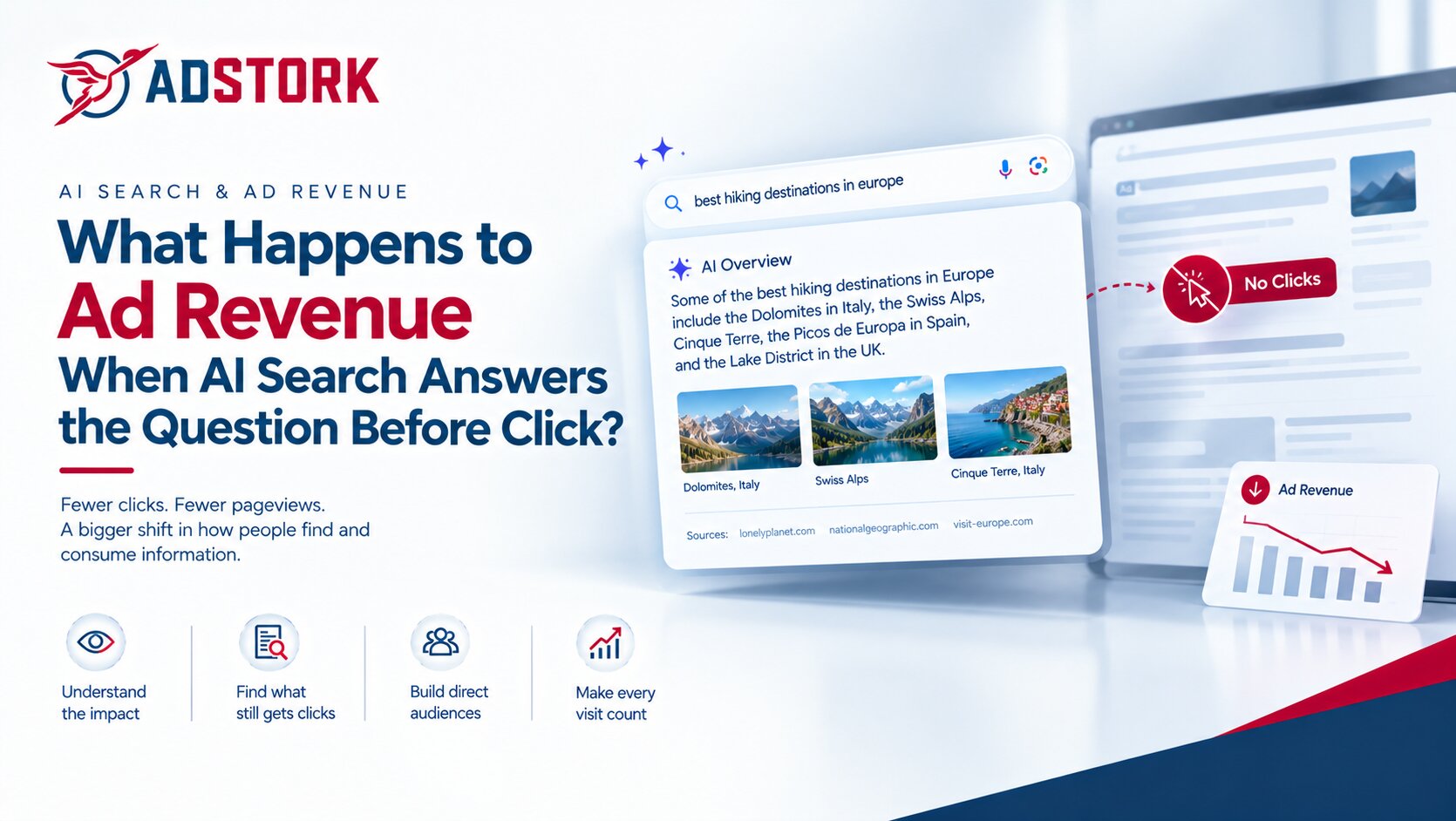
A reader types a question into a search engine and gets a complete answer at the top of the page, sourced from sites like yours. They read it, close the tab, and never visit. The publisher whose work fed that answer sees the impression in a report and nothing in the revenue dashboard.This is the concern behind a lot of recent publisher anxiety, and it is not imaginary. It is also more nuanced than "AI will take all the traffic," and the details decide which sites are exposed.In short: AI-generated answers in search can reduce clicks to publisher sites, especially for simple factual queries, which lowers pageviews and ad revenue. Publishers can respond by building direct audiences, targeting queries that need depth, and structuring content so AI tools cite it, which turns a threat into a new traffic source.Key TakeawaysAI answers hurt simple, fact-lookup content the most and affect in-depth, original content far less.Direct, email, and returning traffic is largely unaffected, which makes owned audiences more valuable than before.Being cited inside an AI answer can send smaller but more engaged traffic.Fewer pageviews make revenue per pageview and per session matter more than raw traffic volume.1. How Do AI Search Answers Reduce Publisher Traffic?When a search engine or chatbot answers a question directly, the reader may never need to open a source page. Research from groups like the Pew Research Center in 2025 found that people clicked traditional results noticeably less often when an AI summary appeared at the top of the results. Treat the exact figures as a snapshot, since they shift as products change, but the direction is consistent across studies.For publishers, fewer clicks mean fewer ad impressions. The effect is uneven. A page that exists to answer a quick factual question is exposed. A page that offers analysis, original data, tools, or a point of view is much harder for a summary to replace.2. Which Kinds of Content Are Most and Least Exposed?Most exposed: Definitions, quick facts, simple how-to steps, and short lookup answers that a summary can fully satisfy.Moderately exposed: General explainers and list articles that cover widely available information.Least exposed: Original research, benchmarks, opinionated analysis, community content, tools, and anything where the reader wants depth or a specific voice.3. What Can Publishers Do About It?Build audiences that do not depend on search. Newsletters, direct visits, and returning readers are not intercepted by an AI summary.Publish what a summary cannot replace. Original data, firsthand testing, and clear expert opinion give readers a reason to click through.Structure content so it can be cited. Question-style headings, concise standalone answers, clear sourcing, and comparison tables make it easier for AI tools to pull from and credit a page.Raise revenue per visit. With fewer visitors, each one needs to be monetized well, through sensible placement and competing demand rather than a single fixed buyer.4. Where Does Adstork Fit In?When traffic is harder to win, every visit has to earn more. Adstork connects publishers to multiple competing demand sources across banner, native, push, popunder, and video formats, so each remaining impression is matched against real competition instead of one fixed rate. Transparent, real-time reporting lets publishers watch revenue per session, not just traffic totals, and see early whether AI-driven changes are reaching their numbers.5. What Are the Honest Limits?No monetization setup replaces visitors who never arrive. Better yield per visit softens the loss but does not remove it, and citation by AI tools is not guaranteed or easily controlled. Publishers whose entire business rests on simple answers searched by anonymous visitors face the hardest adjustment, and for them diversifying content and audience sources is a necessity rather than an option.Content Types and AI ExposureContent TypeExposure to AI AnswersBest ResponseQuick facts and definitionsHighAdd depth, or accept as a citation playGeneral explainersMediumAdd original examples and dataOriginal research and benchmarksLowPublish more, structure for citationNewsletters and direct audienceVery lowInvest and growWhat Comes Next for Publishers and AI Search?AI answer products will keep changing, and so will the share of traffic they send. The durable advantages are the same ones advertisers already reward: first-party audiences, original content, and trust. Publishers who invest in them are better placed whichever way the technology moves.Final WordAI search is changing how readers find content, but it rewards the same fundamentals: original work, loyal audiences, and strong monetization of every visit. At Adstork Ad Network, competing demand and transparent reporting help publishers earn more from the traffic they do get.Ready to get more from every visit? Partner with Adstork Ad Network today.FAQsDo AI Overviews reduce traffic to publisher websites? Studies indicate users click through to sources less often when an AI summary appears, with the largest effect on simple factual queries. The impact varies by site and content type.What type of content is safest from AI answers? Original research, benchmarks, opinionated analysis, tools, and community content, since a short summary cannot fully replace them.How can I get my site cited by AI tools? Use question-style headings, give concise standalone answers, cite sources clearly, include comparison tables, and publish original data. Citation is not guaranteed, but structure improves the odds.Should I stop publishing informational content? No. Shift toward depth and originality, and build owned audiences so traffic does not depend on a single search feature.How can publishers protect revenue if traffic falls? Increase revenue per visit through competing demand sources and sensible placement, and grow direct channels like email that AI summaries cannot intercept.Suggested Internal LinksWhy Does One Website Keep Growing While a Similar Website Stays Stuck?Newsletter Monetization: Turning Email Subscribers Into a Second Revenue StreamThe Publisher's Guide to Surviving a Google Algorithm Update Without Losing Ad Revenue
Read more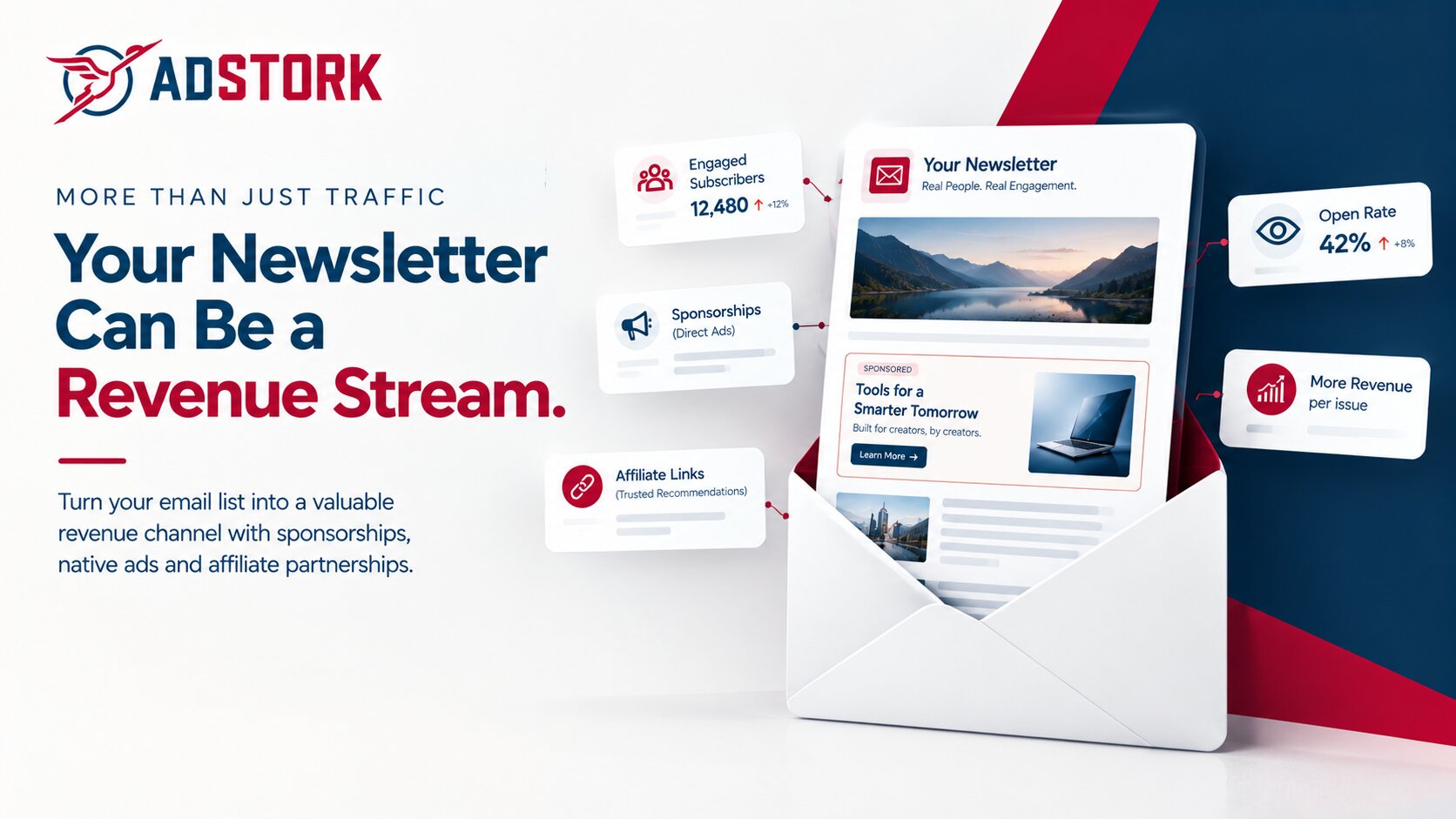
Most publishers spend years building an email list and treat it purely as a traffic funnel, a way to pull subscribers back to the site where the real ads live. The list itself sits there earning nothing on its own.That is a missed asset. A newsletter is not just a traffic source. It is an owned, first-party audience advertisers increasingly want direct access to, and treating it as a second revenue stream, not just a funnel, can meaningfully change a publisher's total earnings.In short: Newsletter monetization means generating revenue directly from email content, through sponsorships, native ad placements, or affiliate links, rather than relying solely on the newsletter to drive site traffic. A list of even a few thousand engaged subscribers can produce meaningful standalone revenue once structured correctly.Key TakeawaysA newsletter list is a first-party asset, exactly the kind of audience advertisers are prioritizing as cookies fade out.Sponsorships and native placements typically outperform display banners inside email.Open rate and click rate matter more than list size when pricing sponsorship slots.Newsletter revenue compounds with site revenue rather than competing with it.1. Why Email Monetizes Differently Than a WebpageA webpage ad competes with a reader's wandering attention. An email ad competes with almost nothing else in that moment, the subscriber opened one message and is reading it start to finish. That attention is worth more to advertisers, which is why well-run newsletter sponsorships often command higher effective rates per reader than the same audience would generate browsing a site.2. Three Ways to Actually Monetize a NewsletterDirect sponsorships. A single advertiser pays a flat rate to be featured in a specific issue, usually with a short blurb and link. Priced based on open rate and list size, not just subscriber count.Native ad placements. A short, clearly labeled promotional section woven into the newsletter's normal format, blending with editorial content rather than interrupting it.Affiliate and product recommendations. Particularly effective in niche newsletters where subscribers trust the publisher's recommendations on tools, products, or services relevant to the topic.3. Pricing Based on the Right NumbersList size alone is a weak pricing signal. A 5,000-subscriber list with a 45% open rate is worth more to an advertiser than a 20,000-subscriber list with an 8% open rate. Price sponsorships against actual opens, not raw subscriber count, and be transparent with advertisers about both numbers upfront.4. Where Adstork Fits InNewsletter revenue works best alongside strong site monetization, not instead of it. Adstork helps publishers capture the full value of the traffic a newsletter sends back to the site, through competing demand sources and transparent reporting, so the newsletter's job of driving return visits and the site's job of monetizing them both get captured fully rather than one subsidizing the other.5. Being Honest About the Effort RequiredDirect sponsorship sales take real time, finding advertisers, negotiating rates, fulfilling placements manually. This is not a passive revenue stream in the way programmatic display ads are. It works best for publishers who already have some advertiser relationships or are willing to build them specifically for this channel.Newsletter vs. Site MonetizationFactorNewsletterSiteAttention levelHigh, focusedVariable, dividedSales effortManual, directAutomated, programmaticScalabilityLimited by sales capacityScales with trafficFinal WordA newsletter that only drives traffic back to the site is leaving a second revenue stream untouched. At Adstork Ad Network, we help publishers capture full value from the traffic their newsletter sends, so both channels work together rather than one doing all the earning.Ready to make your whole audience work for you? Partner with Adstork Ad Network today.FAQsHow many subscribers do I need to monetize a newsletter? There is no strict minimum. A smaller, highly engaged list often sells better than a large, disengaged one. Open rate matters more than size.What should I charge for a newsletter sponsorship? Base pricing on actual opens, not subscriber count. A common starting approach is a CPM-style rate applied to average opens per issue.Do newsletter ads hurt subscriber trust? Not if clearly labeled and relevant to the audience. Native, well-integrated placements perform better and damage trust less than disruptive, off-topic ads.Should I use a newsletter ad network instead of selling directly? Direct sales typically pay more but require more effort. Networks are faster to start but usually pay less per placement.Suggested Internal LinksWhat Makes an Online Audience Valuable to Brands?The RPM Benchmark Report: What Publishers Actually Earn by Niche
Read more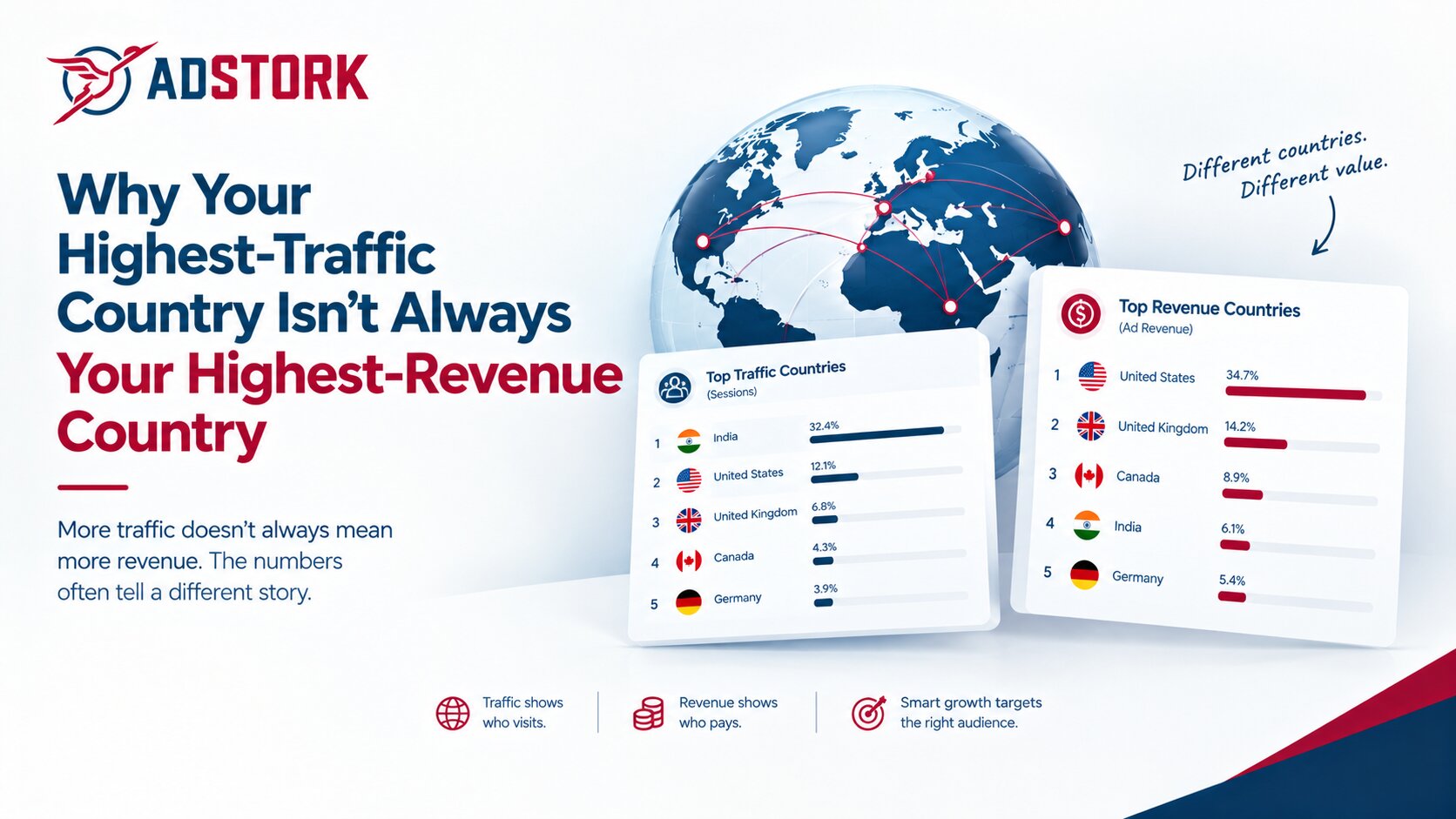
Open the analytics dashboard and the top traffic country is obvious at a glance. Open the revenue dashboard and a different country is often sitting at the top instead. Publishers notice this gap and rarely investigate it beyond a shrug.That gap is worth investigating. It usually reveals exactly where a site's growth strategy and its monetization strategy have quietly drifted apart.In short: A country driving the most traffic is not necessarily driving the most revenue, because CPM varies dramatically by geography regardless of volume. Auditing traffic against revenue by country reveals whether growth efforts are targeting the audience that actually pays, or simply the audience that is easiest to acquire.Key TakeawaysTier-1 traffic can earn 3-5x more per visitor than tier-2 or tier-3 traffic in the same niche.SEO and social growth often skew toward whatever country is easiest to rank or go viral in, not the highest-paying one.A revenue-per-country audit takes under an hour and frequently changes content and acquisition priorities.1. Why This Gap HappensTraffic growth and revenue growth are driven by different forces. SEO tends to reward whichever country has the least competition for a given keyword, which is often not a tier-1 market. Social virality skews toward whatever region a platform's algorithm favors that week. Neither force cares about CPM. The result is a site that can grow traffic steadily while growing revenue far more slowly, simply because the new traffic is arriving from lower-paying geographies.2. How to Run the AuditPull sessions by country from analytics for the last 90 days.Pull revenue by country from the ad network's reporting for the same period.Calculate revenue per session for each country, not just total revenue, since raw totals get skewed by volume.Rank both lists side by side. The gap between the two rankings is the diagnostic.3. What to Do With the ResultIf the top traffic country and top revenue country differ sharply, two responses are worth considering. Content strategy can lean further into topics and keywords that naturally attract the higher-paying geography. Separately, check whether the current demand setup has weak coverage in the top-traffic country specifically, since a GEO's low revenue is sometimes a demand gap rather than an inherent low-value market.4. Where Adstork Fits InThis audit only matters if the underlying demand actually scales with whichever GEO a publisher decides to grow. Adstork's global demand coverage across 195+ regions means growth in a specific GEO is more likely to be matched by real advertiser demand there, rather than growing traffic into a country the current demand stack can't monetize well.5. The Limit of This FrameworkNot every publisher should chase the highest-CPM country. A site with a genuine, built-in audience in a specific region has real value in serving that audience well, even at a lower CPM. This audit is a diagnostic for unconscious drift, not a mandate to abandon an audience that happens to pay less per impression.Sample GEO AuditCountryTraffic RankRevenue RankIndia#1#4United States#3#1United Kingdom#5#2Final WordTraffic growth and revenue growth are not the same goal, and conflating them hides exactly where a site's strategy has drifted. At Adstork Ad Network, global demand coverage means growth in any GEO has a real chance of being matched by actual advertiser demand.Ready to find out where your traffic and revenue actually align? Partner with Adstork Ad Network today.FAQsHow much more does tier-1 traffic earn than tier-3? Typically 3-5x or more for the same content niche, though the exact gap varies by vertical and demand availability.Should I stop targeting lower-CPM countries entirely? Not necessarily. The goal is awareness of the mismatch, not abandoning audiences that pay less, especially if they have other strategic value.How often should I run this audit? Quarterly is reasonable for most sites, or after any major traffic acquisition shift, like a new content vertical or viral event.Suggested Internal LinksWhat Makes a Website Valuable to Advertisers?The RPM Benchmark Report: What Publishers Actually Earn by Niche
Read more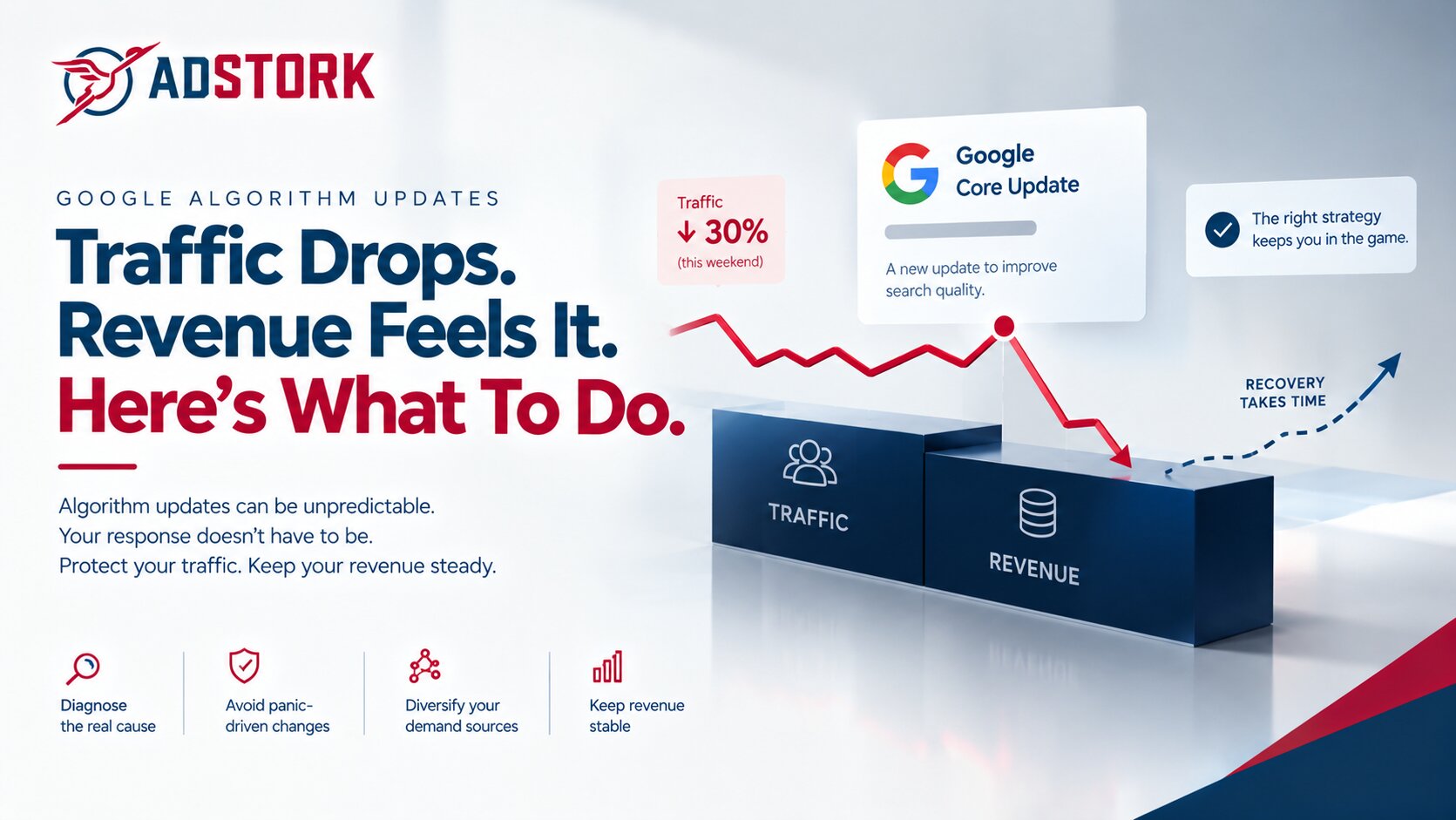
Traffic drops 30% over a weekend. No code changed, no content was removed, nothing on the site is different. Then the news breaks: Google rolled out a core update. The explanation arrives, but the revenue is already gone for the month.Algorithm updates are one of the few genuinely uncontrollable forces in a publisher's business. The response to them, however, is controllable, and most publishers respond badly in ways that make the financial impact worse than it needs to be.In short: Google algorithm updates can cause sudden traffic volatility that directly impacts ad revenue, but the publishers who recover fastest are the ones who diagnose correctly before reacting, avoid panic-driven content purges, and have a monetization setup resilient enough to absorb a temporary traffic dip without compounding the damage.Key TakeawaysMost traffic drops attributed to "an update" are not actually related to the update at all.Panic-driven content deletion often does more damage than the update itself.Revenue diversification across multiple demand sources softens the financial impact of a traffic dip.Recovery typically takes weeks to months, not days, and rushing the process usually backfires.1. First, Confirm It's Actually the UpdateTraffic drops coincide with update rollouts often enough that publishers assume correlation automatically means causation. Before reacting, check Google Search Console for manual actions, confirm the drop lines up precisely with the rollout date rather than starting days before it, and compare against industry chatter to see if other sites in the same space reported similar timing. A drop that started a week before the update was announced is probably not about the update.2. The Panic Response That Makes Things WorseThe most common reaction, mass-deleting or drastically rewriting content within days of a drop, is usually premature. Core updates take time to fully roll out and for rankings to settle, often several weeks. Making large structural changes mid-rollout means a publisher cannot tell whether a change helped, hurt, or had no effect at all, because the update itself is still moving the baseline underneath them.3. Protecting Revenue While Traffic RecoversDon't cut ad density during the dip. It is tempting to assume fewer ads will help recovery somehow. It will not affect rankings, and it compounds the revenue loss unnecessarily.Check whether the remaining traffic shifted in value. Sometimes an update changes which pages rank, shifting traffic toward lower or higher commercial-intent content than before, which affects RPM independent of volume.Lean on non-search channels temporarily. Direct, email, and social traffic are unaffected by the update and can partially offset the gap while rankings stabilize.4. Where Adstork Fits InA single-network setup with one fixed buyer has no flexibility to absorb a sudden volume change. Adstork's multiple competing demand sources mean that whatever traffic does arrive during a volatile period is still being exposed to real competition for the best possible rate, rather than a fixed, pre-negotiated price that doesn't adjust to changing conditions.5. Being Honest About Recovery TimelinesSome sites recover fully within the same update cycle. Others don't recover for months, or ever, if the update reflected a genuine, lasting shift in what Google considers quality for that content type. There is no guaranteed timeline, and any claim promising one should be treated skeptically.Panic Response vs. Measured ResponseActionPanic ResponseMeasured ResponseContentMass delete/rewrite within daysWait for full rollout, then diagnoseAd densityCut immediatelyLeave unchangedTraffic channelsIgnoredLean on email/direct/socialFinal WordAlgorithm updates are uncontrollable. The response to them is not, and a measured response protects both long-term rankings and short-term revenue far better than panic does. At Adstork Ad Network, competing demand sources mean whatever traffic a site has during a volatile period is still earning what it's actually worth.Ready for a monetization setup that holds steady through SEO volatility? Partner with Adstork Ad Network today.FAQsHow long does it take to recover from a core update? It varies widely, from weeks to several months, and some sites never fully recover if the update reflects a lasting quality shift rather than a temporary fluctuation.Should I delete content that dropped in rankings? Not immediately. Wait for the update to fully roll out and diagnose the actual cause before making structural changes.Does reducing ads help SEO recovery? No. Ad density does not directly affect core update recovery and cutting it only compounds revenue loss unnecessarily.Suggested Internal LinksWhy Does One Website Keep Growing While a Similar Website Stays Stuck?What Happens to Ad Revenue During Major Traffic Events?
Read more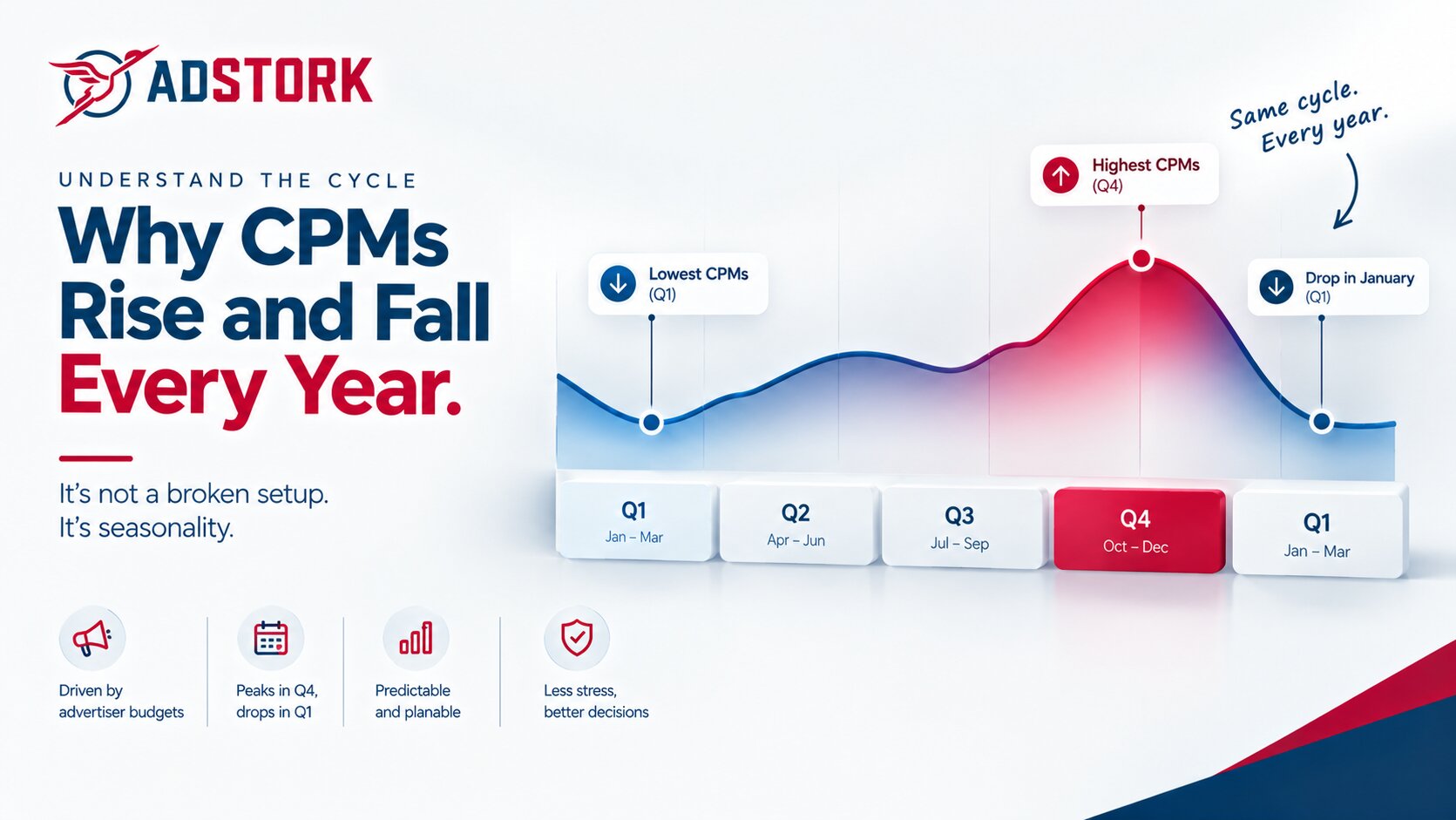
Every January, the same message appears in publisher communities: "Did something break? My CPM just fell off a cliff." Every November, the opposite message appears: "CPMs are amazing right now, what changed?"Nothing broke in January, and nothing special happened in November beyond the calendar. Both are the same predictable cycle repeating every year, and understanding it removes a lot of unnecessary anxiety.In short: CPMs follow a predictable annual cycle driven by advertiser budget timing, peaking in Q4 around holiday shopping season and dropping in January as new annual budgets restart at lower initial spend. Recognizing this pattern prevents publishers from mistaking normal seasonality for a broken setup.Key TakeawaysCPM seasonality is driven by advertiser budget cycles, not changes in a publisher's own setup.Q4 typically delivers the highest CPMs of the year, Q1 typically the lowest.The swing is predictable enough to plan content and cash flow around.1. The Annual Budget Cycle, ExplainedMost advertisers plan and allocate budgets annually, often with a disproportionate share pushed into Q4 to capture holiday shopping demand. Retail, e-commerce, and consumer brands compete intensely for inventory from October through December, bidding up prices across the board. Once the calendar resets in January, new annual budgets have just been approved but spending typically ramps slowly, since campaigns need to be planned and launched before dollars actually flow into bids.2. The Typical Shape of the YearQ1 (Jan-Mar): Lowest CPMs of the year, slow ramp as new budgets get planned.Q2-Q3 (Apr-Sep): Steady, moderate CPMs as campaigns run at normal pace.Q4 (Oct-Dec): Highest CPMs, driven by holiday shopping competition, peaking around Black Friday and Cyber Monday specifically.3. How to Plan Around the CycleTreat Q1 revenue dips as expected rather than alarming, and avoid making reactive changes to the ad setup based on a seasonal dip alone. For cash flow planning, the gap between Q4 peak earnings and Q1 trough earnings can be significant, smoothing income across the year, or budgeting conservatively based on Q1-level revenue, prevents surprises.4. Where Adstork Fits InCompeting demand sources help soften, though not eliminate, the Q1 trough, since a broader pool of advertisers means a better chance of finding whatever demand is active even during slower months. Transparent reporting also helps publishers distinguish a normal seasonal dip from an actual setup problem, rather than guessing.5. When It's Not Just SeasonalitySeasonality explains a predictable, proportional dip. It does not explain a dip far steeper than prior years, or one that doesn't recover by Q2. If a January drop is dramatically worse than the same period last year, something beyond normal seasonality is worth investigating.Typical Quarterly CPM PatternQuarterTypical CPM TrendQ1Lowest, slow budget rampQ2-Q3Steady, moderateQ4Highest, holiday competitionFinal WordCPM seasonality is predictable, not a sign of a broken setup. Planning around it, rather than reacting to it, saves both stress and unnecessary changes. At Adstork Ad Network, competing demand helps soften the Q1 trough while transparent reporting shows exactly what's seasonal and what isn't.Ready for a setup that holds steady through the seasonal cycle? Partner with Adstork Ad Network today.FAQsWhy does my CPM drop every January? New annual advertiser budgets take time to ramp into active spending, while Q4 holiday competition that drove rates up has ended.When is CPM typically highest during the year? Q4, usually peaking around Black Friday and Cyber Monday, driven by retail and e-commerce competition for holiday shopping traffic.How do I know if a CPM drop is seasonal or a real problem? Compare the drop's severity against the same period in prior years. A proportional, predictable dip is seasonal. A dip far steeper than usual warrants investigation.Suggested Internal LinksWhat Happens to Ad Revenue During Major Traffic Events?The RPM Benchmark Report: What Publishers Actually Earn by Niche
Read moreGet answers to your most common questions about AdsRock. Discover how to optimize your campaigns, resolve issues, and access the information you need effortlessly.
Our ad network “Adstork” connects advertisers with websites and apps to help promote products and services. We provide an efficient platform for advertisers to reach their target audience while offering publishers a way to monetize their websites or apps through ads.
To get started, sign up on our platform, create an account, and set up your first campaign. Choose your target audience, set your budget, and let our system optimize your ad placements for the best results.
Our ad network offers various ad formats, including display ads, video ads, native ads, and more. We provide a range of customization options to help you design ads that suit your campaign and audience.
Our platform offers a comprehensive dashboard where you can track your campaign performance in real-time. You’ll have access to key metrics such as impressions, clicks, conversions, and revenue, helping you monitor and optimize your campaigns.
We support a variety of payment methods, including PayPal, bank transfers, and other online payment systems. Check our payment options in your account settings for specific details.
We use advanced algorithms to ensure that ads displayed on your site or app are relevant to your audience. We also maintain strict quality control measures to ensure that all ads comply with our policies and offer value to users.
Yes, we offer various targeting options including geographic location, device type, language, interests, and more. You can tailor your campaigns to ensure they reach the most relevant audience for your product or service.
Our ad network is designed for a wide range of advertisers and publishers. Whether you're a small business looking to reach a local audience or a large enterprise targeting global markets, we have solutions to suit your needs. Publishers with high traffic and engaging content are ideal partners for us.
Advertisers create campaigns through our platform, targeting specific demographics, interests, and locations. Publishers integrate our ad units on their websites or apps, and we deliver relevant ads to their audience. Our technology ensures ads are optimized for performance.
If you own a website or app, sign up as a publisher on our platform. Once your application is approved, you’ll be given access to ad units that can be embedded into your site or app. You’ll start earning revenue based on ad impressions, clicks, or other interactions.
As a publisher, you earn money when users interact with the ads displayed on your website or app. Depending on the ad type, you may earn revenue through impressions (CPM), clicks (CPC), or conversions (CPA).
The minimum payout threshold varies depending on your account type and payment method. Typically, the minimum payout is $50. Once you reach this threshold, you can request a payment.
Yes! Our platform allows you to manage and run multiple campaigns simultaneously, providing you with flexibility to target different audience segments and goals. Each campaign can be customized based on budget, targeting, and ad format.
You can reach our support team by emailing contact@adstork.com or using the live chat feature in your account. Our team is available 24/7 to assist you with any questions or concerns.
We provide a variety of optimization tools that allow you to test different ad creatives, targeting options, and bidding strategies. Use our performance data to make informed decisions about which ads and placements are delivering the best results.
Yes, we have strict guidelines to ensure that the ads and websites we work with are appropriate for all audiences. Prohibited content includes adult material, illegal activities, hate speech, and anything that violates our policies. All ads and sites are reviewed before approval.
Unlock the power of Adstork’s expansive network to elevate your brand. Partner with top publishers, reach your target audience, and see your business grow. Start today!
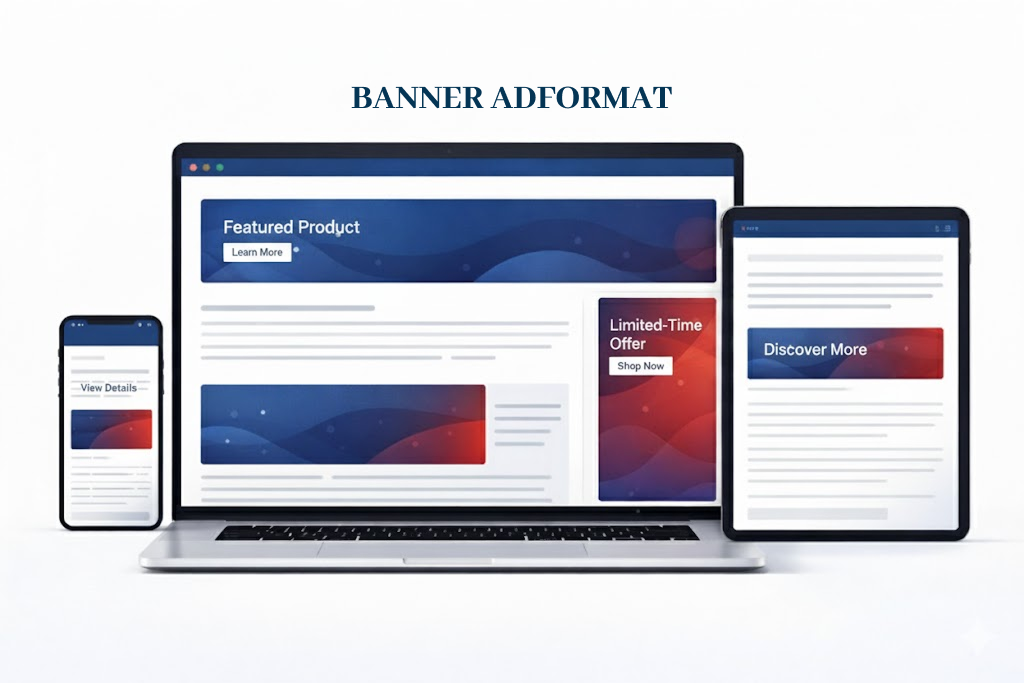
.png)
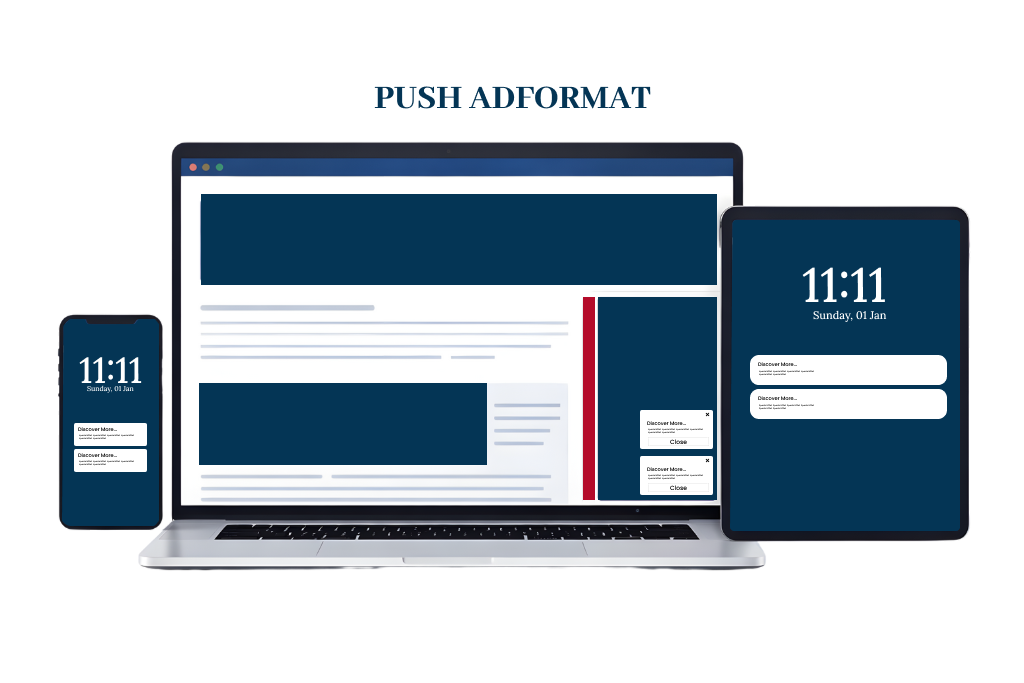
.png)
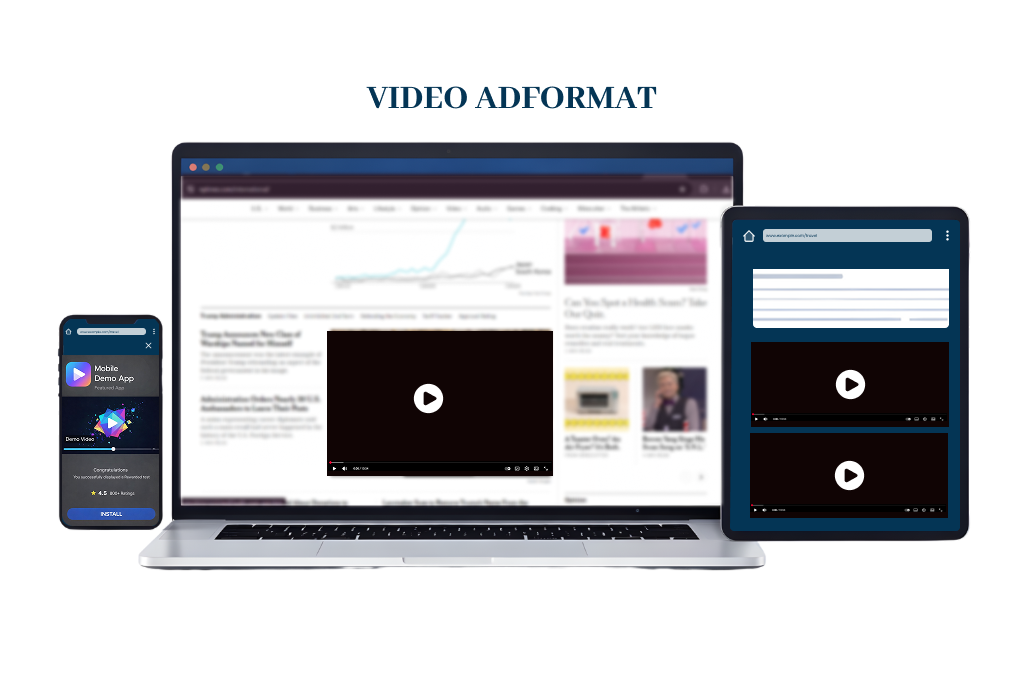
.png)