- 26 Oct, 2026
Why Your Campaign Gets Clicks but No Conversions (And How to Fix It)
The dashboard looks healthy. Impressions are rising, clicks are coming in at a fair price, and the click-through rate is better than expected. Then the conversion column shows zero, or close to it. The budget is going out and nothing is coming back.
Most advertisers react by changing the creative or switching networks. Both are guesses. A click is only the first step of a longer path, and the problem usually sits at one specific point along it.
In short: Clicks without conversions usually come from one of four causes: traffic that does not match your offer, an ad that promises something the page does not deliver, a landing page that loses visitors, or tracking that fails to record real conversions. Checking each stage in order is faster and cheaper than changing everything at once.
Key Takeaways
- A click shows interest in the ad, not intent to buy. Many problems start with who is clicking, not what they see afterward.
- Always rule out broken tracking first. It is the cheapest fix and the most common false alarm.
- Break results down by country, device, and format before judging a campaign as a whole.
- Change one thing at a time, so you know which change caused the improvement.
1. Why Do Campaigns Get Clicks but No Conversions?
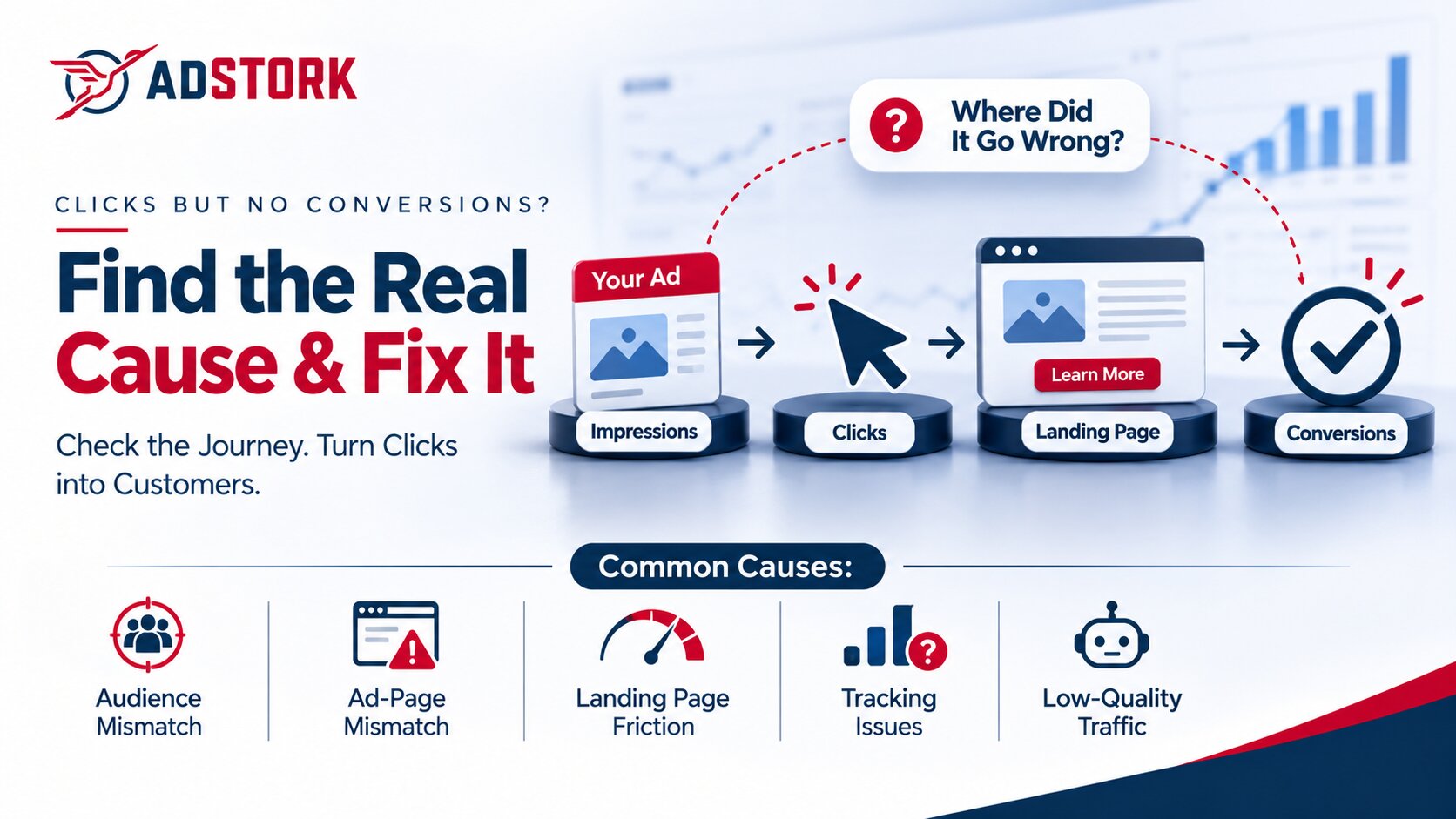
Think of the path as a chain: the right person sees the ad, the ad sets an honest expectation, the page meets that expectation, and the conversion is recorded. A break at any link produces the same symptom on the dashboard, which is why the cause is easy to misread.
- Audience mismatch. The ad is reaching people who are curious but have no use for the offer, or who sit in a country where the offer does not apply.
- A gap between promise and page. The ad suggests one thing and the landing page shows another, so visitors leave within seconds.
- Landing page friction. A slow load, a long form, a confusing layout, or a page that works poorly on phones.
- Tracking gaps. Conversions happen but are never recorded, so the campaign looks like a failure when it is not.
- Low-quality traffic. Accidental clicks, automated visits, or incentivized traffic that has no real interest in the offer.
2. How Do You Find Where Visitors Drop Off?
Work through the chain in this order, stopping when you find the break.
- Test your own tracking. Complete a conversion yourself and confirm it appears in your reports. If it does not, fix this before touching anything else.
- Compare clicks to landing page visits. A large gap means visitors leave before the page loads, which points to slow pages or accidental clicks.
- Check time on page and bounce rate. Visits of a few seconds suggest a mismatch between ad and page, or low-intent traffic.
- Segment by country, device, and format. A campaign that fails overall often works well in one segment, and that segment is where to scale.
- Look at the step after the click. If visitors reach the form or checkout and stop, the offer or the page is the issue, not the traffic.
3. What Should You Fix First?
- Tracking, then targeting. Confirm conversions are recorded, then narrow countries, devices, and placements to the segments that show any sign of response.
- Make the ad and page say the same thing. The headline, offer, and visual on the page should match what the ad promised.
- Shorten the path. One clear action per page, fewer form fields, and a fast load on mobile.
- Try a different format. The same offer can behave very differently in native, push, popunder, banner, or video, because each reaches people in a different frame of mind.
- Pause what clearly fails. Cutting the worst placements frees budget for the ones that show promise.
4. Where Does Adstork Fit In?
Diagnosing a campaign needs visible data and a clean traffic source. Adstork gives advertisers transparent reporting by country, device, and format, so the weak segment can be found and cut rather than guessed at. Ad quality and traffic integrity are screened, which reduces the share of clicks coming from visitors who were never going to convert. Advertisers can launch through the self-serve platform with guided onboarding and live chat, or work directly with an account manager who can review a campaign that is not converting and suggest what to test next. Confirm your conversion tracking setup with the team before launching, so results are recorded correctly from day one.
5. What Are the Honest Limits?
Sometimes the traffic and the page are fine and the offer simply does not suit the market, or the price is wrong. No network can fix that. Small tests can also mislead, since a campaign with a handful of conversions gives a noisy picture. Give each test enough volume to read before declaring a winner, and accept that some offers need several rounds before they work.
Symptom and Likely Cause
| What You See | Likely Cause | First Fix |
|---|---|---|
| Clicks but zero conversions recorded | Tracking is broken | Test a conversion yourself |
| Many clicks, few page visits | Slow page or accidental clicks | Speed up the page, review placements |
| Visitors leave within seconds | Ad and page do not match | Align headline and offer |
| Visitors stop at the form | Too much friction | Cut fields and steps |
| One country or device converts, others do not | Audience mismatch | Narrow targeting to the winner |
What Comes Next for Conversion Tracking?
Privacy changes are making third-party tracking less reliable, so advertisers are moving toward first-party conversion data and cleaner measurement on their own sites. Building that foundation now makes every future campaign easier to read and easier to trust.
Final Word
Clicks without conversions are a symptom, and the cause is almost always findable. Check tracking, then traffic, then the page, and change one thing at a time. At Adstork Ad Network, transparent reporting and hands-on account support help advertisers find the break in the chain and fix it faster.
Ready to turn clicks into customers? Partner with Adstork Ad Network today.
FAQs
Why am I getting clicks but no sales? The usual causes are traffic that does not match the offer, a landing page that does not match the ad, page friction, or conversion tracking that is not recording sales. Check tracking first, then work through the path from click to conversion.
How do I know if my conversion tracking is broken? Complete a conversion yourself and see whether it appears in your reports. If it does not, tracking is the problem and no other change will help until it is fixed.
What is a good conversion rate for ads? It varies widely by offer, price, country, and format, so there is no single good number. Compare each segment against your own target cost per result instead of an industry average.
Could bad traffic be the reason my campaign is not converting? Yes. Accidental clicks, automated visits, or low-intent visitors can inflate clicks without adding customers. Segmenting by placement and country usually reveals where the weak traffic sits.
How long should I run a test before changing it? Long enough to collect a meaningful number of conversions per variation. Changing too early makes results look random, and changing several things at once hides what worked.
How does Adstork help advertisers whose campaigns are not converting? Through reporting by country, device, and format, screening for ad quality and traffic integrity, and access to an account manager who can review the campaign.
Leave a Comment