- 14 Oct, 2026
CPM vs. CPC vs. CPA: Which Pricing Model Fits Your Campaign Goal?
Two advertisers launch campaigns on the same traffic with the same budget. One pays per thousand impressions and the other pays per action. A month later, one report says the campaign was a bargain and the other says it was a waste. Neither advertiser made a mistake with the creative. They chose different pricing models for goals that did not match.
The pricing model decides who carries the risk, what the platform optimizes for, and which numbers will tell you whether the campaign worked. It is one of the first decisions in a campaign and one of the most often rushed.
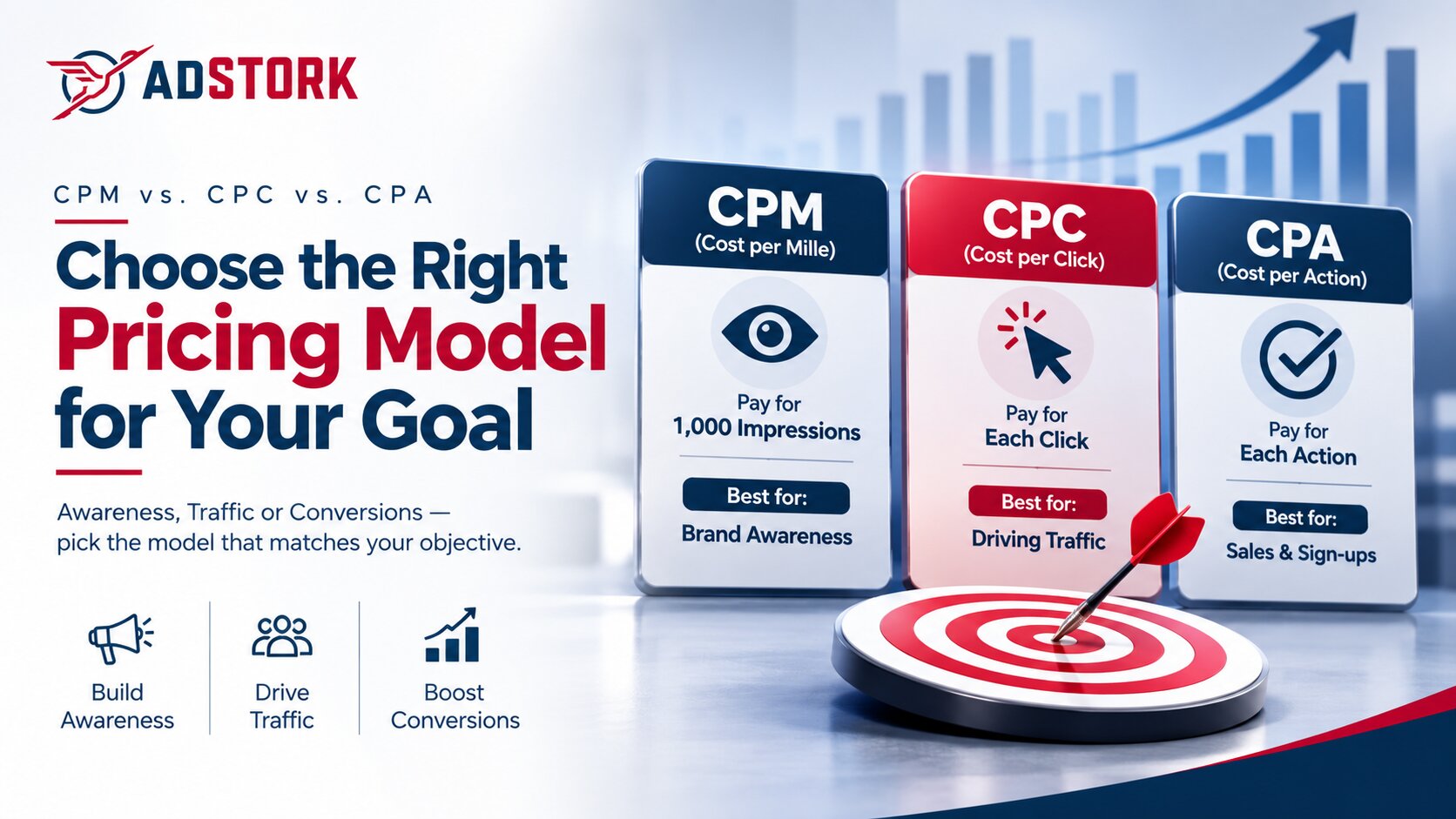
In short: CPM charges per 1,000 impressions and suits awareness goals. CPC charges per click and suits traffic goals. CPA charges per completed action, such as a sign-up or sale, and suits conversion goals. The right model is the one that matches the outcome you can actually measure.
Key Takeaways
- Each pricing model moves risk to a different party. CPM puts it on the advertiser, CPA puts more of it on the platform and publisher.
- Match the model to the goal: awareness, traffic, or conversions.
- Compare models by cost per result, not by the headline rate, since a low CPM can still be an expensive way to get a customer.
- Reliable conversion tracking is a requirement for CPA, and a weak setup is the most common reason CPA campaigns fail.
1. What Do CPM, CPC, and CPA Actually Mean?
- CPM (cost per mille): You pay for every 1,000 times your ad is shown, whether or not anyone clicks.
- CPC (cost per click): You pay only when someone clicks your ad.
- CPA (cost per action): You pay only when a defined action is completed, such as a registration, install, or purchase.
2. Which Pricing Model Fits Which Goal?
Start from what you want to learn at the end of the campaign, then pick the model that makes that number easiest to read.
- Brand awareness or a product launch: CPM. You are buying reach and repetition, and clicks are not the point.
- Driving visits to a page or offer: CPC. You pay for the visit and can judge the quality of the landing page separately.
- Sales, sign-ups, or installs: CPA, once you know your target cost per customer and can track conversions accurately.
3. Why Is the Cheapest Rate Not Always the Cheapest Result?
A $2 CPM sounds cheap until it delivers no customers. A $0.05 click sounds cheap until none of those visitors buy. The useful comparison is cost per result. If 1,000 impressions at $2 produce no conversions and 40 clicks at $0.50 produce two sales, the second option cost $10 per sale. Anchoring on the rate you see first is how advertisers drift into models that look efficient and perform poorly.
Before choosing, write down a target cost per result you can afford. Every pricing model can then be judged against the same yardstick.
4. How Should Advertisers Test Without Wasting Budget?
- Start small and split the test. Run a modest budget across two models for the same offer and compare cost per result after enough conversions to be meaningful.
- Test one variable at a time. Change the pricing model or the creative, not both, so you know what caused the difference.
- Set conversion tracking up first. Confirm that actions are recorded correctly before spending, since bad tracking can make a good campaign look like a failure.
- Check by country and format. A model that wins in one country or format can lose in another, so segment the results before scaling.
5. Where Does Adstork Fit In?
Choosing a pricing model is easier when the platform lets you test it cleanly. Adstork offers a self-serve platform with guided onboarding and live chat, and advertisers who prefer hands-on help can work directly with an account manager. Campaigns can run across banner, native, push, popunder, and video formats, with transparent reporting by country, device, and format so cost per result is visible rather than estimated. Ad quality and traffic integrity are screened, so the spend you test with is reaching real users. Pricing options can vary by format, so confirm which models apply to your campaign with your account manager before you launch.
6. What Are the Honest Limits of Each Model?
- CPM: You pay whether or not anyone responds, so weak creative or poor targeting is costly.
- CPC: Clicks are not customers. Accidental or low-intent clicks can inflate cost without adding value.
- CPA: It needs accurate tracking and enough volume to optimize, and publishers may be less willing to run offers they expect to convert poorly.
CPM vs. CPC vs. CPA Compared
| Factor | CPM | CPC | CPA |
|---|---|---|---|
| You pay for | 1,000 impressions | Each click | Each completed action |
| Best goal | Awareness and reach | Traffic | Sales, sign-ups, installs |
| Who carries the risk | Advertiser | Shared | Mostly platform and publisher |
| Main requirement | Strong creative and targeting | A landing page that converts | Accurate conversion tracking |
| Watch out for | Paying for impressions that do nothing | Low-intent clicks | Tracking gaps and limited volume |
What Comes Next for Advertiser Pricing?
Automated optimization is making outcome-based buying easier, and privacy changes are pushing advertisers toward first-party conversion data and contextual signals. Advertisers who build clean tracking and a clear cost-per-result target now will be able to use these tools well as they mature.
Final Word
There is no best pricing model, only the best match for a goal you can measure. Decide the outcome first, pick the model that makes it readable, and judge every campaign by cost per result. At Adstork Ad Network, self-serve tools, hands-on account management, and transparent reporting help advertisers test with confidence and scale what works.
Ready to launch a campaign you can actually measure? Partner with Adstork Ad Network today.
FAQs
What is the difference between CPM, CPC, and CPA? CPM charges per 1,000 impressions, CPC charges per click, and CPA charges per completed action such as a sign-up or sale.
Which pricing model is best for beginners? CPC is a common starting point because it ties spend to visits and is easy to read, while CPA suits advertisers who already track conversions reliably.
Is CPA always cheaper than CPM? No. A CPA rate looks safer because you only pay for results, but it can carry a higher cost per action and may attract less publisher supply. Compare cost per result across models.
How do I calculate cost per result? Divide total spend by the number of results, such as sales or sign-ups. This gives one comparable number across CPM, CPC, and CPA campaigns.
How much budget do I need to test pricing models? Enough to collect a meaningful number of conversions for each model, which depends on your conversion rate and target cost. Start small and scale the winner.
How does Adstork help advertisers test campaigns? Through a self-serve platform with guided onboarding and live chat, optional account manager support, five ad formats, and transparent reporting by country, device, and format.


Leave a Comment