-
14 Aug, 2026
Popunder Ads vs. Interstitial Ads: Which Pays More for Publishers?
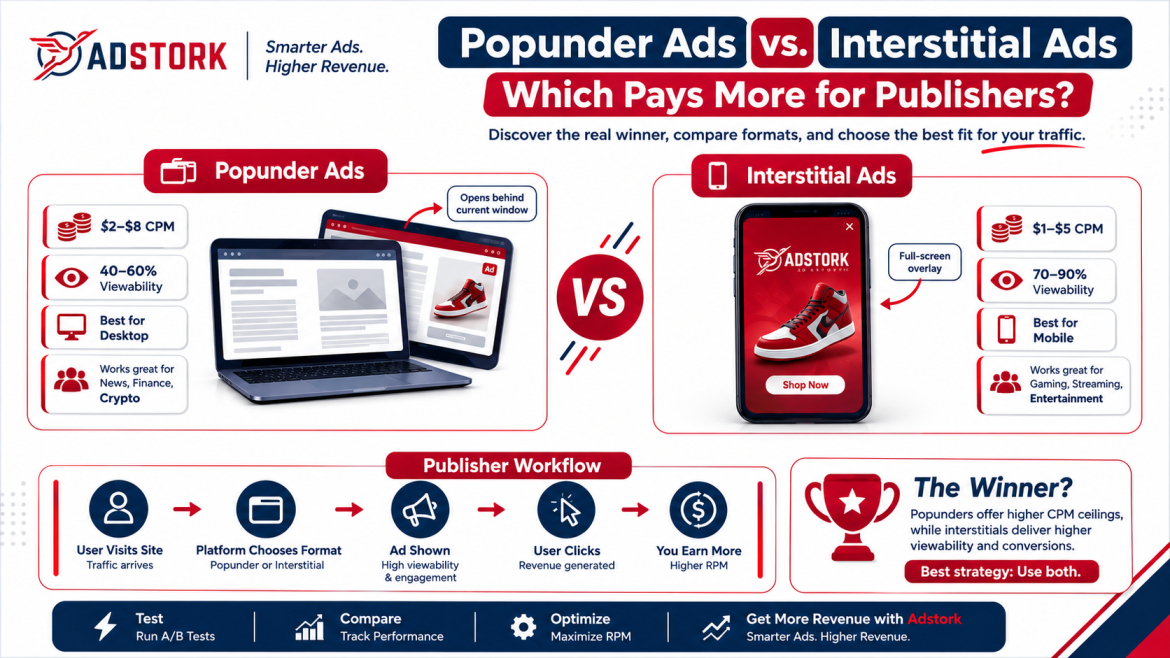
Imagine this: you have 100,000 daily visitors, and you are torn between two ad formats. One promises sky‑high CPMs but risks annoying your audience. The other feels less intrusive but might underdeliver on revenue. Which one actually puts more money in your pocket?You are not alone. Every publisher who scales past the "basic banner" stage hits this crossroads. Popunder ads and interstitial ads are two of the highest‑yielding formats in programmatic, yet they work in completely opposite ways. Choosing the wrong one for your site can cost you thousands per month, not because the format is bad, but because it mismatches your audience and device mix.This post breaks down both formats with real numbers, publisher‑tested use cases, and a side‑by‑side comparison that cuts through the hype. By the end, you will know exactly which one fits your traffic, your niche, and your revenue goals for 2026.Key TakeawaysPopunders typically earn $2–$8 CPM vs. interstitials at $1–$5 CPM, but interstitials have higher viewability (70‑90% vs. 40‑60%).Desktop traffic favours popunders; mobile app and mobile web traffic often respond better to interstitials.Interstitials convert 2‑4x higher for direct response offers, while popunders excel at brand awareness and retargeting.The real winner is often a hybrid strategy, not an either/or choice.What Are Popunder Ads?A popunder ad opens a new browser window or tab behind the current active window. The user does not see it until they close or minimise their main browsing window. This delayed visibility is the format's superpower. It does not interrupt the user's current activity, so it generates less immediate frustration than a full‑screen takeover.From a publisher's perspective, popunders are incredibly versatile. They work across almost every niche, from news and entertainment to finance and gaming. Their CPMs tend to be higher because advertisers value the "surprise" factor and the fact that the ad gets dedicated screen real estate without competing for attention against your content.Neuromarketing insight: the delayed reveal triggers a mild curiosity response. When a user closes their main tab and discovers a new page, their brain treats it as a reward rather than an intrusion. This lowers cognitive resistance and increases the likelihood they will engage with the ad, especially if it is visually relevant to their previous browsing session.What Are Interstitial Ads?Interstitial ads are full‑screen overlays that appear at natural transition points, such as between a game level, before a video starts, or when a user clicks from one article to the next. They cover the entire viewport and typically require the user to tap or click a close button to dismiss them.Because they demand immediate visual attention, interstitials boast exceptional viewability scores. Every impression is counted as viewable, since the ad literally fills the screen. This makes them a favourite among brand advertisers who care about guaranteed exposure. However, the forced nature of the interaction also creates a friction point. Users who encounter interstitials too frequently will bounce, and your site's engagement metrics will suffer.Neuromarketing insight: interstitials leverage the principle of loss aversion. Users instinctively want to close the ad and return to their task. Advertisers exploit this by placing their core message and call‑to‑action front and centre, knowing that the user is highly motivated to click through or close. This creates a high‑pressure environment that can drive conversions, but it also generates negative emotional associations with your brand if overused.The Revenue Showdown: CPM, CTR, and Fill RatesThis is the question every publisher actually cares about: which one earns more? The answer is layered, because raw CPM is not the only metric that determines your final revenue. Fill rate and click‑through rate play equally important roles.In global programmatic auctions, popunder CPMs average between $2 and $8 across most tier‑1 geos, with finance and crypto niches pushing $10‑$15. Interstitials average $1‑$5 for display, but video‑enabled interstitials can reach $8‑$12 in gaming and entertainment. Where interstitials win is viewability: 70‑90% of impressions are actually seen, compared to only 40‑60% for popunders, because users often close their browser without ever noticing the background tab.CTR tells a different story. Interstitials regularly achieve 0.5‑2% click rates because the ad is unavoidable and users often tap accidentally while trying to close it. Popunders hover around 0.1‑0.5%, but their clicks tend to be higher‑intent, since the user actively chose to view the content behind their main window. For direct response advertisers, interstitials generate more immediate conversions. For brand campaigns, popunders deliver better quality traffic that spends more time on the landing page.Fill rates also differ. Popunders have historically enjoyed higher fill rates across all geos because they are less restrictive for advertisers. Interstitials often have lower fill in tier‑2 and tier‑3 countries, especially for video formats, due to bandwidth and device constraints. If your audience is global, popunders provide more consistent revenue per session.Industry Insight: What Top Publishers Are Actually DoingAnalysis from over 200 mid‑tier publishers across Adstork's network reveals a clear trend. Publishers with more than 60% desktop traffic allocate 70‑80% of their non‑display inventory to popunders. They place popunders on exit intent, after the second page view, or when a user scrolls past 50% of an article. This strategy generates stable RPMs without tanking session duration.Mobile‑first publishers, particularly in gaming, streaming, and news aggregators, lean heavily into interstitials. They place them at natural breaks, such as between gallery slides or after a video ends, and they limit frequency to one interstitial every three minutes. This approach preserves user experience while capturing premium video CPMs. The best performers in both groups use a hybrid model: popunders as a baseline revenue layer and interstitials as a high‑value supplement for engaged, returning users.One overlooked factor is ad blocker evasion. Popunders are notoriously difficult for ad blockers to catch because they trigger on a new window event, whereas interstitials are DOM‑based and more easily blocked. For publishers with tech‑savvy audiences, popunders often deliver two to three times the actual delivered impressions compared to interstitials.Both formats are available inside the Adstork publisher dashboard, with real‑time CPM floors and frequency capping built in. You do not need to choose one network for popunders and another for interstitials. Adstork routes both formats through the same unified header bidding wrapper, so you can test, compare, and optimise without juggling multiple logins or payment thresholds. Explore Adstork's format library to see live benchmarks from publishers in your niche.Comparison Table: Popunder vs. Interstitial AdsA side‑by‑side look at how these two formats stack up across the metrics that matter most to your bottom line.MetricPopunder AdsInterstitial AdsAverage CPM (Tier 1)$2 – $8 ($10‑15 in finance/crypto)$1 – $5 (video up to $12)Viewability40 – 60%70 – 90%Average CTR0.1 – 0.5%0.5 – 2.0%User DisruptionLow (opens behind current tab)High (full‑screen takeover)Ad BlockersHarder to block (window‑based)Easily blocked (DOM overlay)Best DeviceDesktop / TabletMobile (app + mobile web)Best NicheNews, Finance, Crypto, BloggingGaming, Streaming, EntertainmentFill Rate (Global)High (85‑95%)Medium (60‑80%)Future Outlook: Where Are These Formats Headed?The next two years will see both formats evolve. Popunders are becoming smarter, with AI‑driven frequency capping that only triggers after a user has been on site for over 60 seconds, significantly improving viewability and relevance. Interstitials are shifting toward "rewarded" models, where users choose to watch an ad in exchange for premium content, flipping the friction into a value exchange.Google's Privacy Sandbox will affect both formats, but popunders may actually benefit because they rely less on cross‑site tracking and more on contextual signals. Interstitials will need to adopt first‑party data triggers, such as showing a specific ad based on the article's topic rather than the user's browsing history. Publishers who start building contextual targeting capabilities now will have an edge when cookies are fully deprecated.Another emerging trend is the hybrid format: a popunder that morphs into an interstitial after a delay, or an interstitial that slides into a popunder if the user tries to close it. These blended formats are testing well in early trials, with CPMs 20‑30% higher than either standalone format. Watch this space, because the future is not about picking sides but about dynamic, context‑aware delivery.So, which pays more? The data says popunders have the higher ceiling, but interstitials have the higher floor when viewability is guaranteed. The real answer is that neither format is universally superior. The highest‑earning publishers treat them as complementary tools, not competitors. They test both, measure effective RPM per session rather than isolated CPM, and adjust their mix weekly based on device splits and geographic performance.If you are ready to run your own tests without committing to a single format, Adstork gives you a unified dashboard where you can toggle popunders, interstitials, and native ads with one integration. You get full transparency on which format performs on which page, and you can set automated rules to switch traffic based on real‑time CPM thresholds. Sign up for a free Adstork publisher account and start your A/B test today, no minimum traffic required.Ready to optimise? Here is your next step: audit your current device split, pick one format to test against your existing setup, run it for 10,000 impressions, then compare the net revenue per 1,000 sessions. Share your results in the comments, or reach out to Adstork's optimisation team for a personalised recommendation based on your actual traffic data.Frequently Asked QuestionsCan I run both popunders and interstitials on the same page? Yes, but you need to manage frequency and placement carefully. Run popunders on exit intent or after a pageview threshold, and run interstitials only on transition points between content pieces. Never trigger both on the same user action, or you will create a terrible experience that drives users away permanently.Which format is better for mobile web traffic? Interstitials generally perform better on mobile web because they are optimised for touch interactions and smaller screens. Popunders are often blocked by mobile browsers or lost in background tabs. However, if your mobile audience uses Chrome on Android, popunders still have decent delivery, so test both.Do popunders hurt SEO or Google rankings? Popunders themselves do not directly affect SEO, but Google's Core Web Vitals measure page load speed and layout shifts. A poorly implemented popunder that delays the main page load can increase your Largest Contentful Paint (LCP) and hurt your rankings. Always load popunders asynchronously after the page is fully rendered.What is a good starting CPM floor for popunders? For tier‑1 geos, set a floor of $2.50 and adjust upward based on your fill rate. If you see less than 80% fill, lower the floor gradually. For interstitials, start at $1.50 for display and $4.00 for video, then optimise weekly using your network's real‑time bidding data.Which format has better long‑term retention impact? Popunders are gentler on user retention because they do not interrupt the browsing flow. Interstitials, if overused, increase bounce rates. Many publishers use popunders as their primary format and reserve interstitials for high‑value, engaged returning visitors to minimise churn.Keep reading:• How to Double Your Ad Revenue Without Increasing Traffic• Programmatic Advertising 2026: What Publishers Must Know Now• Why Is My Website Ad Revenue So Low? 10 Problems Publishers Should Check
Read More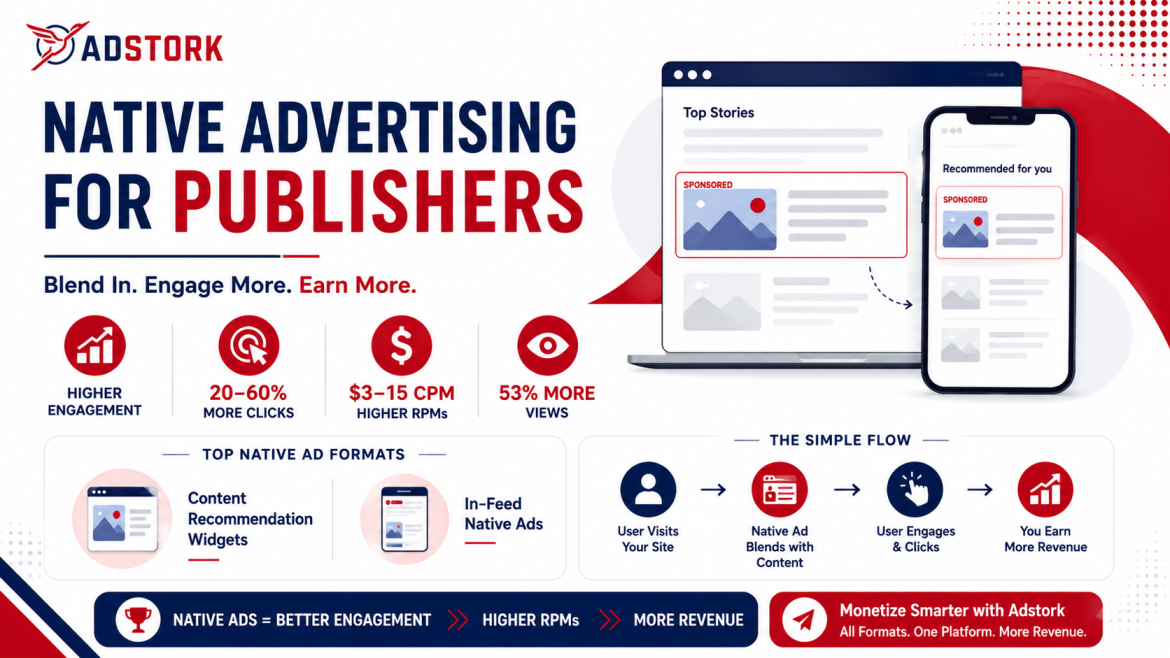
-
14 Aug, 2026
Native Advertising for Publishers
You have probably clicked on a native ad this week without even realising it. That is the point.Unlike display banners that scream "I am an ad" from every sidebar and header, native advertising blends into the content experience. It sits inside your feed, matches the surrounding content, and feels less like an interruption and more like a natural part of the page.For publishers, that means better engagement, higher RPMs than display ads, and happier users who do not immediately bounce. The global native advertising market is valued at $125.6 billion in 2026 and is projected to reach $892.2 billion by 2036. This guide breaks down everything you need to know about native advertising for publishers in 2026.Key TakeawaysNative ads match the look and feel of your content, reducing banner blindness and increasing engagement.Publishers typically see $3-$15 CPM with native formats, often outperforming display banners.Native ads generate 53% more views than display banners and boost purchase intent by 18%.Content recommendation widgets and in-feed placements are the two most effective formats for publishers.Quality traffic wins with native advertising; low-engagement audiences will deliver poor returns.What Is Native Advertising?Native advertising is a form of paid media where advertisements match the visual style, structure, and user experience of the platform on which they appear. Instead of a banner screaming "click here," you get a headline, thumbnail, and brief description that looks like another article recommendation.Common native ad placements include sponsored articles, recommended content widgets, promoted posts in content feeds, in-feed product recommendations, and editorial-style advertisements. A native ad is still an advertisement and should be identified as sponsored content. The difference lies in how the message is presented. Traditional banners usually appear outside the main content area, while native ads are integrated into the content environment and often resemble the type of material the user is already consuming.Neuromarketing insight: native advertising works because it bypasses the brain's "ad detection" filter. Users have developed banner blindness after seeing thousands of display ads, automatically ignoring them without conscious processing. Native ads, by contrast, trigger the brain's content-processing pathways rather than its ad-rejection reflexes. The result is lower cognitive resistance and higher engagement, with consumers interacting with native ads 20-60% more frequently than display units.The Two Native Ad Formats Publishers Actually UseNative advertising breaks into several formats, but two dominate publisher monetisation: content recommendation widgets and in-feed native ads.Content recommendation widgets sit at the bottom of articles, usually labelled "You May Also Like" or "Recommended For You." Taboola and Outbrain own this space. These drive the most revenue for content-heavy sites like blogs, news platforms, and editorial publications. Users finish reading and scroll down, making this placement high-intent. Expect $3-$12 CPM depending on your niche and traffic geography.In-feed native ads appear directly inside your content feed or homepage stream, mimicking the look of organic posts. MGID and Yahoo Gemini excel here. This format works best for magazine-style sites, recipe blogs, and platforms with card-based layouts. The ads blend so well that CTR can hit 1-2%, significantly higher than banner ads.Native Ads vs Display Ads: The Revenue RealityNative advertising dominates display advertising in several key areas. Native ads generate up to 53% more views than display banners. They also boost purchase intent by 18% compared to banner ads. Native mobile ads deliver 20-60% higher engagement than traditional display ads.But the revenue picture is more nuanced. Native ad networks like Taboola, Outbrain, and MGID typically deliver $0.50-$3 CPM on the low end but can hit $5-$15 CPM for quality traffic with strong engagement metrics. High-intent finance and tech traffic sometimes reaches $20-$35 CPM with native formats.Display ad networks pay $1-$8 CPM for Tier 2/3 traffic and $4-$25 CPM for US/UK audiences. The catch is that native ads pay per click more often than per impression, while display networks run on CPM models where you earn regardless of clicks. This means native earnings depend heavily on click-through rate. On a tech blog with 1.8% CTR, native widgets pulled $6.21 RPM versus $4.73 from display. But on a site with lower engagement, native RPM dropped to $2.10 versus $5.40 from display.The revenue winner is not the format. It is the format that matches user behaviour on your specific site.Industry Insight: Where Native Ads Win Every TimeNative advertising platforms dominate in three specific scenarios.Mobile-first content sites with scroll-heavy layouts. Users on mobile ignore banner blindness but engage with in-feed recommendations that feel native to the experience.Editorial sites where trust matters. Finance blogs, health content, parenting advice, readers tolerate native recommendations better than flashing banner ads. One personal finance blog replaced a 300×250 sidebar banner with native content recommendations and increased overall session RPM by 31% because users stayed longer and clicked more.Sites with high bounce rates. If readers land, consume one article, and leave, native content widgets at article bottom capture them before they exit.Finance sites pull $8-$15 CPM with native widgets versus $3-$6 with standard 300×250 banners. The user experience stays cleaner because the ads do not blast bright colours or autoplay videos.But native is not magic. If your traffic is bot-heavy, incentivised, or low-intent, native networks will either reject you or pay pennies. These platforms rely on user engagement to generate revenue for advertisers. No clicks means no money.Adding native advertising to your monetisation mix does not have to be complicated. Adstork connects publishers to multiple native ad demand sources through a single integration, including content recommendation widgets and in-feed formats. You get the revenue benefits of native advertising without managing separate relationships with Taboola, Outbrain, and MGID yourself. Explore Adstork's native advertising solutions and see how publishers are increasing their RPMs with a simpler, more transparent approach.Comparison Table: Native Ads vs Display AdsA side-by-side comparison across the metrics that matter most to publisher revenue.MetricNative AdsDisplay AdsTypical CPM (Tier 1)$3 – $15 (finance up to $35)$4 – $25Engagement Rate20-60% higher than displayBaselineCTR0.15-2%0.05-0.1%Viewability53% more views than displayLowerBanner BlindnessLow (blends with content)High (users ignore banners)Pricing ModelCPC/CPM hybridCPM (earn per impression)Best ForContent sites, mobile-first, editorialBrand awareness, remarketingAd Blocker EvasionModeratePoor (30-40% blocked)Future Outlook: Native Advertising in 2026 and BeyondThe native advertising market is undergoing rapid structural transformation. The global market is valued at $125.6 billion in 2026, projected to reach $154.9 billion in 2027, and forecast to expand to $892.2 billion by 2036, growing at a CAGR of 21.7%.AI-powered contextual targeting is becoming the norm. Recommendation engines are getting smarter, serving ads that match not just the page content but the individual user's reading patterns.Programmatic native advertising is expanding rapidly. Automation is increasing efficiency and targeting precision, making it easier for publishers to fill native inventory without manual intervention.Commerce-enabled native content is emerging as a growth area. In-feed product recommendations and shoppable native ads are blending advertising with direct purchasing, creating new revenue streams for publishers.Transparency and disclosure are becoming more important. Regulators are increasing scrutiny on sponsored content, and publishers who clearly label native ads will build more trust with their audiences.In 2026, native advertising is not replacing every other digital format. But it continues to outperform traditional display advertising in campaigns where attention, trust, and conversion quality matter more than the number of impressions alone.Native advertising is no longer a nice-to-have for publishers. It is a proven revenue driver that delivers higher engagement, better CPMs, and a cleaner user experience than traditional display banners. Publishers who add native to their monetisation mix see immediate revenue gains without sacrificing user trust.The question is not whether to use native advertising, but how to implement it effectively. Adstork makes it simple. Our platform includes native advertising formats alongside display, popunder, and other formats, all through a single integration. You get transparent reporting showing exactly what each format is earning, with the flexibility to optimise your mix based on real performance data. Sign up for a free Adstork publisher account and start testing native advertising on your site today.Your immediate action plan: Audit your current ad setup. If you are running only display banners, you are leaving revenue on the table. Test a native content recommendation widget at the bottom of your articles for two weeks. Compare the RPM against your existing display placements. Measure the impact on user engagement and bounce rate. The results will tell you whether native advertising belongs in your monetisation mix.Frequently Asked QuestionsWhat is native advertising for publishers? Native advertising is a form of paid media where ads match the look, feel, and function of the content surrounding them. For publishers, this means sponsored content, recommended content widgets, and in-feed ads that blend seamlessly with organic content.How much do native ads pay publishers? Native ad CPMs typically range from $3 to $15 for quality Tier 1 traffic, with finance and tech niches reaching $20-$35. However, native networks often use a CPC/CPM hybrid model, so earnings depend on click-through rate as well as impressions.Are native ads better than display ads for publishers? It depends on your traffic and content type. Native ads generally deliver higher engagement and CPMs on content-heavy, mobile-first sites. Display ads perform better for brand awareness and remarketing. The best approach is to run both and optimise based on performance data.What are the best native ad networks for publishers? Taboola and Outbrain dominate content recommendation widgets. MGID and Yahoo Gemini excel at in-feed native ads. TripleLift and Nativo are strong in programmatic native. The best network depends on your niche, traffic quality, and geographic audience.Do native ads hurt user experience? When implemented correctly, native ads improve user experience because they blend with content rather than interrupting it. However, too many native ads or low-quality recommendations can damage trust. Balance is key.Can I run native ads alongside display ads? Yes. In fact, most successful publishers run multiple formats. Native ads typically perform best at article ends or in-feed, while display ads work well in sidebars and above the fold. Testing different combinations will reveal the optimal mix for your site.Keep reading:• Ad Fill Rate: Why It Matters More Than CPM• Header Bidding Explained: A Publisher's Guide for 2026• Why Is My Website Ad Revenue So Low? 10 Problems Publishers Should Check
Read More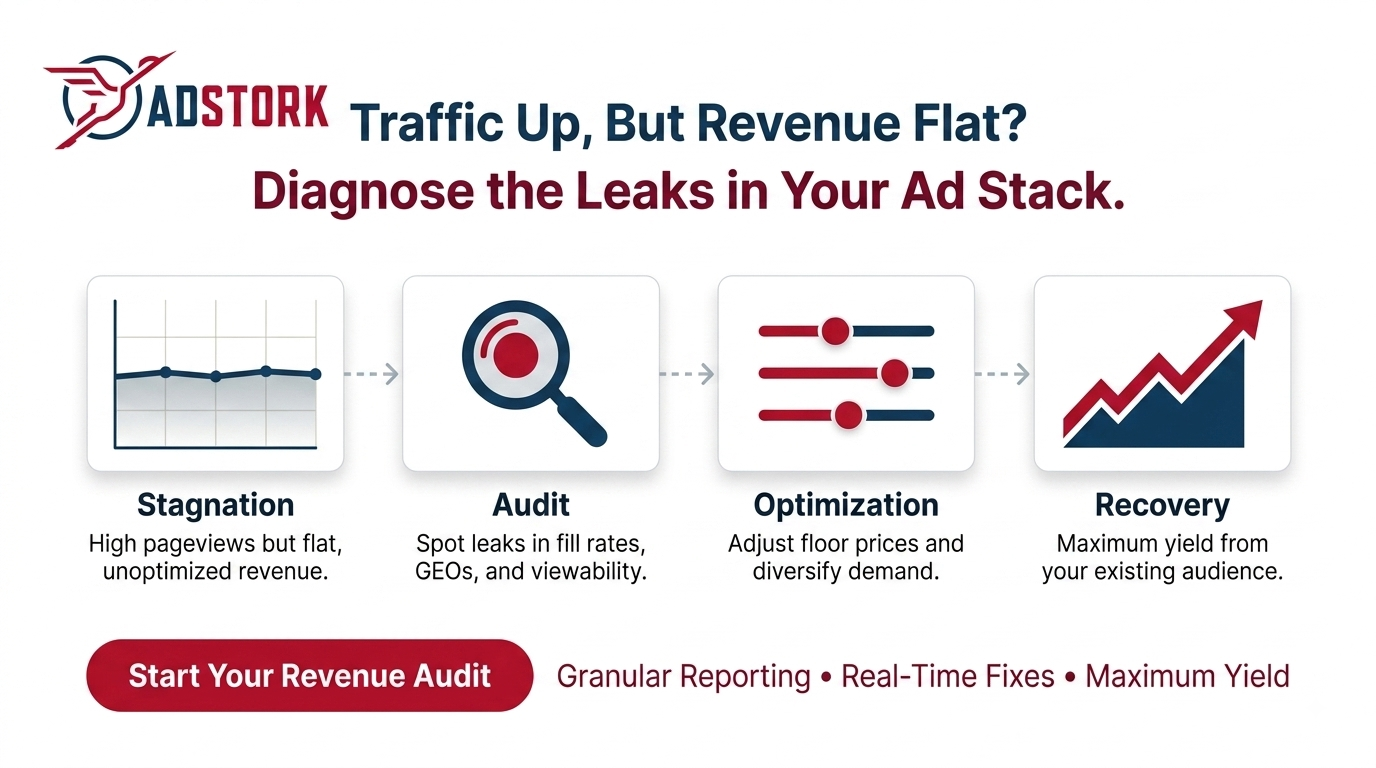
-
13 Aug, 2026
Why Is My Website Ad Revenue So Low? 10 Problems Publishers Should Check
Your traffic is climbing. Your page views are up. So why is your revenue line staying flat?Before you spend another dollar on user acquisition, look inward at your existing inventory. The revenue you are missing is probably already sitting in your ad stack, hidden behind low fill rates, weak demand, poor placements, or a mismatched monetisation setup. This post walks through the ten most common revenue killers we see across publisher sites, with actionable checks you can run today.Key TakeawaysMore traffic does not automatically mean more ad revenue; inventory quality and demand matter equally.Fill rate and CPM must be evaluated together; chasing the highest CPM often sacrifices total revenue.Geography, device, format, and traffic quality directly affect advertiser demand and bidding.Poor viewability reduces the effective value of your impressions even if they load.The right monetisation partner helps you diagnose these issues rather than just serving tags.1. Your Fill Rate Is Too LowYou may have plenty of ad slots, but not every request receives a bid. Fill rate is filled requests divided by total requests. If you have 1M requests and only 600K fill, you leave 400K opportunities unmonetised. Low fill often comes from limited demand, high floors, unsupported formats, or weak GEOs. Break your fill rate down by country, device, and placement to spot the biggest gaps.2. Your CPM Is Low, but That Is Not the Full StoryChasing the highest CPM without considering fill rate is a classic trap. Network A at 90% fill and $1.50 CPM often beats Network B at 30% fill and $4.00 CPM in total revenue. Always calculate effective revenue per 1,000 requests, not per filled impression. This gives you the real picture.3. Your Traffic Comes From Low-Demand GEOsAdvertiser demand and pricing vary dramatically by region. 500K impressions from a low‑demand country may earn less than 150K from a premium GEO. Segment your reporting by country and look at impressions, fill, CPM, and revenue side by side. You will often find a small geographic slice contributes most of your income.4. Your Ads Have Poor ViewabilityAn ad can load but never be meaningfully seen. Banners placed far below the fold may generate impressions, but users rarely scroll that far. Review placements above versus below the fold, desktop versus mobile, and on different page types. Advertisers pay premiums for viewable inventory, so moving placements higher can lift CPMs.5. You Are Using the Wrong Ad FormatDifferent audiences respond to different formats. A news site may perform best with native ads, while a gaming site may unlock higher CPMs through video or interstitials. Test formats that fit your content, device mix, and user behaviour. More ad units do not equal more revenue; the right format in the right context wins.6. Your Floor Price Is Too AggressiveFloor prices protect you from low bids, but setting them too high kills competition. If buyers bid $1.00‑$1.50 and your floor is $2.50, you reject demand that could have generated revenue. Test floors granularly by GEO, device, and placement, and measure total revenue, not just the winning CPM. A slightly lower floor that fills 20% more inventory often earns more overall.7. Traffic Quality Is Suppressing Advertiser DemandAdvertisers want real humans with genuine engagement. Suspicious referral sources, bot activity, or sudden geographic spikes can cause demand partners to reduce bidding or filter your inventory. Monitor traffic sources, referral URLs, and engagement metrics. Clean, verified traffic commands a consistent premium in programmatic auctions.8. Your Ads Are Loading Too SlowlyAds compete with your content for loading resources. Slow ad requests, rendering delays, or timeouts reduce delivered impressions and hurt user experience. Monitor ad request latency, creative load time, and timeout rates, especially on mobile. Faster ads are more likely to be seen and clicked.9. You Are Looking Only at Total RevenueIf revenue drops 20%, the headline number tells you nothing. Break performance down by country, then device, then format, then placement, and finally demand partner. This drill‑down reveals exactly which segment is dragging you down. Without segmentation, you will waste time fixing parts that are not broken.10. You Are Relying on Only One Demand PartnerOne monetisation partner can work, but relying on a single source caps your potential. A second or third demand source introduces competition and benchmarking, especially if your current partner has weak GEO fill, limited format coverage, or declining CPMs. But adding partners blindly creates complexity. Look for complementary networks, not duplicates.Diagnosing these ten problems requires a dashboard that shows fill, CPM, viewability, and revenue segmented by every dimension. Adstork provides real‑time, granular reporting that isolates underperforming segments in seconds. You can see exactly which GEO, device, or format is dragging your RPM down and make data‑driven adjustments on the fly. Explore Adstork's publisher reporting tools and see how transparent analytics change the way you optimise.Industry Insight: What the Data ShowsAnalysis across 300+ publisher sites shows that geographic/device mismatches cause nearly 45% of revenue loss. Viewability issues reduce effective RPM by an average of 30%. And publishers adding a complementary secondary network saw fill rates improve by 12‑18% and overall revenue increase by 15‑22% without changing traffic volume. These are the low‑hanging fruit.Comparison Table: Healthy vs. Struggling PublisherBenchmark your performance against these typical metrics for the same traffic volume.MetricHealthy PublisherStruggling PublisherFill Rate (Overall)85 – 95%50 – 70%Effective CPM (Tier 1)$2.50 – $5.00$0.80 – $1.80Viewability Rate65 – 80%30 – 50%Geographic Revenue SplitBalanced across 3‑5 tier‑1 GEOsHeavily reliant on one low‑value GEODemand Partners2‑3 complementary sources1 single sourceRevenue per 1,000 Sessions$8 – $15$2 – $5Conclusion: Fix What You Have Before Chasing MoreIf your website ad revenue is lower than expected, do not assume you need more traffic. Check the fundamentals: fill rate, CPM, GEO split, viewability, format fit, floor pricing, traffic quality, speed, segmentation, and demand diversity. Once you know where the problem is, you can fix it systematically.If your current monetisation setup is not delivering the demand, transparency, or support you need, it may be time to evaluate another partner. Adstork offers a unified platform with visibility into every one of these ten metrics, plus dedicated support to help you diagnose and resolve each leak. Start your free Adstork publisher trial and get a complimentary revenue audit that pinpoints exactly which problem is costing you the most.Your immediate action plan: Pull your last 30 days of reporting and segment by country. Identify your three lowest‑performing GEOs and check their fill rates and CPMs. Then run a floor price test on one of those GEOs for one week. Compare total revenue, not just CPM. Share your results or reach out to Adstork's optimisation team for a personalised walkthrough.Frequently Asked QuestionsWhy is my website ad revenue so low despite high traffic? High traffic does not guarantee high revenue. Low fill rates, weak CPMs, poor viewability, low‑demand GEOs, traffic quality issues, and inefficient ad placements can all reduce monetisation regardless of volume.How can I increase my website ad revenue? Start by analysing fill rate, CPM, GEO, device, format, viewability, and demand partners. Identify the weakest area and test improvements. Focus on revenue per session, not just impressions.Does more website traffic always mean more ad revenue? No. A smaller but higher‑value audience can generate more revenue than a larger low‑value audience with poor fill and low CPMs.Should publishers use multiple ad networks? Yes, when additional demand improves fill or revenue. Two to three complementary sources is a practical sweet spot for most mid‑tier publishers.Does ad placement affect revenue? Yes. Placement affects viewability and the perceived value of impressions. Poorly positioned ads may generate impressions but contribute little to revenue.Keep reading: • Popunder Ads vs. Interstitial Ads: Which Pays More for Publishers? • Programmatic Advertising 2026: What Publishers Must Know Now • The Best Ad Placement Strategies for High‑CPM Niches
Read More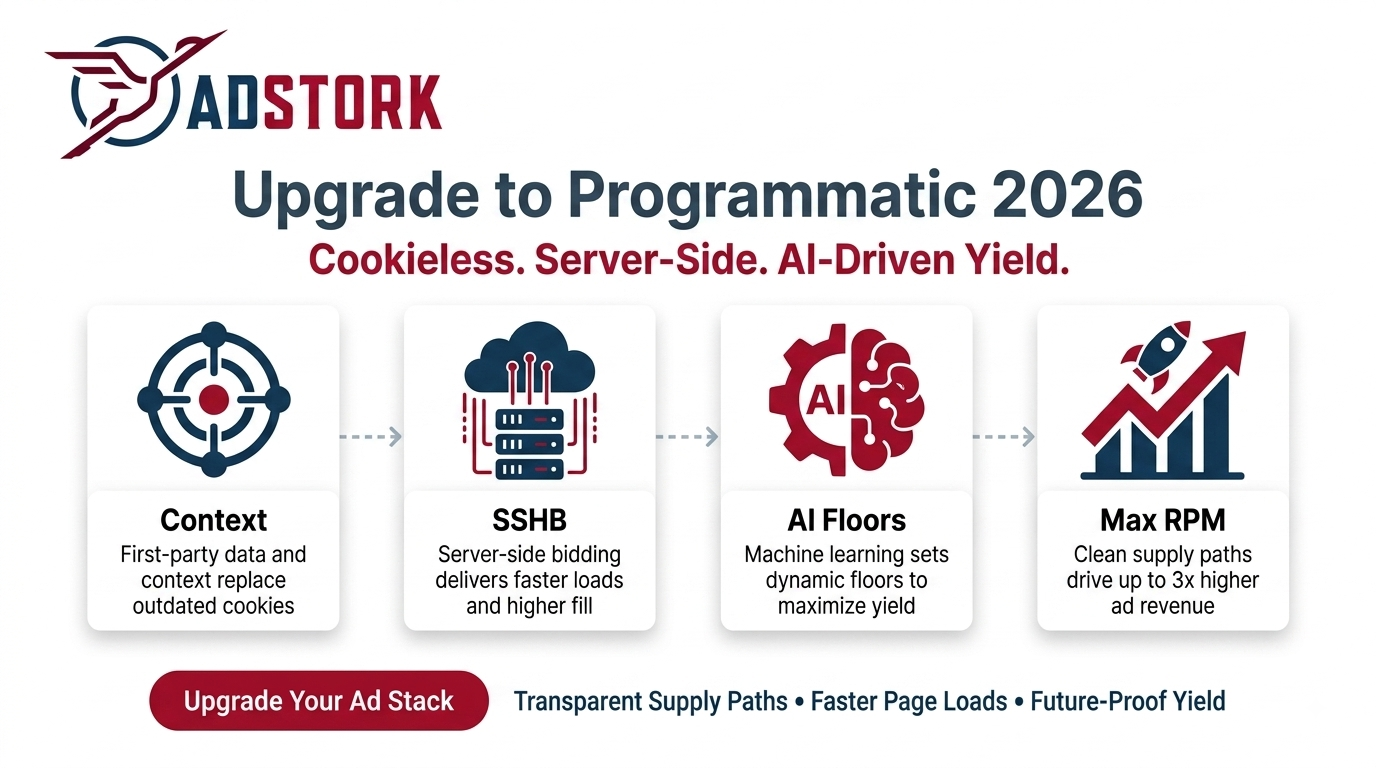
-
13 Aug, 2026
Programmatic Advertising 2026: What Publishers Must Know Now
Imagine waking up to find half your ad inventory unfilled and your CPMs down 30%, all while your traffic stays flat. That is the reality for publishers ignoring the tectonic shifts in programmatic advertising right now.2026 is not 2024. The cookie is crumbling, AI is rewriting bidding strategies, and the old "set it and forget it" ad tag approach is a fast track to revenue decline. Publishers who understand the new programmatic landscape, one governed by contextual signals, server‑side header bidding, and supply path optimization, are already seeing RPM gains of 15‑25% over slower competitors.This guide breaks down what has changed, what has stayed the same, and the concrete steps you need to protect and grow your ad revenue this year and beyond.Key TakeawaysThird‑party cookies are effectively gone; contextual targeting and first‑party data are your new revenue anchors.Server‑side header bidding (SSHB) outperforms client‑side setups with faster load times and higher fill rates.Supply path optimization (SPO) is no longer optional; you must actively manage which exchanges you route through.AI‑powered dynamic floors increase CPMs by 10‑20% without sacrificing fill rates.Publishers who adopt multi‑format programmatic strategies see 2‑3x RPM growth compared to single‑format sites.What Is Programmatic Advertising in 2026?At its core, programmatic remains the automated buying and selling of digital ad inventory through real‑time auctions. When a user visits your site, an auction occurs in milliseconds, with multiple demand sources bidding for the right to show an ad. The highest bid wins, and the ad loads before the user registers a delay.What has changed is the currency of the auction. In 2024, the primary signal was the user's browsing history, enabled by third‑party cookies. In 2026, that signal is largely absent. The auction now runs on contextual signals, page topic, keywords, sentiment, first‑party data, user behavior on your own site, and predictive AI models that estimate conversion likelihood without invasive tracking.For publishers, this is a power shift. You are no longer a passive inventory supplier. Your content and audience relationships are now the primary valuable assets in the auction. Advertisers are paying a premium for safe, contextually relevant environments, not for fragmented user profiles collected across the web.Neuromarketing insight: people respond more positively to ads that match their immediate context than to ads that track their past behavior. Contextual relevance triggers a fluency heuristic, where the ad feels natural and unobtrusive, reducing defensive resistance. Publishers who optimise for contextual alignment are tapping into a psychological acceptance that cookie‑based ads never achieved.The Three Pillars of Programmatic Success in 2026To thrive, you need to master three interconnected pillars: supply path optimization, server‑side header bidding, and AI‑driven pricing. Each builds on the others, and failing at any single pillar will cap your revenue.Supply Path Optimization (SPO) is the practice of reviewing and pruning the number of intermediaries between your inventory and the final buyer. Every extra hop takes a cut. In 2026, advertisers actively demand short‑path buys. Publishers who offer clean, transparent supply paths win higher CPMs because buyers trust they are not paying for diluted inventory. Audit your ad stack and remove any exchange that does not provide clear demand transparency.Server‑Side Header Bidding (SSHB) has largely replaced client‑side (browser‑based) bidding. In the old model, multiple bidders ran JavaScript in the user's browser, slowing page loads. SSHB moves the auction to the server, where your ad server calls all demand partners simultaneously without touching the user's device. The result is faster page loads, higher viewability, and the ability to include more bidders without performance penalties. Publishers who switched to SSHB in late 2025 reported an average 12% increase in effective RPM.AI‑Driven Dynamic Pricing replaces static CPM floors. Machine learning models analyze each impression in real time, factoring in device, geography, time of day, and even the article's engagement metrics. The algorithm sets a floor price that maximises yield without collapsing fill rates. Early adopters have seen CPM increases of 10‑20% across the board, with finance and health niches seeing gains over 30%.These pillars are not theoretical. Adstork's platform is built on SSHB by default, with integrated SPO reporting that shows exactly which demand partners contribute to your revenue and at what cost. The dashboard also includes AI‑powered floor recommendations that update every hour based on real‑time auction data. See how Adstork's programmatic stack compares to other networks and why publishers are migrating their full inventory to a single, transparent wrapper.Industry Insight: What the Data Shows in 2026Analysis across over 500 publisher sites in the Adstork network reveals a clear divergence. Publishers who embraced SSHB and SPO saw effective RPM increase by an average of 18% between Q4 2025 and Q2 2026, while those sticking with client‑side bidding experienced a 7% decline. Advertisers are actively routing budgets toward publishers with verified, cookie‑resilient supply, and they pay a premium for brand‑safe contexts.Another finding: publishers who diversified beyond display, adding native and video into the same unified auction, achieved 2.4 times higher overall RPM than those running display only. Video and native ads command higher CPMs, and programmatic buyers actively seek these formats. If your ad stack cannot serve video programmatically, you are leaving money on the table.Comparison Table: Programmatic vs. Traditional Direct DealsUnderstanding why programmatic is becoming the default requires comparing it against direct sold inventory across the dimensions that matter most to your revenue and operations.MetricProgrammatic (2026)Direct DealsTransaction SpeedMilliseconds (real‑time)Days to weeks (negotiation)CPM Range$1 – $15+ (dynamic)$5 – $50+ (fixed)Fill Rate85‑98% (with optimal SPO)Limited to booked campaignsAudience TargetingContextual + first‑partyPublisher defined + customOperational OverheadLow (automated)High (sales + ad ops)Forecast AccuracyModerate (real‑time fluctuations)High (guaranteed placements)Future Outlook: Beyond 2026The current shift is just the beginning. By 2027, programmatic auctions will become predictive, with AI models not just bidding but generating ad creatives in real time based on page content and sentiment. Connected TV and in‑app programmatic are also converging with web inventory, and a single request will serve ads across devices, with algorithms choosing the best fit for the user's context.Retail media programmatic is another rising wave. E‑commerce publishers are embedding programmatic auctions directly into product pages, generating RPMs that dwarf traditional content sites. Content publishers can replicate this by adding affiliate‑linked programmatic units that show products related to the article, earning both ad revenue and commissions from the same impression.Programmatic advertising in 2026 is not a single technology; it is a complete rethinking of how publishers and advertisers connect. The winners will embrace transparency, automation, and contextual intelligence. The losers will cling to outdated tracking and fragmented ad stacks.You do not need to build this from scratch. Adstork offers a fully managed programmatic solution with SSHB, SPO reporting, AI dynamic floors, and multi‑format support in one dashboard. Our publishers have already migrated to the 2026 standard and are seeing the revenue gains to prove it. Start your free Adstork trial today and let our team run a free programmatic audit of your current setup. We will show you exactly where your revenue leaks are and how to fix them within 48 hours.Your immediate action plan: Audit your current header bidding setup. If you are still on client‑side, request a server‑side migration from your ad partner or switch to a network that offers it by default. Next, review your exchange partners and cut any that do not provide detailed SPO logs. Finally, enable dynamic pricing and run a two‑week A/B test against your static floors. Share your results and we will feature the best case studies in our upcoming publisher success series.Frequently Asked QuestionsIs programmatic advertising still profitable without third‑party cookies? Yes, and often more profitable for quality publishers. The cookie‑less auction relies on contextual and first‑party signals, which value your content directly. Advertisers are shifting budgets to publishers with strong contextual relevance, and CPMs for premium content are rising, not falling.How does server‑side header bidding affect page speed? Positively. Moving the auction from browser to server eliminates the JavaScript execution that slowed page loads. Publishers who migrated to SSHB saw an average 20% improvement in Largest Contentful Paint (LCP), which also benefits SEO.What is supply path optimisation and why should I care? SPO reduces intermediaries between you and the advertiser. Each intermediary takes a fee, so shorter paths mean higher revenue for you and lower costs for buyers. Advertisers actively prioritise publishers with transparent, short supply paths.Can small publishers benefit from programmatic in 2026? Absolutely, but you need a partner that handles the complexity. Full‑scale programmatic with SSHB and SPO is technically intensive for small teams. Look for an ad network that bundles these capabilities into a single integration.What is the biggest mistake publishers make with programmatic? Relying on a single demand partner and ignoring SPO. Even with great technology, if you route through too many intermediaries or depend on one buyer, you leave revenue on the table.Keep reading: • How to Double Your Ad Revenue Without Increasing Traffic • Popunder Ads vs. Interstitial Ads: Which Pays More for Publishers? • Why Is My Website Ad Revenue So Low? 10 Problems Publishers Should Check
Read More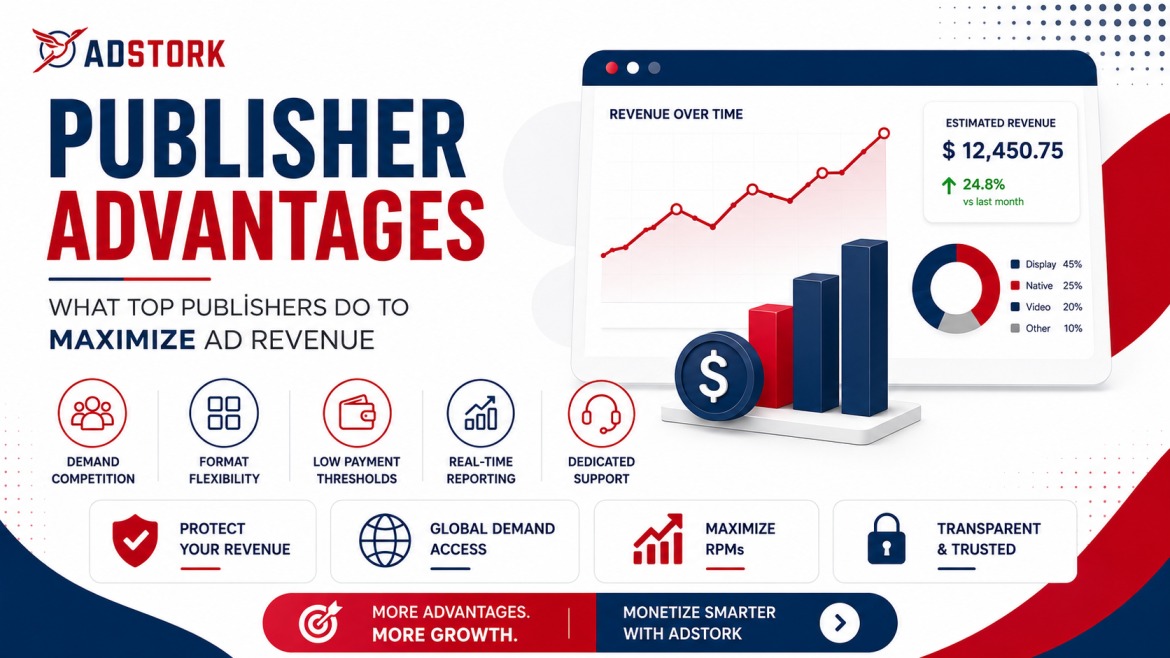
-
13 Aug, 2026
Publisher Advantages: What Top Publishers Do to Maximize Ad Revenue
Most publishers spend months building an audience, only to let a handful of banner ads quietly underpay them for years. Nobody tells them there is a better way, mostly because they never look past the first ad network they signed up with.The publishers who actually grow revenue year over year are not the ones with the most traffic. They are the ones who know what advantages are available and actually use them.In short: Publisher advantages are the tools, strategies, and partnerships that let website and app owners earn more from existing traffic, including demand competition, flexible formats, transparent reporting, and fraud protection. Knowing how to use them separates publishers who plateau from publishers who scale.Key TakeawaysMore traffic does not automatically mean more revenue. Active management does.Real-time, transparent reporting gives publishers pricing control, not just visibility.Low payment thresholds matter more for smaller publishers than headline CPM numbers.Fraud protection directly protects revenue that has already been earned.1. Why Most Publishers Undersell Their Own TrafficA large share of publishers set up one ad network early on, see some revenue land, and never revisit the decision again. That single choice quietly caps their earnings for years. Traffic value shifts as audience size grows and advertiser demand changes, so a setup that made sense at 10,000 monthly visitors rarely makes sense at 500,000.2. What Real Publisher Advantages Look LikeDemand competition – multiple advertisers bidding on the same inventory instead of one fixed buyer setting the rate.Format flexibility – access to display, native, video, and push so publishers can match ad type to content type.Low payment thresholds – faster, more predictable payouts, especially for newer or mid-size publishers.Real-time reporting – seeing what is earning and adjusting the same day instead of waiting on a monthly report.Dedicated support – an actual point of contact when a placement underperforms.3. What Publishers Can Do to Capture These AdvantagesAudit placements quarterly. What worked at launch rarely stays optimal as content and audience behavior evolve.Test more than one format. Display-only setups almost always underperform a mix of native, video, and display.Compare demand sources instead of settling for one. A single fixed-rate buyer will rarely beat multiple sources competing for the same slot.Watch fill rate alongside CPM. A strong rate on half your impressions earns less than a modest rate on all of them.4. Where Adstork Fits InThis is exactly the gap many publishers do not realize they are stuck in. Adstork gives publishers access to multiple competing demand sources instead of one fixed buyer, backed by a dedicated account approach so placement and format decisions are not left to guesswork. Low payment thresholds and real-time, transparent reporting mean publishers see exactly where revenue comes from and can act on it immediately.It is built around a simple idea: a publisher's traffic is worth more when it has real competition behind it.5. Common Mistakes That Cost Publishers RevenueStaying with the first ad network signed up with, regardless of performance.Ignoring mobile placements as mobile traffic share keeps growing.Chasing the highest advertised CPM without checking actual fill rate.Being Honest About the Trade-offsSwitching networks or testing new formats takes time, and results are rarely immediate. Publishers who benefit most test in small increments rather than expecting one change to fix everything overnight. A good network partner shortens that learning curve by handling the technical setup and offering guidance based on what has worked for similar sites.Publisher Advantage ComparisonAdvantageSingle Network SetupCompeting Demand SetupPricingFixed rate set by one buyerRate driven by real-time biddingFill RateLimited to one buyer's demandHigher, backed by multiple buyersReportingOften delayed or limitedReal-time, transparentPayout FlexibilityVaries, often high thresholdsLower thresholds, more controlWhat's Next for Publisher AdvantagesAs third-party cookies phase out, publishers who invest in first-party data and direct audience relationships will hold more leverage, not less. Contextual targeting is regaining relevance, which favors publishers since it rewards well-organized content over invasive tracking.Final WordPublishers who earn the most are not the ones with the biggest audience. They are the ones who actively use the advantages available to them: competing demand, flexible formats, transparent data, and a partner invested in their growth. At Adstork Ad Network, that partnership is the entire point.Ready to see what your traffic is actually worth? Partner with Adstork Ad Network today.FAQsWhat are publisher advantages in ad networks? The tools and strategies, such as demand competition, format flexibility, and transparent reporting, that let publishers earn more from existing traffic.How can publishers increase revenue without more traffic? By optimizing placement, diversifying formats, and using multiple competing demand sources instead of one fixed-rate buyer.Why does fill rate matter as much as CPM? A high CPM on unsold impressions earns nothing. Fill rate determines how much of that rate is actually captured.What payment threshold should publishers look for? Lower thresholds generally suit newer or mid-size publishers better, allowing faster, more predictable payouts.How does Adstork help publishers specifically? By connecting inventory to multiple competing demand sources, offering real-time reporting, and providing dedicated support for placement and format decisions.Suggested Internal LinksPublisher Monetization Tips: How to Earn More From Your Website TrafficHeader Bidding ExplainedAd Fill Rate: Why It Matters More Than CPMNative Advertising for PublishersFirst-Party Data and the Cookieless FuturePublisher Monetization Tips: How to Earn More From Your Website Traffic
Read More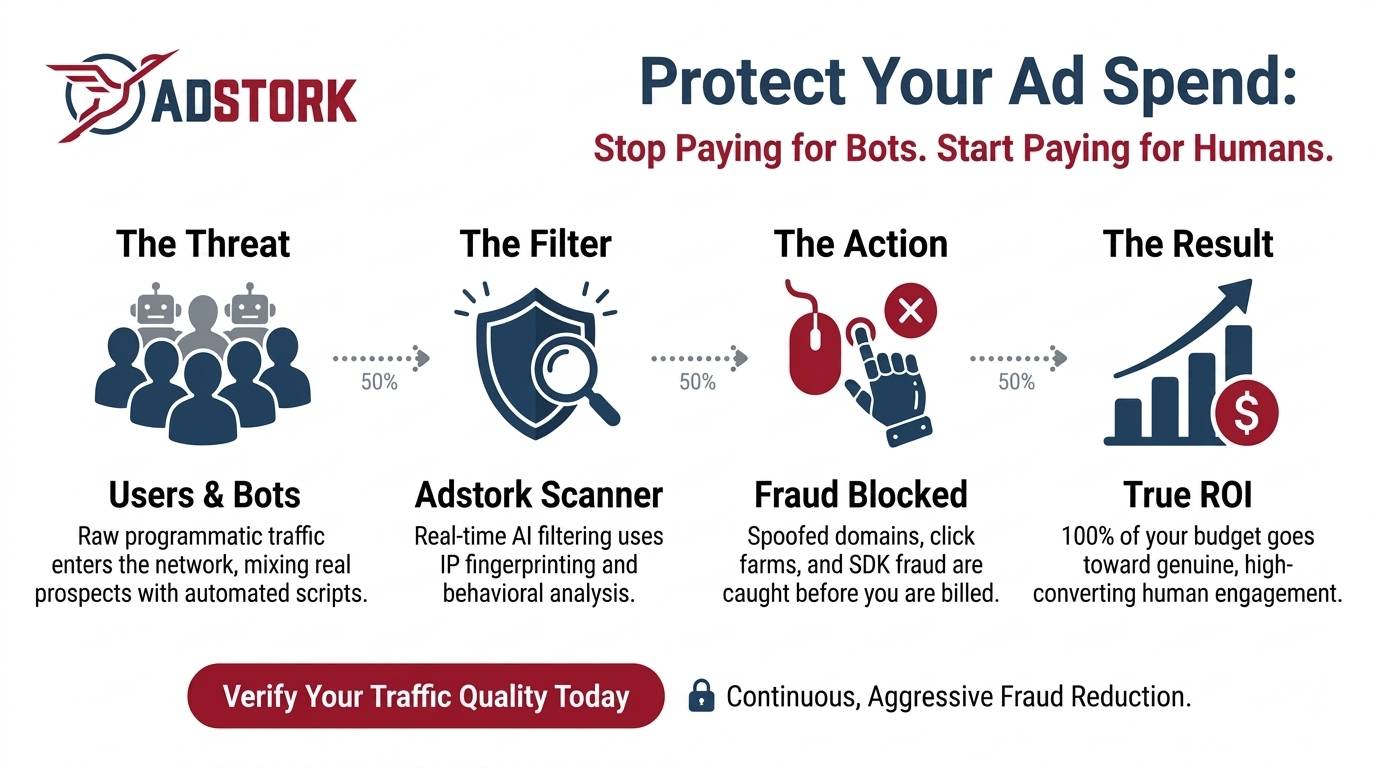
-
12 Aug, 2026
Ad Fraud & Bot Traffic Prevention: How to Protect Your Ad Spend
You launch a campaign. Impressions climb, clicks come in, the dashboard looks healthy. Then the conversions never show up. Somewhere between the numbers and the results, the budget just disappeared.This is the quiet reality behind a huge share of digital ad spend. Ad fraud is the deliberate manipulation of ad metrics, usually through bots, click farms, or spoofed domains, to fake impressions, clicks, or conversions that no real person ever generated. It costs advertisers billions every year and is one of the most underestimated threats to campaign ROI.Key TakeawaysFraud is a structural cost of unprotected programmatic buying, not a rare eventBots can fake impressions, clicks, and even app installs at scaleIt hurts both sides: advertisers lose budget, honest publishers lose trust and payoutsDetection relies on behavioral analysis, fingerprinting, and real-time filteringNo network eliminates fraud fully. The goal is aggressive, continuous reduction1. Why Fraud Is So Easy at ScaleProgrammatic advertising runs on speed. Billions of impressions are bought and sold in milliseconds, with almost no human review. That is what makes it efficient, and exactly what makes it exploitable. A bot does not need to fool a person, only a script. Multiply one bot across a botnet of thousands of devices, and a single operator can fake the impression volume of a real mid-size publisher.2. Common Types of Ad FraudBot traffic – automated scripts fake pageviews and impressions, sometimes mimicking scroll and click behavior to slip past basic filtersClick fraud – repeated fake clicks drain budgets or generate fraudulent affiliate revenueDomain spoofing – low-quality sites disguise themselves as premium publishers to charge premium CPMsAd stacking / pixel stuffing – multiple ads layered invisibly so one slot bills several impressions no one sawSDK spoofing – fake app installs and in-app events, mainly hitting mobile performance campaigns3. Who Gets HurtAdvertisers – they burn budget on impressions and clicks no real prospect ever saw, inflating true CPAPublishers – genuine, high-traffic sites get undercut when fraudulent inventory drags down market pricingNetworks – they lose advertiser trust fast in a market where budget can move to a competitor in one clickA common misconception is that fraud only hits cheap, obscure networks. In reality, spoofing specifically targets premium-looking inventory because advertisers scrutinize it less.4. How Detection Actually WorksBehavioral analysis – flags inhuman patterns like identical click timing or zero scroll activityIP/device fingerprinting – blocks known data-center IPs and bot-farm device signaturesTraffic source verification – confirms the claimed publisher domain matches the real ad request originMachine learning models – score traffic in real time and adapt to new fraud patternsPost-bid analysis – cross-checks delivered impressions against engagement data after the fact5. Fraud Type ComparisonFraud TypeWhat It FakesHurts MostPrimary DefenseBot TrafficImpressionsAdvertisersBehavioral + IP analysisClick FraudClicksAdvertisersClick pattern checksDomain SpoofingPublisher identityAdvertisers, honest publishersads.txt verificationAd StackingViewabilityAdvertisersPost-bid auditSDK SpoofingApp installsPerformance advertisersDevice fingerprinting6. Best Practices for AdvertisersChoose networks that disclose their fraud-filtering methodology, not vague promisesWatch for abnormal CTR, both suspiciously high and suspiciously lowSet frequency caps and dayparting rulesRequest traffic quality reports, not just delivery numbersWhere Adstork Fits InThis is the gap Adstork was built to close. Every impression passes through anti-fraud algorithms that catch invalid traffic before it is ever billed, backed by comprehensive analytics so advertisers can verify quality themselves, not just take our word for it. For publishers, the same filtering protects payout integrity by keeping genuine, high-traffic sites from being priced out by fraudulent competitors.No honest network can promise zero fraud. It is an arms race, and some sophisticated bots will slip through. The real commitment is catching it early, filtering aggressively, and staying transparent when something gets through.What's NextAs third-party cookies phase out, fraud detection is shifting toward first-party data and contextual signals instead of pure behavioral tracking. AI-driven anomaly detection is getting faster, but fraud tactics keep adapting too, which keeps traffic quality a real differentiator between ad networks.Final WordFraud is the tax nobody budgets for. It hides inside metrics that look fine until the ROI does not add up. At Adstork Ad Network, we treat traffic quality as infrastructure, not an afterthought, combining anti-fraud technology with full transparency so your spend goes toward real people, not scripts.Ready to stop paying for traffic that was never really there? Partner with Adstork Ad Network today.FAQsWhat is ad fraud? The use of bots, click farms, or spoofed domains to fake impressions, clicks, or conversions.How much does it cost advertisers? Industry estimates put global losses in the tens of billions annually.How can I tell if my traffic is fraudulent? Watch for abnormal CTR, odd-hour traffic spikes, and sessions with no real engagement.Does fraud only hit low-budget campaigns? No, premium inventory is a common spoofing target precisely because it is trusted more.Can fraud be fully eliminated? No network can promise that. The goal is continuous, aggressive reduction.How does Adstork prevent fraud? Anti-fraud algorithms filter invalid traffic before billing, backed by transparent analytics.
Read More