- 13 Aug, 2026
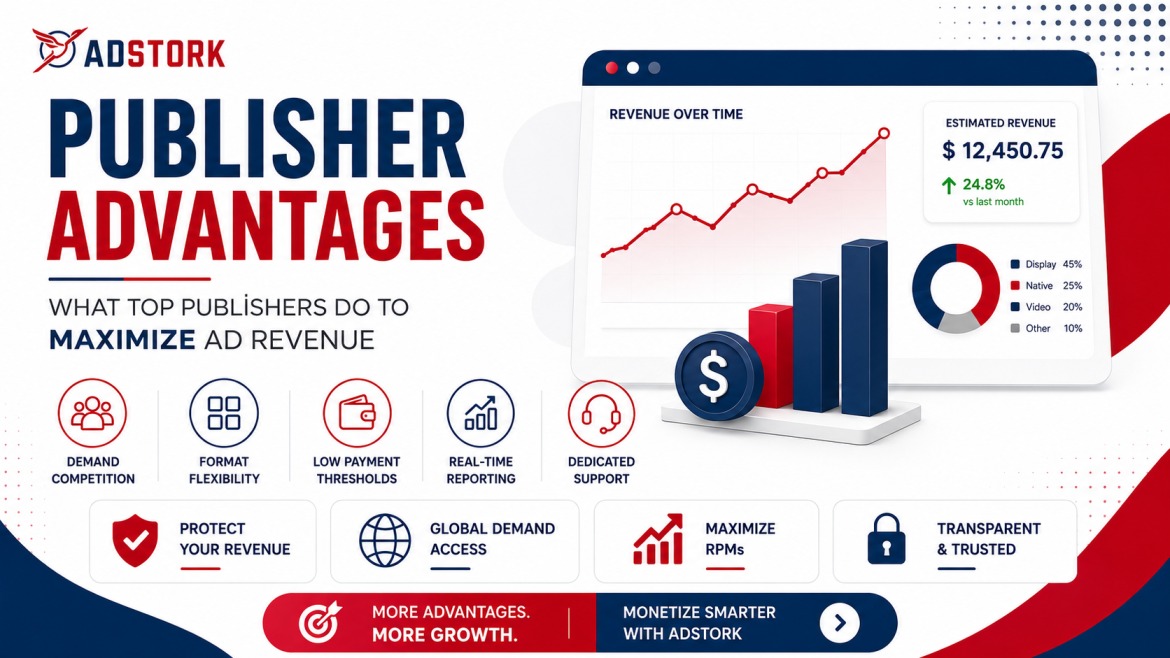
Publisher Advantages: What Top Publishers Do to Maximize Ad Revenue
Most publishers spend months building an audience, only to let a handful of banner ads quietly underpay them for years. Nobody tells them there is a better way, mostly because they never look past the first ad network they signed up with.
The publishers who actually grow revenue year over year are not the ones with the most traffic. They are the ones who know what advantages are available and actually use them.
In short: Publisher advantages are the tools, strategies, and partnerships that let website and app owners earn more from existing traffic, including demand competition, flexible formats, transparent reporting, and fraud protection. Knowing how to use them separates publishers who plateau from publishers who scale.
Key Takeaways
- More traffic does not automatically mean more revenue. Active management does.
- Real-time, transparent reporting gives publishers pricing control, not just visibility.
- Low payment thresholds matter more for smaller publishers than headline CPM numbers.
- Fraud protection directly protects revenue that has already been earned.
1. Why Most Publishers Undersell Their Own Traffic
A large share of publishers set up one ad network early on, see some revenue land, and never revisit the decision again. That single choice quietly caps their earnings for years. Traffic value shifts as audience size grows and advertiser demand changes, so a setup that made sense at 10,000 monthly visitors rarely makes sense at 500,000.
2. What Real Publisher Advantages Look Like
- Demand competition – multiple advertisers bidding on the same inventory instead of one fixed buyer setting the rate.
- Format flexibility – access to display, native, video, and push so publishers can match ad type to content type.
- Low payment thresholds – faster, more predictable payouts, especially for newer or mid-size publishers.
- Real-time reporting – seeing what is earning and adjusting the same day instead of waiting on a monthly report.
- Dedicated support – an actual point of contact when a placement underperforms.
3. What Publishers Can Do to Capture These Advantages
- Audit placements quarterly. What worked at launch rarely stays optimal as content and audience behavior evolve.
- Test more than one format. Display-only setups almost always underperform a mix of native, video, and display.
- Compare demand sources instead of settling for one. A single fixed-rate buyer will rarely beat multiple sources competing for the same slot.
- Watch fill rate alongside CPM. A strong rate on half your impressions earns less than a modest rate on all of them.
4. Where Adstork Fits In
This is exactly the gap many publishers do not realize they are stuck in. Adstork gives publishers access to multiple competing demand sources instead of one fixed buyer, backed by a dedicated account approach so placement and format decisions are not left to guesswork. Low payment thresholds and real-time, transparent reporting mean publishers see exactly where revenue comes from and can act on it immediately.
It is built around a simple idea: a publisher's traffic is worth more when it has real competition behind it.
5. Common Mistakes That Cost Publishers Revenue
- Staying with the first ad network signed up with, regardless of performance.
- Ignoring mobile placements as mobile traffic share keeps growing.
- Chasing the highest advertised CPM without checking actual fill rate.
Being Honest About the Trade-offs
Switching networks or testing new formats takes time, and results are rarely immediate. Publishers who benefit most test in small increments rather than expecting one change to fix everything overnight. A good network partner shortens that learning curve by handling the technical setup and offering guidance based on what has worked for similar sites.
Publisher Advantage Comparison
| Advantage | Single Network Setup | Competing Demand Setup |
|---|---|---|
| Pricing | Fixed rate set by one buyer | Rate driven by real-time bidding |
| Fill Rate | Limited to one buyer's demand | Higher, backed by multiple buyers |
| Reporting | Often delayed or limited | Real-time, transparent |
| Payout Flexibility | Varies, often high thresholds | Lower thresholds, more control |
What's Next for Publisher Advantages
As third-party cookies phase out, publishers who invest in first-party data and direct audience relationships will hold more leverage, not less. Contextual targeting is regaining relevance, which favors publishers since it rewards well-organized content over invasive tracking.
Final Word
Publishers who earn the most are not the ones with the biggest audience. They are the ones who actively use the advantages available to them: competing demand, flexible formats, transparent data, and a partner invested in their growth. At Adstork Ad Network, that partnership is the entire point.
Ready to see what your traffic is actually worth? Partner with Adstork Ad Network today.
FAQs
What are publisher advantages in ad networks? The tools and strategies, such as demand competition, format flexibility, and transparent reporting, that let publishers earn more from existing traffic.
How can publishers increase revenue without more traffic? By optimizing placement, diversifying formats, and using multiple competing demand sources instead of one fixed-rate buyer.
Why does fill rate matter as much as CPM? A high CPM on unsold impressions earns nothing. Fill rate determines how much of that rate is actually captured.
What payment threshold should publishers look for? Lower thresholds generally suit newer or mid-size publishers better, allowing faster, more predictable payouts.
How does Adstork help publishers specifically? By connecting inventory to multiple competing demand sources, offering real-time reporting, and providing dedicated support for placement and format decisions.
Suggested Internal Links
- Publisher Monetization Tips: How to Earn More From Your Website Traffic
- Header Bidding Explained
- Ad Fill Rate: Why It Matters More Than CPM
- Native Advertising for Publishers
- First-Party Data and the Cookieless Future
Publisher Monetization Tips: How to Earn More From Your Website Traffic


Leave a Comment