- 14 Aug, 2026
Native Advertising for Publishers
You have probably clicked on a native ad this week without even realising it. That is the point.
Unlike display banners that scream "I am an ad" from every sidebar and header, native advertising blends into the content experience. It sits inside your feed, matches the surrounding content, and feels less like an interruption and more like a natural part of the page.
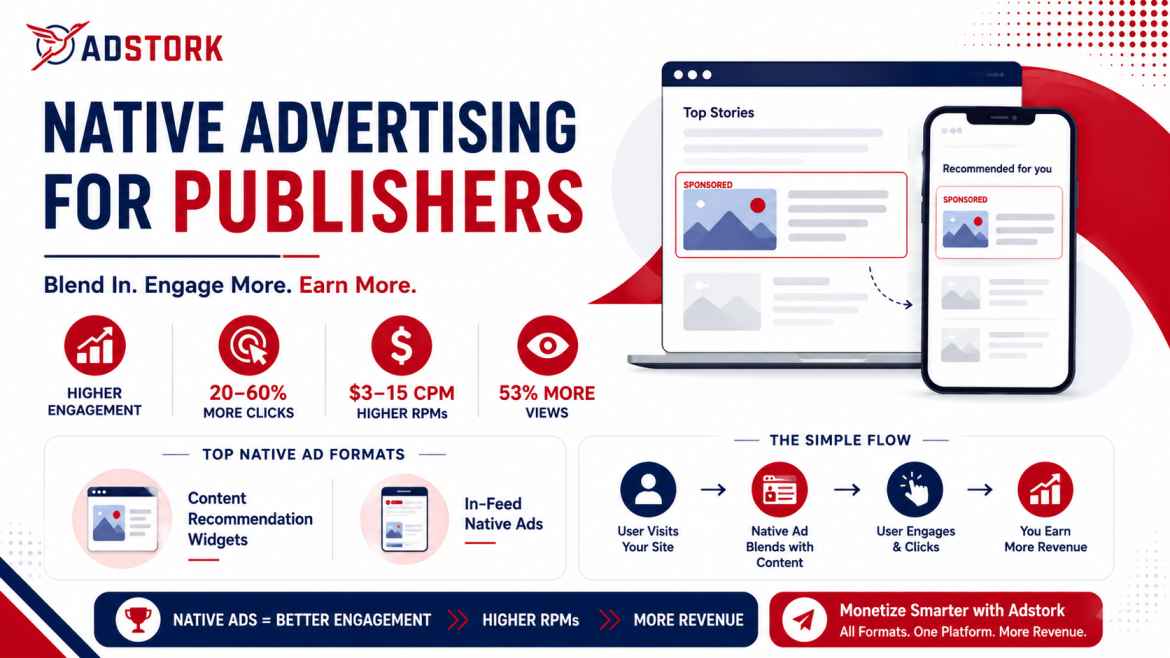
For publishers, that means better engagement, higher RPMs than display ads, and happier users who do not immediately bounce. The global native advertising market is valued at $125.6 billion in 2026 and is projected to reach $892.2 billion by 2036. This guide breaks down everything you need to know about native advertising for publishers in 2026.
Key Takeaways
- Native ads match the look and feel of your content, reducing banner blindness and increasing engagement.
- Publishers typically see $3-$15 CPM with native formats, often outperforming display banners.
- Native ads generate 53% more views than display banners and boost purchase intent by 18%.
- Content recommendation widgets and in-feed placements are the two most effective formats for publishers.
- Quality traffic wins with native advertising; low-engagement audiences will deliver poor returns.
What Is Native Advertising?
Native advertising is a form of paid media where advertisements match the visual style, structure, and user experience of the platform on which they appear. Instead of a banner screaming "click here," you get a headline, thumbnail, and brief description that looks like another article recommendation.
Common native ad placements include sponsored articles, recommended content widgets, promoted posts in content feeds, in-feed product recommendations, and editorial-style advertisements. A native ad is still an advertisement and should be identified as sponsored content. The difference lies in how the message is presented. Traditional banners usually appear outside the main content area, while native ads are integrated into the content environment and often resemble the type of material the user is already consuming.
Neuromarketing insight: native advertising works because it bypasses the brain's "ad detection" filter. Users have developed banner blindness after seeing thousands of display ads, automatically ignoring them without conscious processing. Native ads, by contrast, trigger the brain's content-processing pathways rather than its ad-rejection reflexes. The result is lower cognitive resistance and higher engagement, with consumers interacting with native ads 20-60% more frequently than display units.
The Two Native Ad Formats Publishers Actually Use
Native advertising breaks into several formats, but two dominate publisher monetisation: content recommendation widgets and in-feed native ads.
Content recommendation widgets sit at the bottom of articles, usually labelled "You May Also Like" or "Recommended For You." Taboola and Outbrain own this space. These drive the most revenue for content-heavy sites like blogs, news platforms, and editorial publications. Users finish reading and scroll down, making this placement high-intent. Expect $3-$12 CPM depending on your niche and traffic geography.
In-feed native ads appear directly inside your content feed or homepage stream, mimicking the look of organic posts. MGID and Yahoo Gemini excel here. This format works best for magazine-style sites, recipe blogs, and platforms with card-based layouts. The ads blend so well that CTR can hit 1-2%, significantly higher than banner ads.
Native Ads vs Display Ads: The Revenue Reality
Native advertising dominates display advertising in several key areas. Native ads generate up to 53% more views than display banners. They also boost purchase intent by 18% compared to banner ads. Native mobile ads deliver 20-60% higher engagement than traditional display ads.
But the revenue picture is more nuanced. Native ad networks like Taboola, Outbrain, and MGID typically deliver $0.50-$3 CPM on the low end but can hit $5-$15 CPM for quality traffic with strong engagement metrics. High-intent finance and tech traffic sometimes reaches $20-$35 CPM with native formats.
Display ad networks pay $1-$8 CPM for Tier 2/3 traffic and $4-$25 CPM for US/UK audiences. The catch is that native ads pay per click more often than per impression, while display networks run on CPM models where you earn regardless of clicks. This means native earnings depend heavily on click-through rate. On a tech blog with 1.8% CTR, native widgets pulled $6.21 RPM versus $4.73 from display. But on a site with lower engagement, native RPM dropped to $2.10 versus $5.40 from display.
The revenue winner is not the format. It is the format that matches user behaviour on your specific site.
Industry Insight: Where Native Ads Win Every Time
Native advertising platforms dominate in three specific scenarios.
Mobile-first content sites with scroll-heavy layouts. Users on mobile ignore banner blindness but engage with in-feed recommendations that feel native to the experience.
Editorial sites where trust matters. Finance blogs, health content, parenting advice, readers tolerate native recommendations better than flashing banner ads. One personal finance blog replaced a 300×250 sidebar banner with native content recommendations and increased overall session RPM by 31% because users stayed longer and clicked more.
Sites with high bounce rates. If readers land, consume one article, and leave, native content widgets at article bottom capture them before they exit.
Finance sites pull $8-$15 CPM with native widgets versus $3-$6 with standard 300×250 banners. The user experience stays cleaner because the ads do not blast bright colours or autoplay videos.
But native is not magic. If your traffic is bot-heavy, incentivised, or low-intent, native networks will either reject you or pay pennies. These platforms rely on user engagement to generate revenue for advertisers. No clicks means no money.
Adding native advertising to your monetisation mix does not have to be complicated. Adstork connects publishers to multiple native ad demand sources through a single integration, including content recommendation widgets and in-feed formats. You get the revenue benefits of native advertising without managing separate relationships with Taboola, Outbrain, and MGID yourself. Explore Adstork's native advertising solutions and see how publishers are increasing their RPMs with a simpler, more transparent approach.
Comparison Table: Native Ads vs Display Ads
A side-by-side comparison across the metrics that matter most to publisher revenue.
| Metric | Native Ads | Display Ads |
|---|---|---|
| Typical CPM (Tier 1) | $3 – $15 (finance up to $35) | $4 – $25 |
| Engagement Rate | 20-60% higher than display | Baseline |
| CTR | 0.15-2% | 0.05-0.1% |
| Viewability | 53% more views than display | Lower |
| Banner Blindness | Low (blends with content) | High (users ignore banners) |
| Pricing Model | CPC/CPM hybrid | CPM (earn per impression) |
| Best For | Content sites, mobile-first, editorial | Brand awareness, remarketing |
| Ad Blocker Evasion | Moderate | Poor (30-40% blocked) |
Future Outlook: Native Advertising in 2026 and Beyond
The native advertising market is undergoing rapid structural transformation. The global market is valued at $125.6 billion in 2026, projected to reach $154.9 billion in 2027, and forecast to expand to $892.2 billion by 2036, growing at a CAGR of 21.7%.
AI-powered contextual targeting is becoming the norm. Recommendation engines are getting smarter, serving ads that match not just the page content but the individual user's reading patterns.
Programmatic native advertising is expanding rapidly. Automation is increasing efficiency and targeting precision, making it easier for publishers to fill native inventory without manual intervention.
Commerce-enabled native content is emerging as a growth area. In-feed product recommendations and shoppable native ads are blending advertising with direct purchasing, creating new revenue streams for publishers.
Transparency and disclosure are becoming more important. Regulators are increasing scrutiny on sponsored content, and publishers who clearly label native ads will build more trust with their audiences.
In 2026, native advertising is not replacing every other digital format. But it continues to outperform traditional display advertising in campaigns where attention, trust, and conversion quality matter more than the number of impressions alone.
Native advertising is no longer a nice-to-have for publishers. It is a proven revenue driver that delivers higher engagement, better CPMs, and a cleaner user experience than traditional display banners. Publishers who add native to their monetisation mix see immediate revenue gains without sacrificing user trust.
The question is not whether to use native advertising, but how to implement it effectively. Adstork makes it simple. Our platform includes native advertising formats alongside display, popunder, and other formats, all through a single integration. You get transparent reporting showing exactly what each format is earning, with the flexibility to optimise your mix based on real performance data. Sign up for a free Adstork publisher account and start testing native advertising on your site today.
Your immediate action plan: Audit your current ad setup. If you are running only display banners, you are leaving revenue on the table. Test a native content recommendation widget at the bottom of your articles for two weeks. Compare the RPM against your existing display placements. Measure the impact on user engagement and bounce rate. The results will tell you whether native advertising belongs in your monetisation mix.
Frequently Asked Questions
What is native advertising for publishers? Native advertising is a form of paid media where ads match the look, feel, and function of the content surrounding them. For publishers, this means sponsored content, recommended content widgets, and in-feed ads that blend seamlessly with organic content.
How much do native ads pay publishers? Native ad CPMs typically range from $3 to $15 for quality Tier 1 traffic, with finance and tech niches reaching $20-$35. However, native networks often use a CPC/CPM hybrid model, so earnings depend on click-through rate as well as impressions.
Are native ads better than display ads for publishers? It depends on your traffic and content type. Native ads generally deliver higher engagement and CPMs on content-heavy, mobile-first sites. Display ads perform better for brand awareness and remarketing. The best approach is to run both and optimise based on performance data.
What are the best native ad networks for publishers? Taboola and Outbrain dominate content recommendation widgets. MGID and Yahoo Gemini excel at in-feed native ads. TripleLift and Nativo are strong in programmatic native. The best network depends on your niche, traffic quality, and geographic audience.
Do native ads hurt user experience? When implemented correctly, native ads improve user experience because they blend with content rather than interrupting it. However, too many native ads or low-quality recommendations can damage trust. Balance is key.
Can I run native ads alongside display ads? Yes. In fact, most successful publishers run multiple formats. Native ads typically perform best at article ends or in-feed, while display ads work well in sidebars and above the fold. Testing different combinations will reveal the optimal mix for your site.
Keep reading:
• Ad Fill Rate: Why It Matters More Than CPM
• Header Bidding Explained: A Publisher's Guide for 2026
• Why Is My Website Ad Revenue So Low? 10 Problems Publishers Should Check


Leave a Comment