- 23 Sep, 2026
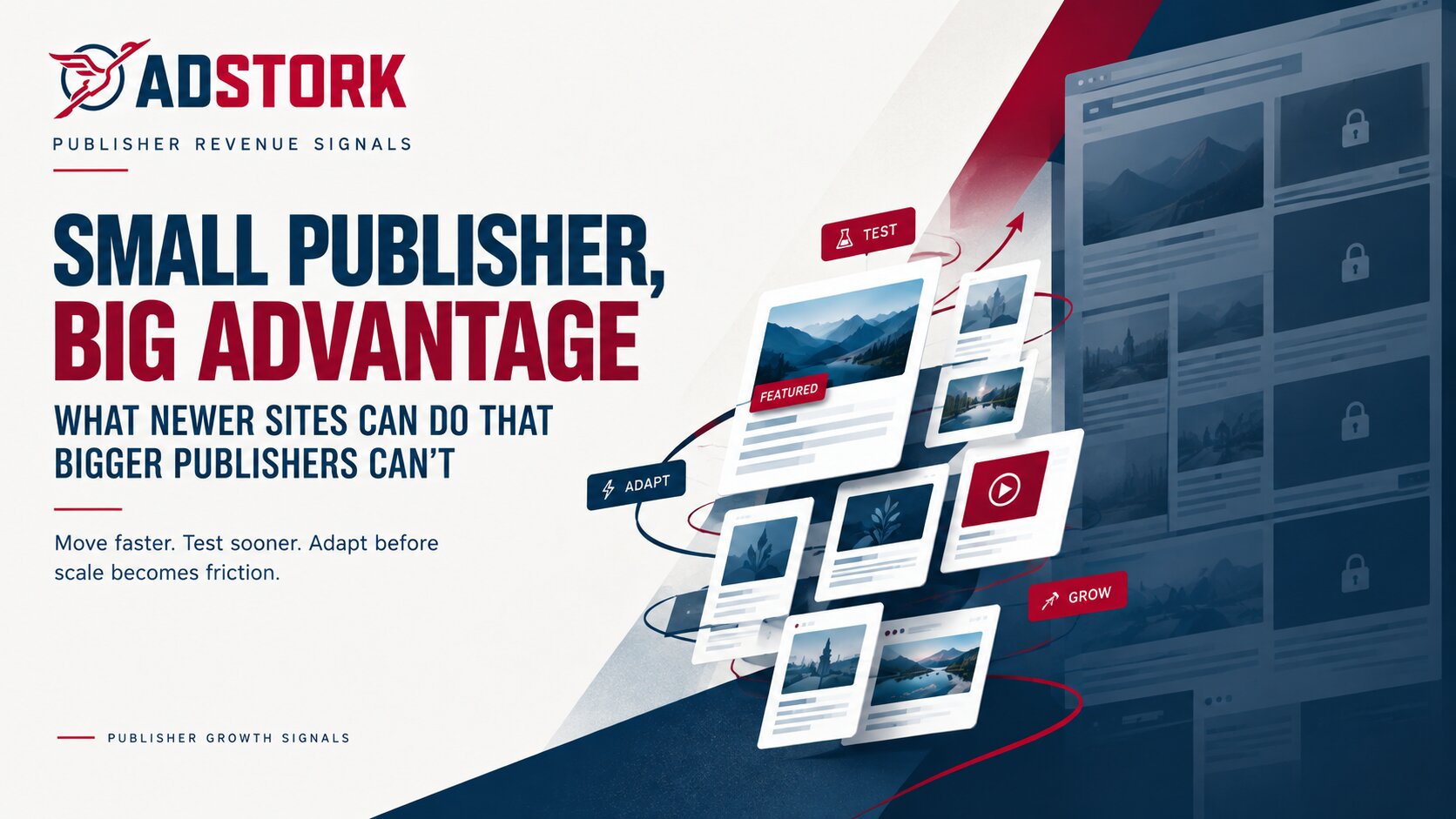
Small Publisher, Big Advantage: What Newer Sites Can Do That Bigger Publishers Can't
Most advice written for publishers assumes a certain size. Millions of pageviews, an ad ops team, a Google Ad Manager account someone has spent years tuning. If you are running a site with 50,000 monthly visitors, most of that advice does not apply to you, and worse, it can make you feel like you are behind before you have even started.
You are not behind. You are just playing a different game, one where the rules actually favor you in a few specific ways that established publishers have lost access to.
In short: Smaller publishers hold structural advantages larger sites cannot replicate, including faster decision-making, freedom from legacy contracts, and the ability to test new formats or partners without risking existing revenue streams. Used deliberately, these advantages can produce a higher revenue-per-visitor than sites many times their size.
Key Takeaways
- Scale is not the only variable that determines revenue. Agility and low switching costs matter more for smaller publishers than most realize.
- Larger publishers often carry contractual and operational weight that slows them down. Smaller sites do not have that weight yet.
- Fast approval and low payout thresholds matter disproportionately when a site is still building consistent cash flow.
- Testing new formats or demand sources carries almost no downside for a smaller site, since there is less existing revenue to disrupt.
1. What Larger Publishers Give Up as They Scale
A publisher at three million monthly pageviews usually has direct advertiser deals, SSP agreements with exclusivity clauses, and a sales team whose incentives are tied to protecting existing revenue. None of that is a mistake. It is what growth requires. But it also means every decision carries weight. Testing a new demand source means risking a relationship that took years to build. Changing a floor price means a conversation with three different teams before anyone touches anything.
A smaller publisher does not carry that weight. There is no existing deal to protect, no exclusivity clause to work around, and no sales team whose job depends on the current setup staying exactly as it is. That absence of institutional weight is not a disadvantage. It is speed.
2. The Real Advantages Smaller Publishers Hold
- Decision speed. A smaller publisher can test a new ad format this week, not next quarter. There is no committee, no legacy stakeholder, no risk assessment process standing between an idea and its implementation.
- No sunk-cost thinking. Established publishers often keep underperforming demand sources active simply because switching is expensive and disruptive. A newer site has nothing sunk yet, so every decision can be made purely on current performance.
- Low financial barrier to testing. A network with a low payout threshold means a smaller publisher does not need to wait months to see whether a change worked. Faster feedback loops mean faster optimization.
- Content flexibility. Pivoting a content strategy, adding a new vertical, or restructuring a site's architecture is far easier before an editorial team, a content calendar, and years of SEO equity are built around the old structure.
3. What Smaller Publishers Should Actually Do With This Advantage
Agility only produces revenue if it is used deliberately. A few concrete moves make the difference:
- Test formats in parallel, not sequentially. Run native, push, and banner placements simultaneously on different pages rather than testing one for a month before trying the next. A smaller site can afford the short-term noise this creates. A larger one usually cannot.
- Treat the first 90 days as a data-gathering phase, not a revenue target. The publishers who plateau early are usually the ones who locked in a setup in week one and never touched it again, mistaking early results for a stable baseline.
- Use direct link monetization where it fits. For sites without heavy display real estate, direct links can generate revenue from traffic that would otherwise go unmonetized entirely, without requiring any layout changes.
- Negotiate for support, not just rate. A smaller publisher working directly with an account manager, rather than a generic support queue, will typically resolve underperformance faster than one operating in isolation.
4. Where Adstork Fits In
This is the specific gap many newer publishers fall into: they have the agility advantage but partner with a network built for publishers who no longer need it. Adstork approves publishers quickly, pays out starting at a $5 threshold, and gives full control over format, volume, and vertical selection from day one, so a smaller site is not waiting weeks to see whether a change is working. Every publisher, regardless of size, also gets access to a dedicated account manager and 24/7 live chat rather than a generic support ticket queue.
None of this changes the fact that scale eventually matters. What it does is remove the friction that keeps smaller publishers from using the advantage they already have while they build toward it.
5. Where This Advantage Runs Out
Agility is not unlimited. As a site grows past a few million monthly pageviews, some of the same structural weight that slows large publishers down starts to apply. Direct advertiser relationships become worth protecting. Contracts start to matter. The window where a publisher can test anything without consequence closes gradually, not suddenly, and the publishers who benefit most are the ones who use that window deliberately before it closes, rather than assuming it will stay open indefinitely.
Small vs. Established Publisher: Where the Advantage Sits
| Factor | Smaller Publisher | Established Publisher |
|---|---|---|
| Decision speed | Days | Weeks to months |
| Switching cost | Minimal | High, often contractual |
| Raw demand access | Lower | Higher |
| Testing risk | Low, little revenue to disrupt | High, existing revenue at stake |
What's Next for Smaller Publishers
As third-party cookies phase out, the sites best positioned to adapt quickly are often the smaller ones, since they are not unwinding years of tracking-dependent infrastructure. Building first-party relationships and contextual relevance early, before scale forces a slower, more careful approach, is an advantage most established publishers wish they still had.
Final Word
Size is not the only lever that determines how much a publisher earns. Speed, flexibility, and the willingness to test without institutional friction are advantages smaller publishers hold and often do not use. At Adstork Ad Network, we work with publishers at every stage, but we built our setup so newer sites are not waiting on infrastructure to catch up with their ambition.
Ready to see what your site can earn while you still have the advantage of speed? Partner with Adstork Ad Network today.
FAQs
Can a small publisher really out-earn a larger one per visitor? Yes, in revenue-per-visitor terms. Larger publishers often carry legacy contracts and slower decision-making that limit how quickly they can optimize, while smaller sites can test and adjust immediately.
What is direct link monetization? A method of earning revenue by directing traffic through a monetized link rather than relying solely on display ad units, useful for sites with limited ad real estate.
How long should a new publisher test before settling on a setup? At least 90 days of data before drawing conclusions. Locking in a configuration in week one usually means missing better-performing alternatives.
Does a low payout threshold actually matter for revenue? Indirectly, yes. Faster payouts mean faster feedback on whether a change is working, which speeds up optimization cycles for smaller publishers.
At what size does the agility advantage start to disappear? Generally once a publisher builds direct advertiser relationships or signs exclusivity agreements, usually somewhere in the low millions of monthly pageviews, though this varies by vertical.
How does Adstork support newer publishers specifically? Through fast approval, a $5 payout threshold, full control over format and vertical selection, and direct access to a dedicated account manager from day one.


Leave a Comment