- 01 Sep, 2026
What Does an Ad Network Actually Do for a Publisher?
You have heard the term "ad network." You know it has something to do with making money from your website. But what does it actually do?
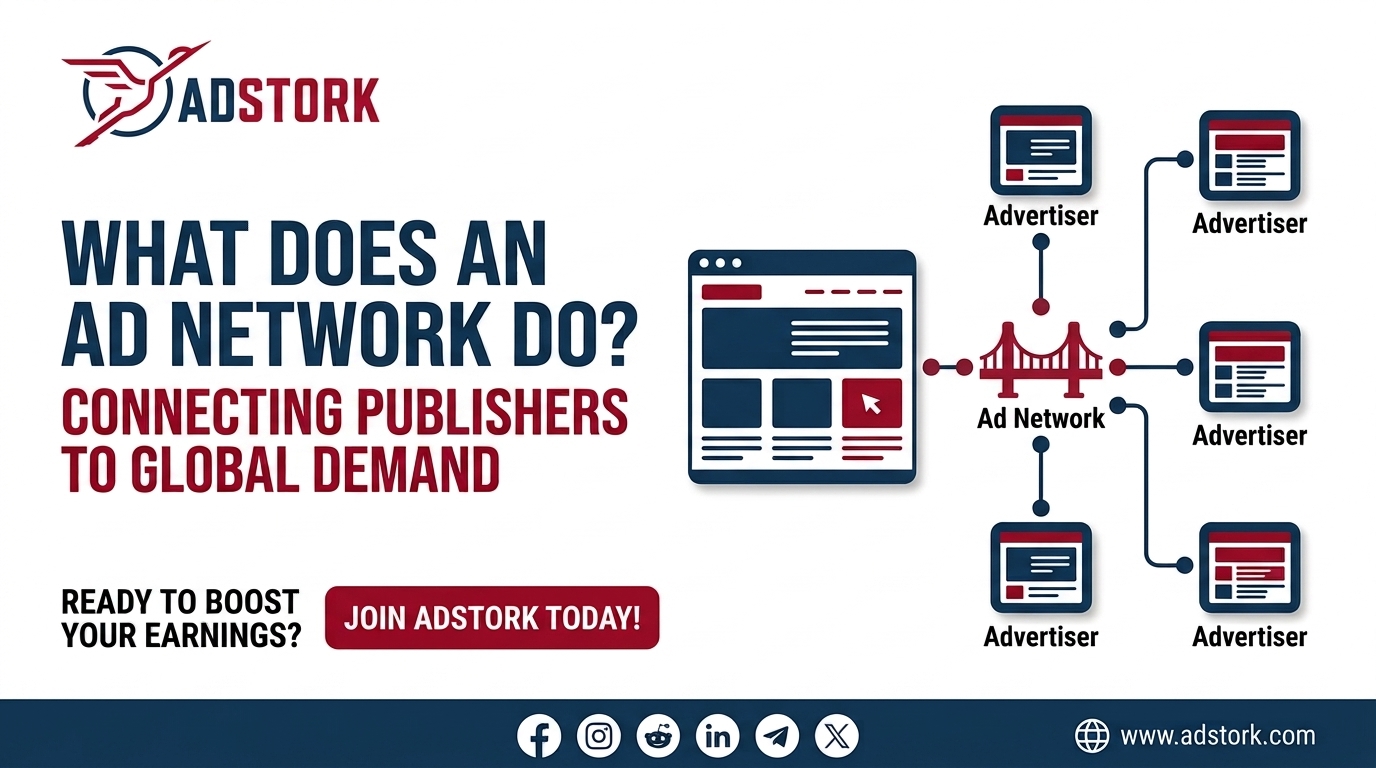
Think of an ad network as the bridge between two worlds: publishers who have ad space to sell and advertisers who want to buy it. Without an ad network, you would need to find advertisers yourself, negotiate prices individually, handle the technical delivery of ads, and chase payments—all while trying to run your website.
An ad network handles all of that for you. It takes your empty ad space, fills it with paying ads, and sends you revenue. Everything else—technology, relationships, reporting, payments; happens behind the scenes so you can focus on creating content and growing your audience.
This guide walks you through exactly what an ad network does, step by step, from the moment a user visits your site to the moment you receive your payout.
Key Takeaways
- An ad network is the intermediary that connects publishers with advertisers.
- It handles everything: filling ad space, running auctions, delivering ads, tracking performance, and paying you.
- The process follows a clear path: ad request → auction → ad delivery → reporting → revenue.
- Ad networks save you from finding advertisers, negotiating prices, and chasing payments.
- The right ad network provides technology, demand, transparency, and support—all in one platform.
The Ad Network Journey: Step by Step
The journey from a user visiting your site to you earning revenue follows a clear, logical path. Here is exactly what happens.
1. Your Website Sends an Ad Request
When a user visits your website, your ad code (provided by the ad network) sends an ad request to the network's servers. This request contains information about the user and the page.
The request includes contextual signals—the page topic, keywords, and content category. Geographic data shows the user's location. Device information identifies whether they are on desktop, mobile, or tablet. User behavior signals may include engagement patterns and return frequency.
This request happens in milliseconds. The user does not see it. They only see the ad that eventually loads.
2. The Ad Network Connects to Advertiser Demand
The ad network takes your request and sends it to multiple advertisers, demand sources, and exchanges simultaneously. This is where the network's relationships matter.
Ad networks with strong demand sources premium SSPs, direct advertisers, and programmatic exchanges can connect your inventory to the right buyers. Networks with weak demand sources will struggle to fill your inventory at good prices.
The goal is to expose your inventory to as many potential buyers as possible. More buyers mean more competition, which means higher CPMs.
3. The Auction or Matching Process Begins
This is where the magic happens. The ad network runs an auction where multiple advertisers bid on your inventory in real time.
Each advertiser evaluates the request based on their campaign goals. Do they want to reach users in this geographic location? Is the content context relevant to their brand? Is the user likely to engage?
Advertisers submit bids based on the value they assign to the impression. The highest bid wins—assuming it meets your floor price. This is called real-time bidding (RTB), and it happens in milliseconds.
Some networks use header bidding, where multiple demand sources bid simultaneously. Others use a waterfall, where partners are called in a fixed order. Header bidding typically generates higher CPMs because more competition drives prices up.
4. The Creative Is Delivered
Once the winning bid is selected, the ad network delivers the ad creative to your website. The user sees the ad in the designated space on your page.
The ad creative might be a display banner, a native ad, a video, a popunder, or a push notification. The format determines how the ad is rendered and how users interact with it.
This is the only part of the process the user sees—the ad itself. Everything else happens behind the scenes.
Neuromarketing insight: users are unaware of the auction. They simply see an ad that feels relevant to their context. This relevance reduces cognitive resistance and increases engagement. The ad network's ability to match the right ad to the right user in real time is what makes programmatic advertising effective.
5. Performance Is Tracked
The ad network tracks every impression, click, and conversion. This data is recorded in real time and made available to you through the network's reporting dashboard.
Key metrics include impressions (how many times ads were displayed), clicks (how many times users clicked), CTR (click-through rate), CPM (cost per mille), eCPM (effective CPM), fill rate (percentage of requests filled), and revenue (total earnings).
Transparent reporting is essential for optimisation. Without it, you cannot know what is working and what is not. The best ad networks provide granular data segmented by country, device, format, and placement.
6. You Review Your Earnings
Your earnings dashboard shows your revenue in real time. You can see how much you have earned today, this week, and this month.
The dashboard also shows which formats, geos, and placements are performing best. This data helps you optimize your monetization strategy.
Most ad networks provide regular payment cycles, typically monthly or weekly. You receive your earnings based on the network's payment terms and your selected payment method.
What a Good Ad Network Provides
Not all ad networks are created equal. A good ad network provides more than just ad tags. Here is what to look for.
Demand access. Premium demand sources that pay well and fill consistently. Direct advertiser relationships and programmatic exchanges. Global coverage that matches your traffic profile.
Ad technology. Real-time bidding and header bidding capabilities. Multiple ad formats including display, native, video, and popunder. Ad quality controls and brand safety features. Fraud prevention and invalid traffic filtering.
Transparency. Granular reporting segmented by country, device, format, and placement. Real-time data access. Clear payment terms and fee disclosure. No hidden charges.
Support. Dedicated account management. Responsive support team. Optimisation guidance. Technical assistance for integration.
Payment reliability. Consistent payment cycles. Multiple payment options. Low minimum payout thresholds. No payment delays.
Industry Insight: The Value Ad Networks Provide
Ad networks have evolved significantly. Modern networks provide value far beyond basic ad serving.
AI-powered optimisation is becoming standard. Networks use machine learning to optimise floor prices, demand routing, and ad placement in real time.
Multi-format support is essential. Publishers want one network that can handle display, native, video, and popunder formats. Managing multiple networks for different formats is inefficient.
Global demand is increasingly important. Ad networks with strong international demand help publishers monetise traffic from all regions.
Transparency is now expected. Publishers demand to know where their revenue comes from, who is buying their inventory, and what fees are being applied.
The network that provides the best combination of demand, technology, transparency, and support will earn long-term publisher loyalty.
At its core, an ad network handles the technology, demand, and payments so you can focus on what matters—creating content and growing your audience. Adstork provides all of this with instant approval, global demand, transparent reporting, and dedicated support. Sign up for a free Adstork publisher account and see how easy monetisation can be.
Comparison Table: Ad Network vs. No Ad Network
Here is what your monetisation experience looks like with and without an ad network.
| Activity | Without an Ad Network | With an Ad Network |
|---|---|---|
| Finding Advertisers | You need to find and negotiate with each advertiser individually | Network connects you to hundreds of advertisers automatically |
| Pricing | Fixed rates, limited competition | Real-time auctions, competitive bids |
| Ad Delivery | You need to host and serve ads yourself | Network handles delivery and rendering |
| Reporting | Manual tracking, or none at all | Automated, real-time dashboards |
| Payment Collection | You chase payments from each advertiser | Network collects and pays you |
| Time Investment | Significant—sales, negotiation, technical | Minimal—focus on content |
| Optimisation | Limited data, manual adjustments | AI-powered, data-driven |
Future Outlook: The Evolving Role of Ad Networks
The role of ad networks is evolving. Several trends are reshaping what publishers should expect from their networks.
AI and automation are becoming standard. Networks increasingly use machine learning to optimise yield, detect fraud, and improve ad targeting. Publishers benefit from higher performance without manual effort.
First-party data integration is growing. Networks that help publishers collect and activate first-party data will provide more value in the post-cookie era.
Transparency requirements are increasing. Publishers demand visibility into demand sources, fees, and auction dynamics. Networks that resist transparency will lose publishers.
Multi-format support is becoming standard. Publishers want one partner that can handle all formats—not separate networks for display, native, and video.
The future belongs to ad networks that provide comprehensive solutions—technology, demand, transparency, and support—in a single, easy-to-use platform.
An ad network is the bridge between your website and advertisers. It handles everything from filling your ad space to running auctions, delivering ads, tracking performance, and paying you.
Without an ad network, you would need to find advertisers yourself, negotiate prices individually, handle technical delivery, and chase payments. With an ad network, you focus on creating content and growing your audience—the network handles the rest.
Adstork provides everything a publisher needs: instant approval, global demand, multiple formats, transparent reporting, and dedicated support. All in one platform. Sign up for a free Adstork publisher account and see what a modern ad network can do for you.
FAQs
What does an ad network do for a publisher? An ad network connects your website's ad inventory to advertisers, runs real-time auctions to determine the highest bid, delivers the ad to your user, tracks performance, and handles payments. It does everything so you do not have to find advertisers or manage ad delivery yourself.
How do ad networks make money? Ad networks typically take a percentage of the ad revenue as a fee. The exact percentage varies by network. Some networks also charge advertisers a markup on media purchases. Transparent networks disclose their fee structure clearly.
Do I need an ad network to make money from ads? You could theoretically find advertisers directly and sell ad space yourself. But this requires significant time and effort—finding advertisers, negotiating prices, managing ad delivery, and chasing payments. Most publishers use ad networks because they handle everything efficiently.
What is the difference between an ad network and a DSP? An ad network connects publishers with demand sources. A DSP (demand-side platform) is used by advertisers to buy inventory across multiple networks and exchanges. Publishers work with ad networks; advertisers work with DSPs.
What is real-time bidding? Real-time bidding (RTB) is the process where advertisers bid on each impression in milliseconds. When a user visits your site, an auction occurs, and the highest bidder's ad is delivered. RTB ensures you capture the true market value of your inventory.
How do I choose an ad network? Evaluate networks based on approval speed, traffic requirements, supported formats, GEO coverage, demand quality, reporting transparency, payment terms, support quality, and account management. Use the Publisher's Checklist to compare your options.




Leave a Comment