- 14 Aug, 2026
Header Bidding Explained
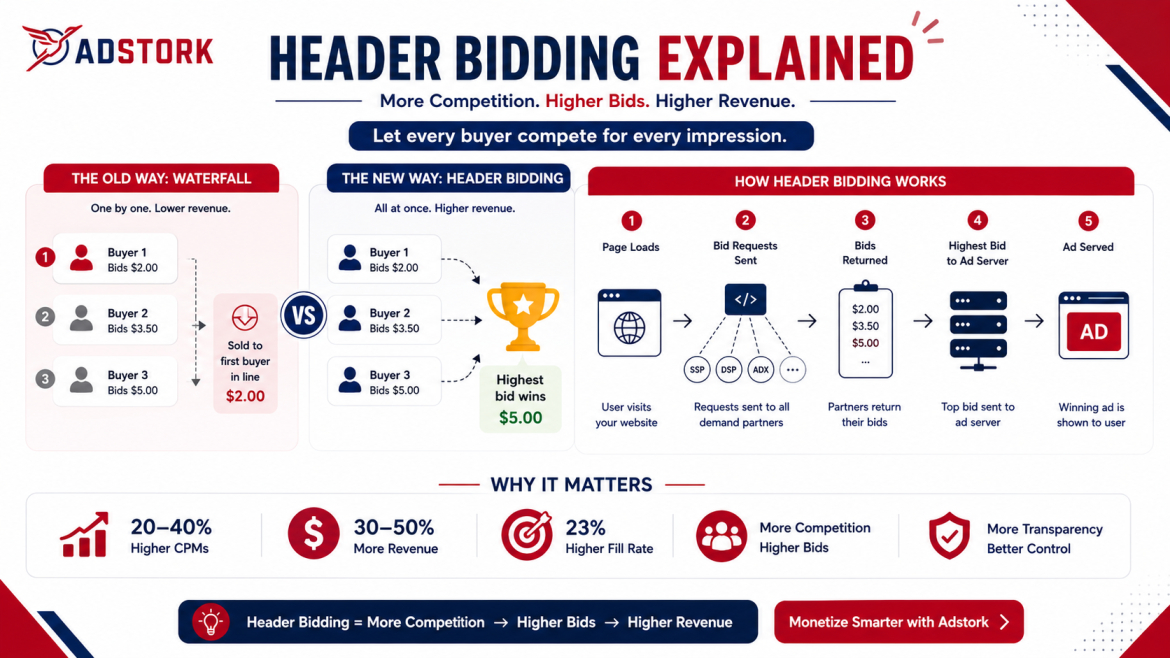
Imagine this: you have a piece of ad inventory that three different buyers want. One is willing to pay $5.00. Another offers $3.50. A third bids $2.00. Under the old system, you would have sold it to the first buyer in line for $2.00, never knowing the others existed. That is exactly what happened, impression after impression, to publishers using the waterfall model.
Header bidding changed everything. It is the single most impactful technology change for publisher ad revenue in the last decade. By letting every demand source bid simultaneously on every impression, header bidding reveals the true market value of your inventory and puts more money in your pocket.
This guide explains exactly what header bidding is, how it works, why it outperforms the waterfall, and what publishers need to know about implementation in 2026.
Key Takeaways
- Header bidding runs a simultaneous auction where all demand partners compete for every impression at the same time.
- Publishers typically see CPM increases of 20-40% and overall revenue lifts of 30-50% after implementation.
- The old waterfall model sold impressions sequentially, often leaving higher bids unseen.
- Client-side (Prebid.js) and server-side (Prebid Server) are the two main implementation approaches.
- In 2026, server-side header bidding is going mainstream as latency and cookie deprecation push publishers off client-side setups.
What Is Header Bidding?
Header bidding is a programmatic advertising technique that allows publishers to offer their ad inventory to multiple demand sources—ad exchanges, supply-side platforms (SSPs), ad networks, and demand-side platforms (DSPs)—simultaneously before calling their primary ad server. The term comes from the JavaScript code originally placed in the <head> section of a webpage, though modern implementations have evolved beyond that.
In practical terms, header bidding creates a fair, competitive auction for every single ad impression on your site. Instead of giving one demand partner the first chance to bid and settling for whatever they offer, you let everyone bid at once and take the highest price. It is the foundation of how modern publisher monetisation works within the broader programmatic advertising ecosystem.
Neuromarketing insight: competition is a powerful psychological driver. When multiple buyers compete for the same impression in a transparent auction, each bidder is psychologically compelled to offer their true maximum value because they know they are competing against everyone else. This mirrors how auction dynamics drive prices up in any market, the fear of losing triggers higher bids.
The Waterfall Problem: What Header Bidding Replaced
To understand why header bidding matters, you need to understand the system it replaced: the waterfall model (also called daisy-chaining).
In the waterfall, ad requests cascaded through demand partners one at a time in a fixed order. The publisher ranked partners by their historical average CPM, and each partner got first look at the impression in sequence. The first partner willing to buy it won, even if a lower-ranked partner would have paid significantly more.
This created several problems. Publishers lost revenue because a partner ranked lower might have bid $5 for a specific impression, but the impression was already sold to a higher-ranked partner for $2. Rankings were based on stale historical averages, not real-time demand. Sequential calls meant each partner added loading time, degrading user experience. And demand partners had no incentive to bid high when they were already at the top of the waterfall.
Header bidding largely replaced this sequential waterfall with a simultaneous auction. Every demand source bids on the impression at the same time, and the highest bid wins. This simple change transformed publisher economics: more competition per impression means higher prices, and every bidder must offer their true value because they know they are competing against everyone else.
How Header Bidding Works: Step by Step
Header bidding acts as a pre-auction before the main ad server determines which ad to serve. It runs in milliseconds and follows a consistent sequence.
Step 1: Page loads. When a user visits your site, the header bidding script activates.
Step 2: Bid requests sent. The script—typically a wrapper like Prebid.js—sends simultaneous bid requests to multiple advertising platforms, SSPs, and demand partners.
Step 3: Bids returned. Each partner's systems analyse the impression and return a bid. All partners bid simultaneously within a timeout window, typically 1-2 seconds.
Step 4: Highest bids passed to ad server. The highest bids are passed to your ad server, which runs a final auction that also includes direct sold and programmatic guaranteed deals.
Step 5: Ad served. The winning ad is served to the user.
Industry Insight: The Numbers Behind Header Bidding
The data is compelling. Publishers implementing header bidding typically see CPM increases of 20-40% and overall revenue lifts of 30-50%. Some publishers have seen even more dramatic results. The Telegraph reported a 70% increase in programmatic revenue after implementing header bidding.
A recent study showed that header bidding led to a 23% increase in fill rate and a 20% increase in average CPM. Another analysis found that 61.3% of header bidding experiments delivered persistent revenue improvements, with an average uplift of 5.56% through deliberately designed experimentation.
The global header bidding platform market was valued at $1.8 billion in 2025 and is forecast to surpass $5 billion by 2034. As of July 2025, 2.2% of the one million highest-traffic websites were leveraging header bidding technology.
In mobile advertising, the shift is even more pronounced. About 60-70% of all mobile video impressions are now served through header bidding.
Implementing header bidding does not have to be complex. Adstork offers a unified platform with built-in header bidding support, connecting publishers to multiple demand sources through a single integration. You get the revenue benefits of header bidding without the technical overhead of managing Prebid.js, server configurations, and multiple SSP relationships yourself. Explore Adstork's header bidding solution and see how publishers are increasing their RPMs with a simpler, more transparent approach.
Client-Side vs. Server-Side: Which Implementation Is Right for You?
There are two main approaches to implementing header bidding, each with its own trade-offs.
Client-side header bidding (also called browser-side) uses JavaScript—typically the open-source Prebid.js library—that runs in the user's browser. The browser calls each demand partner directly and collects bids before the ad server is called. This approach is simpler and cheaper to implement, but it can slow page load times because multiple JavaScript auctions run in the browser.
Server-side header bidding moves the auction logic to a server—typically using Prebid Server. The server calls all demand partners simultaneously and collects bids without involving the user's browser. This approach is faster and more scalable, reducing page latency significantly. However, it is more complex and expensive to set up.
Hybrid approaches combine both methods, using client-side for some partners and server-side for others. These setups are the most complex to maintain but can offer the best balance of performance and demand coverage.
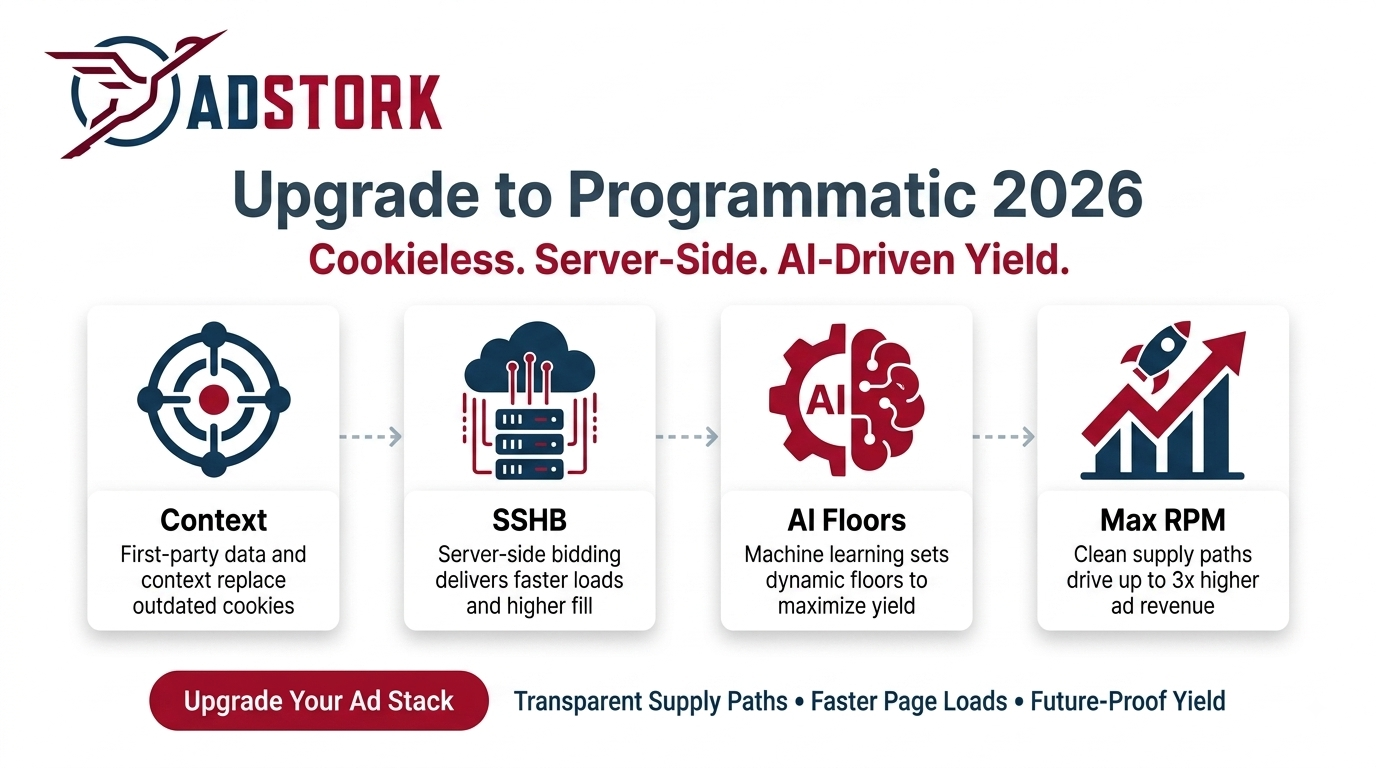
In 2026, server-side header bidding is going mainstream. Cookie deprecation is eroding the client-side advantage, latency costs are no longer acceptable, and demand partner support for Prebid Server is stronger than ever.
Comparison Table: Header Bidding vs. Waterfall
Here is how header bidding and the waterfall model compare across the dimensions that matter most to your revenue and operations.
| Feature | Waterfall | Header Bidding |
|---|---|---|
| Auction Type | Sequential (one at a time) | Simultaneous (all at once) |
| Winner Determined By | Position in the chain | Highest real-time bid |
| Pricing Basis | Historical averages | Real-time market value |
| Revenue Impact | Leaves money on the table | Captures true value |
| Transparency | Limited visibility | Full bid-level reporting |
| Latency | Cumulative (each partner adds delay) | Parallel (single timeout window) |
| CPM Potential | Lower due to lack of competition | Higher due to competition |
| Fill Rate | Lower | Higher |
Future Outlook: Header Bidding in 2026 and Beyond
Header bidding is not standing still. The technology is evolving rapidly, and publishers who stay ahead of the trends will capture the most value.
Server-side is becoming the default. The industry is shifting decisively toward server-side header bidding to reduce latency and improve page speed. Cookie deprecation is accelerating this migration, as client-side auctions lose access to the signals that made them valuable.
Supply path optimisation is becoming critical. In 2026, adding more demand partners can be a liability, not an advantage, due to latency penalties, fee stacking, and duplicative auction paths. Publishers are focusing on quality over quantity, pruning their demand stacks to the partners that deliver the best net yield.
AI and automation are transforming auctions. Publishers are pairing header bidding with AI technologies that optimise in real time, evaluating bidder behaviour, latency, and historical CPM trends to make faster and smarter decisions. Agentic advertising—where AI agents negotiate and bid on behalf of buyers and sellers—is emerging as the next frontier.
Privacy-first signals are replacing cookies. Header bidding auctions are increasingly relying on first-party data and contextual signals rather than third-party cookies. Publishers who build strong first-party data strategies will maintain their competitive advantage in header bidding auctions.
Header bidding is no longer an experiment. It is an essential strategy for modern publishers who want to maximise their ad revenue. The waterfall model leaves money on the table with every impression, while header bidding captures the true market value of your inventory by letting every demand source compete simultaneously.
The question is not whether to implement header bidding, but how. Adstork makes it simple. Our platform includes built-in header bidding with connections to multiple premium demand sources, transparent reporting that shows you exactly what each impression is worth, and support for both display and video formats. Sign up for a free Adstork publisher account and start running header bidding auctions on your site today.
Your immediate action plan: Audit your current ad setup. Are you still running a waterfall? If so, you are leaving revenue on the table. Research header bidding implementation options—client-side, server-side, or through a managed partner like Adstork. Run a two-week test comparing your current setup against a header bidding implementation. Measure the difference in CPM, fill rate, and total revenue. The results will speak for themselves.
Frequently Asked Questions
What is header bidding in simple terms? Header bidding is a way for publishers to let multiple ad buyers bid on each ad impression at the same time. Instead of asking buyers one at a time, you ask everyone at once and take the highest offer. This means you get more money for your ad space.
How much does header bidding increase revenue? Publishers typically see CPM increases of 20-40% and overall revenue lifts of 30-50% after implementing header bidding. Some publishers have reported increases as high as 70%.
What is the difference between header bidding and waterfall? In a waterfall, ad requests go to demand partners one at a time in a fixed order. The first partner that wants the impression gets it, even if a later partner would have paid more. In header bidding, all partners bid simultaneously, and the highest bid wins.
Is header bidding better than Google Ad Manager? Header bidding is not a replacement for Google Ad Manager; it works alongside it. Header bidding runs a pre-auction before your ad server (like Google Ad Manager) makes the final decision. The highest bids from header bidding compete with direct sold and programmatic guaranteed deals in the ad server's final auction.
What is Prebid.js? Prebid.js is a free, open-source JavaScript library that publishers use to implement client-side header bidding. It handles sending bid requests to multiple demand partners, collecting their bids, and passing the highest bids to your ad server.
Does header bidding slow down my website? Client-side header bidding can slow page load times because multiple JavaScript auctions run in the browser. Server-side header bidding is faster because the auction runs on a server, not in the user's browser. In 2026, server-side is becoming the preferred approach.
Keep reading:
• Programmatic Advertising 2026: What Publishers Must Know Now
• Why Is My Website Ad Revenue So Low? 10 Problems Publishers Should Check
• Popunder Ads vs. Interstitial Ads: Which Pays More for Publishers?
Leave a Comment