- 14 Aug, 2026
Popunder Ads vs. Interstitial Ads: Which Pays More for Publishers?
Imagine this: you have 100,000 daily visitors, and you are torn between two ad formats. One promises sky‑high CPMs but risks annoying your audience. The other feels less intrusive but might underdeliver on revenue. Which one actually puts more money in your pocket?
You are not alone. Every publisher who scales past the "basic banner" stage hits this crossroads. Popunder ads and interstitial ads are two of the highest‑yielding formats in programmatic, yet they work in completely opposite ways. Choosing the wrong one for your site can cost you thousands per month, not because the format is bad, but because it mismatches your audience and device mix.
This post breaks down both formats with real numbers, publisher‑tested use cases, and a side‑by‑side comparison that cuts through the hype. By the end, you will know exactly which one fits your traffic, your niche, and your revenue goals for 2026.
Key Takeaways
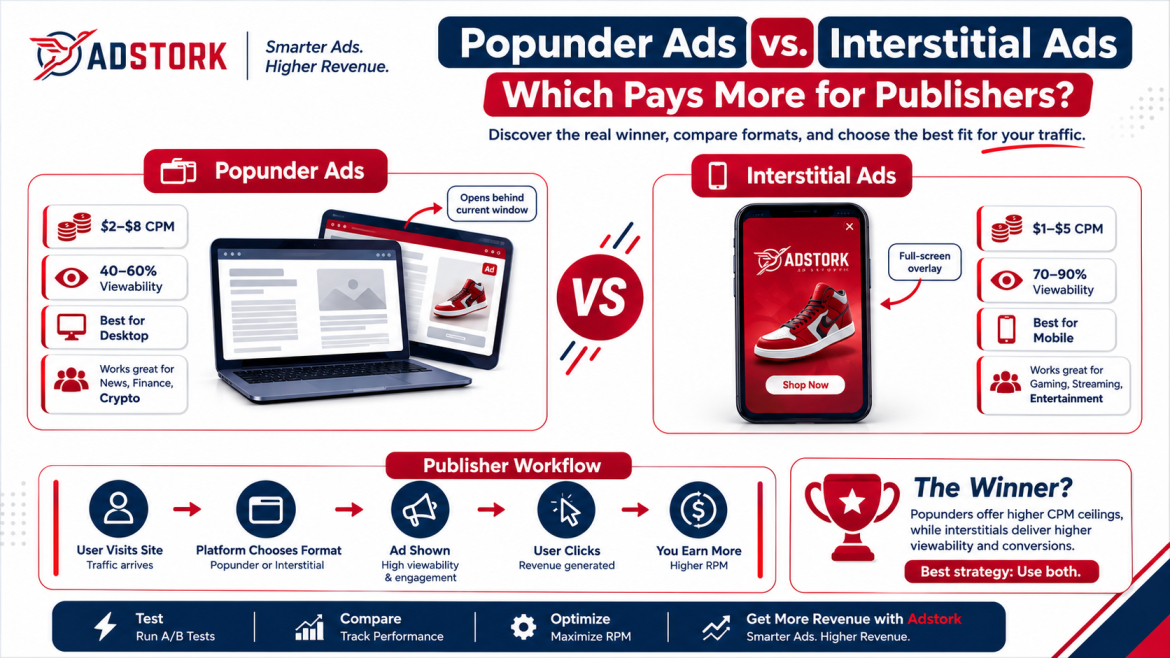
- Popunders typically earn $2–$8 CPM vs. interstitials at $1–$5 CPM, but interstitials have higher viewability (70‑90% vs. 40‑60%).
- Desktop traffic favours popunders; mobile app and mobile web traffic often respond better to interstitials.
- Interstitials convert 2‑4x higher for direct response offers, while popunders excel at brand awareness and retargeting.
- The real winner is often a hybrid strategy, not an either/or choice.
What Are Popunder Ads?
A popunder ad opens a new browser window or tab behind the current active window. The user does not see it until they close or minimise their main browsing window. This delayed visibility is the format's superpower. It does not interrupt the user's current activity, so it generates less immediate frustration than a full‑screen takeover.
From a publisher's perspective, popunders are incredibly versatile. They work across almost every niche, from news and entertainment to finance and gaming. Their CPMs tend to be higher because advertisers value the "surprise" factor and the fact that the ad gets dedicated screen real estate without competing for attention against your content.
Neuromarketing insight: the delayed reveal triggers a mild curiosity response. When a user closes their main tab and discovers a new page, their brain treats it as a reward rather than an intrusion. This lowers cognitive resistance and increases the likelihood they will engage with the ad, especially if it is visually relevant to their previous browsing session.
What Are Interstitial Ads?
Interstitial ads are full‑screen overlays that appear at natural transition points, such as between a game level, before a video starts, or when a user clicks from one article to the next. They cover the entire viewport and typically require the user to tap or click a close button to dismiss them.
Because they demand immediate visual attention, interstitials boast exceptional viewability scores. Every impression is counted as viewable, since the ad literally fills the screen. This makes them a favourite among brand advertisers who care about guaranteed exposure. However, the forced nature of the interaction also creates a friction point. Users who encounter interstitials too frequently will bounce, and your site's engagement metrics will suffer.
Neuromarketing insight: interstitials leverage the principle of loss aversion. Users instinctively want to close the ad and return to their task. Advertisers exploit this by placing their core message and call‑to‑action front and centre, knowing that the user is highly motivated to click through or close. This creates a high‑pressure environment that can drive conversions, but it also generates negative emotional associations with your brand if overused.
The Revenue Showdown: CPM, CTR, and Fill Rates
This is the question every publisher actually cares about: which one earns more? The answer is layered, because raw CPM is not the only metric that determines your final revenue. Fill rate and click‑through rate play equally important roles.
In global programmatic auctions, popunder CPMs average between $2 and $8 across most tier‑1 geos, with finance and crypto niches pushing $10‑$15. Interstitials average $1‑$5 for display, but video‑enabled interstitials can reach $8‑$12 in gaming and entertainment. Where interstitials win is viewability: 70‑90% of impressions are actually seen, compared to only 40‑60% for popunders, because users often close their browser without ever noticing the background tab.
CTR tells a different story. Interstitials regularly achieve 0.5‑2% click rates because the ad is unavoidable and users often tap accidentally while trying to close it. Popunders hover around 0.1‑0.5%, but their clicks tend to be higher‑intent, since the user actively chose to view the content behind their main window. For direct response advertisers, interstitials generate more immediate conversions. For brand campaigns, popunders deliver better quality traffic that spends more time on the landing page.
Fill rates also differ. Popunders have historically enjoyed higher fill rates across all geos because they are less restrictive for advertisers. Interstitials often have lower fill in tier‑2 and tier‑3 countries, especially for video formats, due to bandwidth and device constraints. If your audience is global, popunders provide more consistent revenue per session.
Industry Insight: What Top Publishers Are Actually Doing
Analysis from over 200 mid‑tier publishers across Adstork's network reveals a clear trend. Publishers with more than 60% desktop traffic allocate 70‑80% of their non‑display inventory to popunders. They place popunders on exit intent, after the second page view, or when a user scrolls past 50% of an article. This strategy generates stable RPMs without tanking session duration.
Mobile‑first publishers, particularly in gaming, streaming, and news aggregators, lean heavily into interstitials. They place them at natural breaks, such as between gallery slides or after a video ends, and they limit frequency to one interstitial every three minutes. This approach preserves user experience while capturing premium video CPMs. The best performers in both groups use a hybrid model: popunders as a baseline revenue layer and interstitials as a high‑value supplement for engaged, returning users.
One overlooked factor is ad blocker evasion. Popunders are notoriously difficult for ad blockers to catch because they trigger on a new window event, whereas interstitials are DOM‑based and more easily blocked. For publishers with tech‑savvy audiences, popunders often deliver two to three times the actual delivered impressions compared to interstitials.
Both formats are available inside the Adstork publisher dashboard, with real‑time CPM floors and frequency capping built in. You do not need to choose one network for popunders and another for interstitials. Adstork routes both formats through the same unified header bidding wrapper, so you can test, compare, and optimise without juggling multiple logins or payment thresholds. Explore Adstork's format library to see live benchmarks from publishers in your niche.
Comparison Table: Popunder vs. Interstitial Ads
A side‑by‑side look at how these two formats stack up across the metrics that matter most to your bottom line.
| Metric | Popunder Ads | Interstitial Ads |
|---|---|---|
| Average CPM (Tier 1) | $2 – $8 ($10‑15 in finance/crypto) | $1 – $5 (video up to $12) |
| Viewability | 40 – 60% | 70 – 90% |
| Average CTR | 0.1 – 0.5% | 0.5 – 2.0% |
| User Disruption | Low (opens behind current tab) | High (full‑screen takeover) |
| Ad Blockers | Harder to block (window‑based) | Easily blocked (DOM overlay) |
| Best Device | Desktop / Tablet | Mobile (app + mobile web) |
| Best Niche | News, Finance, Crypto, Blogging | Gaming, Streaming, Entertainment |
| Fill Rate (Global) | High (85‑95%) | Medium (60‑80%) |
Future Outlook: Where Are These Formats Headed?
The next two years will see both formats evolve. Popunders are becoming smarter, with AI‑driven frequency capping that only triggers after a user has been on site for over 60 seconds, significantly improving viewability and relevance. Interstitials are shifting toward "rewarded" models, where users choose to watch an ad in exchange for premium content, flipping the friction into a value exchange.
Google's Privacy Sandbox will affect both formats, but popunders may actually benefit because they rely less on cross‑site tracking and more on contextual signals. Interstitials will need to adopt first‑party data triggers, such as showing a specific ad based on the article's topic rather than the user's browsing history. Publishers who start building contextual targeting capabilities now will have an edge when cookies are fully deprecated.
Another emerging trend is the hybrid format: a popunder that morphs into an interstitial after a delay, or an interstitial that slides into a popunder if the user tries to close it. These blended formats are testing well in early trials, with CPMs 20‑30% higher than either standalone format. Watch this space, because the future is not about picking sides but about dynamic, context‑aware delivery.
So, which pays more? The data says popunders have the higher ceiling, but interstitials have the higher floor when viewability is guaranteed. The real answer is that neither format is universally superior. The highest‑earning publishers treat them as complementary tools, not competitors. They test both, measure effective RPM per session rather than isolated CPM, and adjust their mix weekly based on device splits and geographic performance.
If you are ready to run your own tests without committing to a single format, Adstork gives you a unified dashboard where you can toggle popunders, interstitials, and native ads with one integration. You get full transparency on which format performs on which page, and you can set automated rules to switch traffic based on real‑time CPM thresholds. Sign up for a free Adstork publisher account and start your A/B test today, no minimum traffic required.
Ready to optimise? Here is your next step: audit your current device split, pick one format to test against your existing setup, run it for 10,000 impressions, then compare the net revenue per 1,000 sessions. Share your results in the comments, or reach out to Adstork's optimisation team for a personalised recommendation based on your actual traffic data.
Frequently Asked Questions
Can I run both popunders and interstitials on the same page? Yes, but you need to manage frequency and placement carefully. Run popunders on exit intent or after a pageview threshold, and run interstitials only on transition points between content pieces. Never trigger both on the same user action, or you will create a terrible experience that drives users away permanently.
Which format is better for mobile web traffic? Interstitials generally perform better on mobile web because they are optimised for touch interactions and smaller screens. Popunders are often blocked by mobile browsers or lost in background tabs. However, if your mobile audience uses Chrome on Android, popunders still have decent delivery, so test both.
Do popunders hurt SEO or Google rankings? Popunders themselves do not directly affect SEO, but Google's Core Web Vitals measure page load speed and layout shifts. A poorly implemented popunder that delays the main page load can increase your Largest Contentful Paint (LCP) and hurt your rankings. Always load popunders asynchronously after the page is fully rendered.
What is a good starting CPM floor for popunders? For tier‑1 geos, set a floor of $2.50 and adjust upward based on your fill rate. If you see less than 80% fill, lower the floor gradually. For interstitials, start at $1.50 for display and $4.00 for video, then optimise weekly using your network's real‑time bidding data.
Which format has better long‑term retention impact? Popunders are gentler on user retention because they do not interrupt the browsing flow. Interstitials, if overused, increase bounce rates. Many publishers use popunders as their primary format and reserve interstitials for high‑value, engaged returning visitors to minimise churn.
Keep reading:
• How to Double Your Ad Revenue Without Increasing Traffic
• Programmatic Advertising 2026: What Publishers Must Know Now
• Why Is My Website Ad Revenue So Low? 10 Problems Publishers Should Check


Leave a Comment