- 13 Aug, 2026
Programmatic Advertising 2026: What Publishers Must Know Now
Imagine waking up to find half your ad inventory unfilled and your CPMs down 30%, all while your traffic stays flat. That is the reality for publishers ignoring the tectonic shifts in programmatic advertising right now.
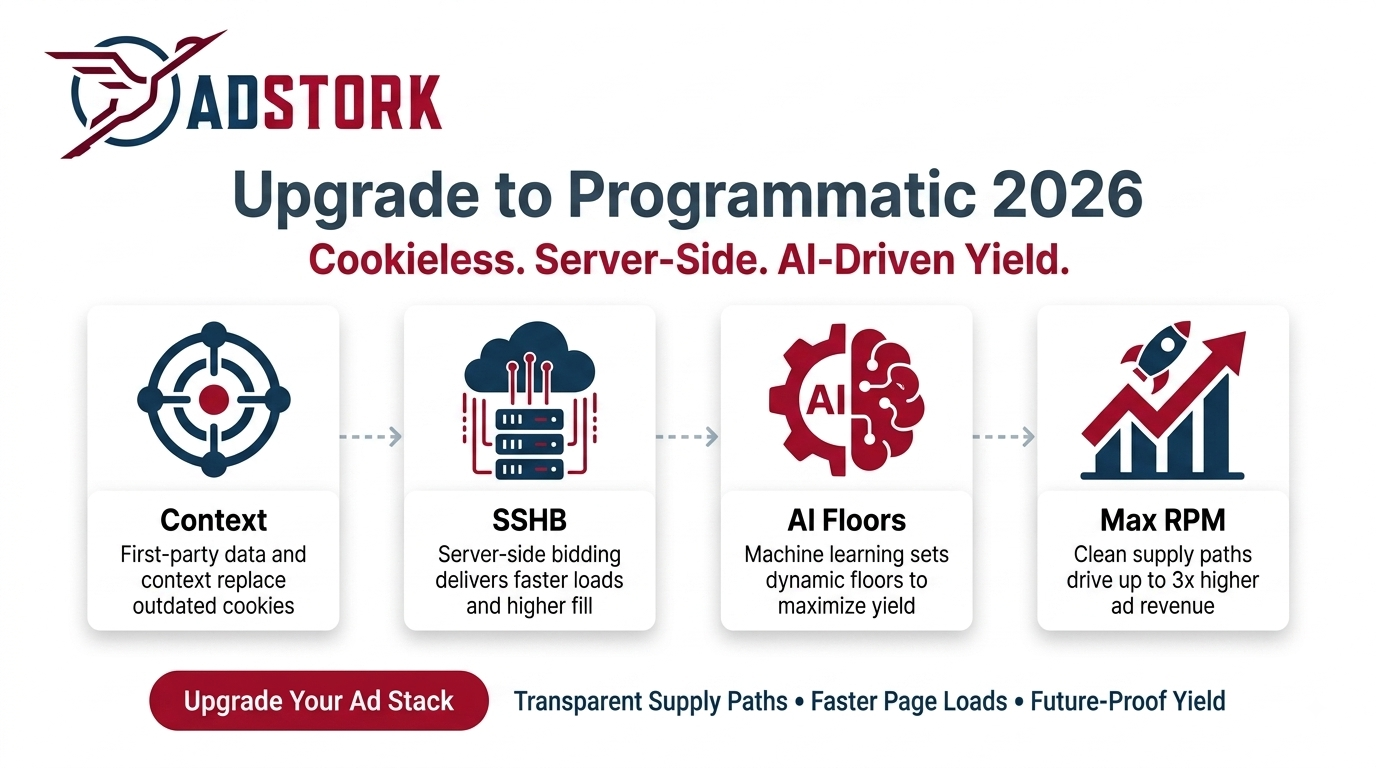
2026 is not 2024. The cookie is crumbling, AI is rewriting bidding strategies, and the old "set it and forget it" ad tag approach is a fast track to revenue decline. Publishers who understand the new programmatic landscape, one governed by contextual signals, server‑side header bidding, and supply path optimization, are already seeing RPM gains of 15‑25% over slower competitors.
This guide breaks down what has changed, what has stayed the same, and the concrete steps you need to protect and grow your ad revenue this year and beyond.
Key Takeaways
- Third‑party cookies are effectively gone; contextual targeting and first‑party data are your new revenue anchors.
- Server‑side header bidding (SSHB) outperforms client‑side setups with faster load times and higher fill rates.
- Supply path optimization (SPO) is no longer optional; you must actively manage which exchanges you route through.
- AI‑powered dynamic floors increase CPMs by 10‑20% without sacrificing fill rates.
- Publishers who adopt multi‑format programmatic strategies see 2‑3x RPM growth compared to single‑format sites.
What Is Programmatic Advertising in 2026?
At its core, programmatic remains the automated buying and selling of digital ad inventory through real‑time auctions. When a user visits your site, an auction occurs in milliseconds, with multiple demand sources bidding for the right to show an ad. The highest bid wins, and the ad loads before the user registers a delay.
What has changed is the currency of the auction. In 2024, the primary signal was the user's browsing history, enabled by third‑party cookies. In 2026, that signal is largely absent. The auction now runs on contextual signals, page topic, keywords, sentiment, first‑party data, user behavior on your own site, and predictive AI models that estimate conversion likelihood without invasive tracking.
For publishers, this is a power shift. You are no longer a passive inventory supplier. Your content and audience relationships are now the primary valuable assets in the auction. Advertisers are paying a premium for safe, contextually relevant environments, not for fragmented user profiles collected across the web.
Neuromarketing insight: people respond more positively to ads that match their immediate context than to ads that track their past behavior. Contextual relevance triggers a fluency heuristic, where the ad feels natural and unobtrusive, reducing defensive resistance. Publishers who optimise for contextual alignment are tapping into a psychological acceptance that cookie‑based ads never achieved.
The Three Pillars of Programmatic Success in 2026
To thrive, you need to master three interconnected pillars: supply path optimization, server‑side header bidding, and AI‑driven pricing. Each builds on the others, and failing at any single pillar will cap your revenue.
Supply Path Optimization (SPO) is the practice of reviewing and pruning the number of intermediaries between your inventory and the final buyer. Every extra hop takes a cut. In 2026, advertisers actively demand short‑path buys. Publishers who offer clean, transparent supply paths win higher CPMs because buyers trust they are not paying for diluted inventory. Audit your ad stack and remove any exchange that does not provide clear demand transparency.
Server‑Side Header Bidding (SSHB) has largely replaced client‑side (browser‑based) bidding. In the old model, multiple bidders ran JavaScript in the user's browser, slowing page loads. SSHB moves the auction to the server, where your ad server calls all demand partners simultaneously without touching the user's device. The result is faster page loads, higher viewability, and the ability to include more bidders without performance penalties. Publishers who switched to SSHB in late 2025 reported an average 12% increase in effective RPM.
AI‑Driven Dynamic Pricing replaces static CPM floors. Machine learning models analyze each impression in real time, factoring in device, geography, time of day, and even the article's engagement metrics. The algorithm sets a floor price that maximises yield without collapsing fill rates. Early adopters have seen CPM increases of 10‑20% across the board, with finance and health niches seeing gains over 30%.
These pillars are not theoretical. Adstork's platform is built on SSHB by default, with integrated SPO reporting that shows exactly which demand partners contribute to your revenue and at what cost. The dashboard also includes AI‑powered floor recommendations that update every hour based on real‑time auction data. See how Adstork's programmatic stack compares to other networks and why publishers are migrating their full inventory to a single, transparent wrapper.
Industry Insight: What the Data Shows in 2026
Analysis across over 500 publisher sites in the Adstork network reveals a clear divergence. Publishers who embraced SSHB and SPO saw effective RPM increase by an average of 18% between Q4 2025 and Q2 2026, while those sticking with client‑side bidding experienced a 7% decline. Advertisers are actively routing budgets toward publishers with verified, cookie‑resilient supply, and they pay a premium for brand‑safe contexts.
Another finding: publishers who diversified beyond display, adding native and video into the same unified auction, achieved 2.4 times higher overall RPM than those running display only. Video and native ads command higher CPMs, and programmatic buyers actively seek these formats. If your ad stack cannot serve video programmatically, you are leaving money on the table.
Comparison Table: Programmatic vs. Traditional Direct Deals
Understanding why programmatic is becoming the default requires comparing it against direct sold inventory across the dimensions that matter most to your revenue and operations.
| Metric | Programmatic (2026) | Direct Deals |
|---|---|---|
| Transaction Speed | Milliseconds (real‑time) | Days to weeks (negotiation) |
| CPM Range | $1 – $15+ (dynamic) | $5 – $50+ (fixed) |
| Fill Rate | 85‑98% (with optimal SPO) | Limited to booked campaigns |
| Audience Targeting | Contextual + first‑party | Publisher defined + custom |
| Operational Overhead | Low (automated) | High (sales + ad ops) |
| Forecast Accuracy | Moderate (real‑time fluctuations) | High (guaranteed placements) |
Future Outlook: Beyond 2026
The current shift is just the beginning. By 2027, programmatic auctions will become predictive, with AI models not just bidding but generating ad creatives in real time based on page content and sentiment. Connected TV and in‑app programmatic are also converging with web inventory, and a single request will serve ads across devices, with algorithms choosing the best fit for the user's context.
Retail media programmatic is another rising wave. E‑commerce publishers are embedding programmatic auctions directly into product pages, generating RPMs that dwarf traditional content sites. Content publishers can replicate this by adding affiliate‑linked programmatic units that show products related to the article, earning both ad revenue and commissions from the same impression.
Programmatic advertising in 2026 is not a single technology; it is a complete rethinking of how publishers and advertisers connect. The winners will embrace transparency, automation, and contextual intelligence. The losers will cling to outdated tracking and fragmented ad stacks.
You do not need to build this from scratch. Adstork offers a fully managed programmatic solution with SSHB, SPO reporting, AI dynamic floors, and multi‑format support in one dashboard. Our publishers have already migrated to the 2026 standard and are seeing the revenue gains to prove it. Start your free Adstork trial today and let our team run a free programmatic audit of your current setup. We will show you exactly where your revenue leaks are and how to fix them within 48 hours.
Your immediate action plan: Audit your current header bidding setup. If you are still on client‑side, request a server‑side migration from your ad partner or switch to a network that offers it by default. Next, review your exchange partners and cut any that do not provide detailed SPO logs. Finally, enable dynamic pricing and run a two‑week A/B test against your static floors. Share your results and we will feature the best case studies in our upcoming publisher success series.
Frequently Asked Questions
Is programmatic advertising still profitable without third‑party cookies? Yes, and often more profitable for quality publishers. The cookie‑less auction relies on contextual and first‑party signals, which value your content directly. Advertisers are shifting budgets to publishers with strong contextual relevance, and CPMs for premium content are rising, not falling.
How does server‑side header bidding affect page speed? Positively. Moving the auction from browser to server eliminates the JavaScript execution that slowed page loads. Publishers who migrated to SSHB saw an average 20% improvement in Largest Contentful Paint (LCP), which also benefits SEO.
What is supply path optimisation and why should I care? SPO reduces intermediaries between you and the advertiser. Each intermediary takes a fee, so shorter paths mean higher revenue for you and lower costs for buyers. Advertisers actively prioritise publishers with transparent, short supply paths.
Can small publishers benefit from programmatic in 2026? Absolutely, but you need a partner that handles the complexity. Full‑scale programmatic with SSHB and SPO is technically intensive for small teams. Look for an ad network that bundles these capabilities into a single integration.
What is the biggest mistake publishers make with programmatic? Relying on a single demand partner and ignoring SPO. Even with great technology, if you route through too many intermediaries or depend on one buyer, you leave revenue on the table.
Keep reading:
• How to Double Your Ad Revenue Without Increasing Traffic
• Popunder Ads vs. Interstitial Ads: Which Pays More for Publishers?
• Why Is My Website Ad Revenue So Low? 10 Problems Publishers Should Check


Leave a Comment