- 26 Aug, 2026
Why Can Two Publishers With the Same Traffic Earn Completely Different Revenue?
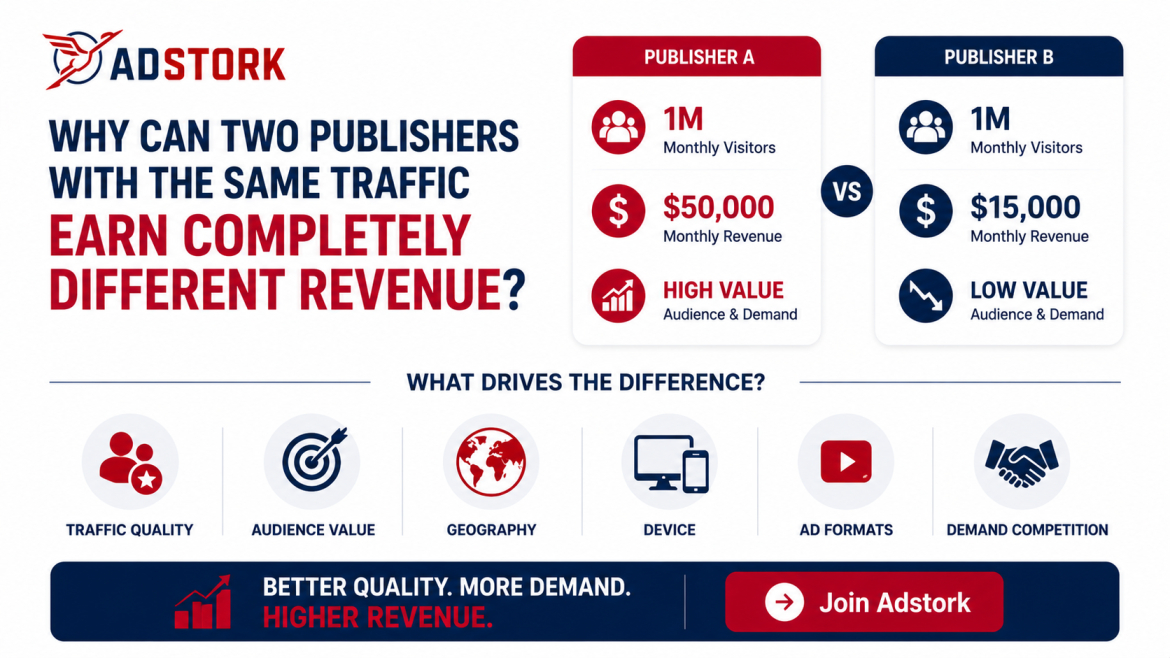
Publisher A and Publisher B both have 1 million monthly visitors. Same traffic volume. Same ad setup. Same basic metrics. But Publisher A earns $50,000 per month. Publisher B earns $15,000.
What gives?
This is the question that frustrates publishers everywhere. They look at the traffic numbers, compare them to competitors, and cannot understand why their revenue lags. The answer is not in the traffic volume. It is in the traffic quality, the audience value, and the advertiser demand that follows.
Traffic is not a commodity. A million visitors to a finance site with engaged subscribers is not the same as a million visitors to a meme site with passive scrollers. Advertisers know the difference. They bid accordingly. The revenue gap reflects that difference.
This guide explains the factors that separate high-earning publishers from low-earning ones, even when the traffic numbers look identical.
Key Takeaways
- Same traffic volume does not mean same revenue—quality, audience, and demand determine earnings.
- A publisher with 500,000 engaged, tier-1 visitors can earn 3-5x more than one with 500,000 passive, tier-3 visitors.
- Traffic quality (engagement, bounce rate, session duration) directly affects advertiser bids.
- Geographic composition is the largest structural factor in revenue differences.
- Monetization strategy—demand partners, ad formats, optimization—determines how much value you capture.
- Top earners combine strong traffic quality, high-value audiences, and competitive demand to maximize revenue.
The Three Pillars of Revenue Difference
The revenue gap between two publishers with the same traffic comes down to three interconnected factors: traffic quality, audience value, and advertiser demand. Each builds on the others.
Traffic quality determines whether visitors are actually engaged with your content or just passing through. Higher engagement means higher advertiser confidence and higher bids.
Audience value determines what advertisers believe they can achieve with your audience. High-value audiences—those with purchase intent, loyalty, and strong demographics—command premium CPMs.
Advertiser demand determines how many bidders compete for your inventory. More competition means higher bids. Less competition means lower bids. Your monetization strategy determines how much of that demand you capture.
These three factors combine to create the revenue gap. Publishers who excel in all three earn multiples of those who ignore them.
Neuromarketing insight: advertisers are not buying traffic. They are buying outcomes. An engaged, high-value audience signals that outcomes are achievable. A passive, low-value audience signals the opposite. The gap in perceived value creates the gap in actual revenue.
1. Traffic Quality
Traffic quality is the first differentiator. Two publishers with the same traffic volume can have dramatically different engagement metrics.
Publisher A has visitors who stay for 3+ minutes, read multiple articles, and return regularly. Bounce rate is 45%. Publisher B has visitors who stay for 30 seconds, read one page, and rarely return. Bounce rate is 85%.
Advertisers can see these differences. They analyze engagement signals and adjust bids accordingly. A visitor who stays 3 minutes is worth far more than a visitor who stays 30 seconds.
The traffic source also matters. Organic search visitors who actively seek your content are more valuable than social media visitors who passively scroll past. Direct visitors who type your URL are more valuable than referral visitors from low-quality sources. Email subscribers are more valuable than one-time visitors.
Publishers who build high-quality traffic through SEO, email, and direct navigation earn significantly more than those who rely on low-quality social or incentivized traffic.
Revenue impact: High-quality traffic can command CPMs 2-5x higher than low-quality traffic.
2. Audience Value
Audience value determines what advertisers believe they can achieve. It is the combination of demographics, purchase intent, and loyalty.
Publisher A has a finance audience with high income, strong purchase intent, and active engagement. They research investments, compare products, and make decisions. Advertisers see high conversion potential. Publisher B has a general entertainment audience with low income, limited purchase intent, and passive consumption. Advertisers see low conversion potential.
The difference is visible in the data. Advertisers use sophisticated tools to analyze audience composition, behavioral patterns, and engagement signals. They bid accordingly.
Geography is a major component of audience value. US audiences command CPMs 3-5x higher than audiences from tier-3 countries. UK, Canadian, and Australian audiences are also premium. European audiences vary by country.
Publishers who build high-value audiences through targeted content, community building, and audience development earn premium CPMs.
Revenue impact: High-value audiences can command CPMs 3-10x higher than low-value audiences.
3. Advertiser Demand
Advertiser demand determines how many bidders compete for your inventory and how much they are willing to pay. More competition means higher bids. Less competition means lower bids.
Publisher A uses header bidding with five SSPs, creating real-time competition for every impression. Multiple bidders compete, driving CPMs higher. Publisher B uses a single SSP, with no competition. The single bidder sets the price, and it is lower.
The difference is structural. More demand partners mean more competition, which means higher bids. It is that simple.
Demand also varies by format, geography, and audience. Some SSPs specialize in certain geos or formats. Publishers who match their demand partners to their inventory see better fill rates and higher CPMs.
Revenue impact: Multi-SSP header bidding can lift CPMs by 20-40% compared to single-SSP setups.
Industry Insight: The Revenue Gap in Numbers
The gap between top-performing and average publishers is substantial. Analysis across publisher sites reveals clear patterns.
Publishers with high traffic quality, tier-1 geos, and multi-SSP demand earn 3-5x more than those with low quality, tier-3 geos, and single-SSP setups. The difference is not theoretical—it is visible in real revenue numbers.
A finance publisher with 500,000 engaged US visitors and five SSPs might earn $15-30 CPM. A meme publisher with 500,000 passive Indian visitors and one SSP might earn $0.50-1.50 CPM. Same traffic volume. 10-30x revenue difference.
The data is clear. Traffic volume is not the revenue driver. Traffic quality, audience value, and demand competition are.
The publishers who earn the most are not necessarily the ones with the most traffic. They are the ones with the best traffic, the most valuable audiences, and the most competitive demand.
Closing the revenue gap requires addressing all three pillars. Adstork connects publishers to multiple premium demand sources through a unified header bidding platform, increasing competition and driving higher CPMs. Our reporting shows you exactly where your traffic quality, audience value, and demand competition stand compared to top performers. Explore Adstork's publisher solutions and see how better demand competition can close your revenue gap.
Comparison Table: Two Publishers, Same Traffic, Different Revenue
Here is a side-by-side comparison of two publishers with the same traffic volume but dramatically different revenue outcomes.
| Factor | High-Earning Publisher | Low-Earning Publisher |
|---|---|---|
| Monthly Visitors | 1,000,000 | 1,000,000 |
| Bounce Rate | 45% | 85% |
| Avg. Session Duration | 3.5 minutes | 45 seconds |
| Geography | US, UK, Canada (80%) | India, Southeast Asia (80%) |
| Traffic Source | Organic, Direct, Email | Social, Incentivized |
| Ad Format | Video, Native, Premium Display | Standard Display, Popunders |
| Viewability | 78% | 42% |
| Demand Partners | 5 SSPs (Header Bidding) | 1 SSP (Waterfall) |
| Average CPM | $8.00 | $1.50 |
| Monthly Revenue | $40,000 | $7,500 |
| Annual Revenue Gap | — | $390,000 |
Same traffic volume. $390,000 annual revenue gap. The difference is not in the traffic count. It is in every factor that makes traffic valuable.
Future Outlook: The Gap Will Widen
The revenue gap between high-earning and low-earning publishers is not shrinking. It is widening. Several trends are accelerating the divergence.
Cookie deprecation is making audience quality more important. Publishers with strong first-party data and engaged audiences will thrive. Those with passive, low-value traffic will struggle.
AI-powered bidding is making advertiser decisions more sophisticated. Bidders will increasingly reward high-quality inventory and punish low-quality inventory. The gap between the two will grow.
Brand safety requirements are becoming stricter. Advertisers will increasingly avoid risky inventory. Publishers with clean, reputable content will capture premium demand.
Supply scarcity is driving value toward premium inventory. As ad supply declines, the premium publishers will capture more of the available spend.
The winners will be those who build high-quality traffic, high-value audiences, and competitive demand. The losers will be those who chase volume at the expense of quality.
Two publishers with the same traffic volume can earn completely different revenue because of traffic quality, audience value, and advertiser demand.
The difference is not in the traffic count. It is in every factor that makes traffic valuable. Publishers who optimise for quality, build high-value audiences, and create competitive demand earn multiples of those who focus only on volume.
The gap is real, measurable, and growing. Understanding it is the first step to closing it.
Adstork helps publishers close the revenue gap by connecting them to multiple premium demand sources, providing transparent reporting on traffic quality and audience value, and offering optimization tools that increase competitive pressure. Sign up for a free Adstork publisher account and get a complimentary revenue gap analysis that shows you exactly where you stand compared to top earners in your niche.
Your immediate action plan: Audit your traffic quality, audience value, and demand competition. Compare your metrics to the high-earning publisher profile in this guide. Identify your biggest gap—is it engagement, geography, viewability, or demand partners? Address that gap first. Test one improvement over two weeks and measure the impact. Share your results with Adstork's optimization team for a personalized revenue growth plan.
FAQs
Why do two publishers with the same traffic earn different revenue? Traffic volume is only one factor. Revenue depends on traffic quality (engagement, sources), audience value (geography, demographics, purchase intent), and advertiser demand (number of bidders, competition). A publisher with high-quality, tier-1 traffic and multiple demand partners earns far more than one with low-quality, tier-3 traffic and a single partner.
How much can traffic quality affect revenue? Significantly. High-quality traffic with strong engagement can command CPMs 2-5x higher than low-quality traffic. The difference compounds across millions of impressions, creating revenue gaps of hundreds of thousands of dollars annually.
What is the biggest factor in revenue differences? Geography is the largest structural factor. US traffic typically earns 3-5x more than tier-3 traffic. Combined with engagement and demand competition, the gap can be 10-30x between high-earning and low-earning publishers.
How can I close the revenue gap? Address traffic quality by building engagement and clean sources. Build audience value by targeting high-value geos and demographics. Increase demand competition by adding SSPs through header bidding. Optimize viewability, formats, and technical performance. Each factor contributes to higher revenue.
Does traffic volume matter at all? Yes, but only after quality and demand are optimized. A high-quality publisher with 100,000 visitors can earn more than a low-quality publisher with 1,000,000 visitors. Volume amplifies quality—it does not replace it.
What is the revenue gap between top and average publishers? Analysis shows that top-performing publishers earn 3-5x more than average publishers with similar traffic volumes. In some cases, the gap can be 10-30x when comparing the best and worst performers.

Leave a Comment