- 24 Aug, 2026
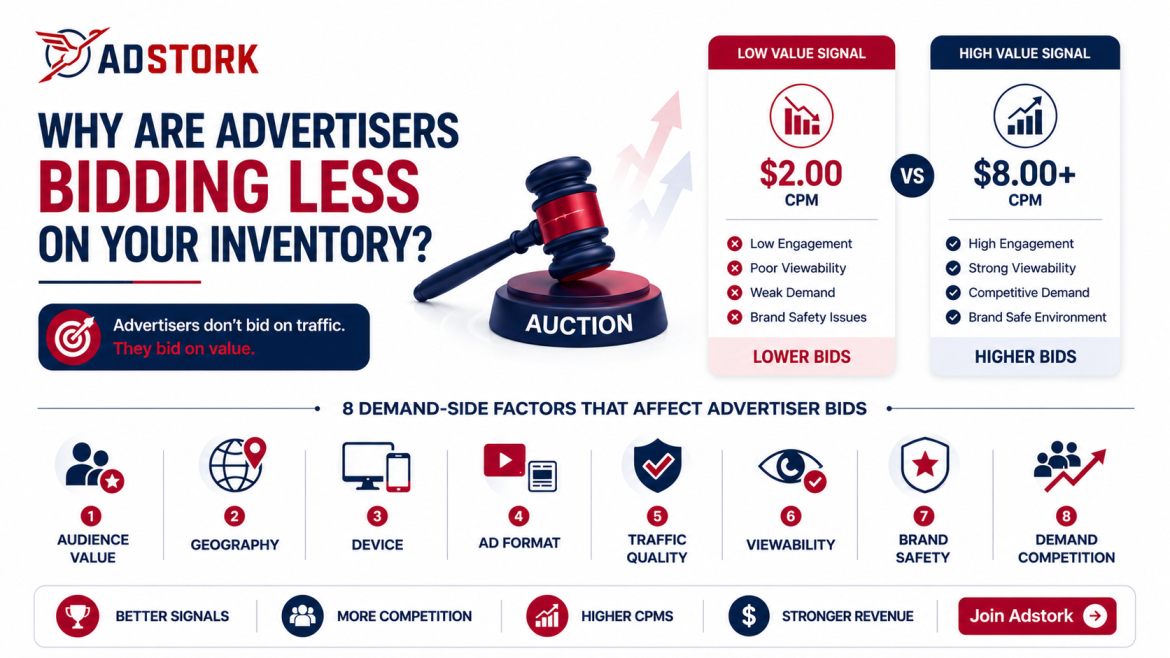
Why Are Advertisers Bidding Less on Your Inventory?
You have done everything right. Your traffic is growing. Your content is solid. Your ad setup is technically sound. But your CPMs are flat or falling. Advertisers are just not bidding what they used to.
The problem is not your setup. It is your signal.
Advertisers do not bid on traffic. They bid on audiences. They bid on the value they expect to extract from each impression. When your CPMs drop, it is because the perceived value of your inventory has dropped. Your audience, placement, format, or context is sending a signal that reduces advertiser confidence.
The publisher-side metrics:- fill rate, eCPM, effective RPM are symptoms. The demand-side factors are the root causes. Understanding why advertisers bid less is the first step to fixing what is broken.
This guide explains the eight demand-side factors that determine advertiser bids and what you can do about each one.
Key Takeaways
- Advertisers bid on perceived audience value, not just traffic volume—low engagement means lower bids.
- Geographic demand varies dramatically—tier-1 traffic earns 3-5x more than tier-3 traffic.
- Desktop and mobile demand differ—optimise for your strongest device mix.
- Viewability below 70% significantly reduces advertiser bids.
- Brand safety concerns can cut CPMs by 50% or more.
- Weak demand competition means lower bids—header bidding with 3-5 partners lifts CPMs by 20-40%.
1. Audience Value
This is the most important factor. Advertisers bid based on the value they expect to extract from an audience. High-value audiences those with strong purchasing power, clear intent, and active engagement command premium CPMs.
What signals high audience value? Deep engagement matters—long session durations, multiple pages per visit, and return visits. Purchase intent is critical—commercial keywords, product research, and buying signals. Demographic quality counts—affluent, educated, and decision-making audiences. Audience loyalty is powerful—subscribers, registered users, and repeat visitors.
Advertisers are sophisticated. They analyse engagement patterns and adjust bids accordingly. A visitor who reads one article and bounces is worth far less than a visitor who explores multiple pages, comments, and returns.
A finance site with engaged subscribers and premium content might command $15-30 CPM. A general news site with passive readers might earn $2-5 CPM. The traffic numbers might be similar. The audience value is not.
Neuromarketing insight: advertisers are not buying impressions. They are buying attention, trust, and action. An engaged audience signals all three. Passive traffic signals none. Publishers who build genuine audience relationships consistently outperform those who chase volume.
Fix: Build deeper audience relationships through quality content, community engagement, and email capture. Segment your audience and offer premium, engaged cohorts to advertisers.
2. Geography
Geography is the most structural factor affecting advertiser bids. Demand and pricing vary dramatically by country.
Tier-1 countries - United States, United Kingdom, Canada, Australia, Western Europe command the highest CPMs. Advertiser budgets are largest, competition is fiercest, and audience purchasing power is strongest. Tier-2 countries - Eastern Europe, Latin America, parts of Asia have lower demand and lower CPMs. Tier-3 countries - Africa, South Asia, parts of Southeast Asia have the lowest demand and CPMs.
The difference is dramatic. US traffic might earn $5-10 CPM. Indian traffic might earn $0.50-1.50. The volume might be similar. The revenue is not.
Geography also affects fill rate. Tier-1 traffic enjoys fill rates above 85%. Tier-3 traffic often struggles below 60%. The combination of lower CPMs and lower fill rates creates a revenue gap that can be 5-10x.
Fix: Accept that geography sets a ceiling on your CPMs. Focus on growing traffic from high-value geos. Add demand partners with strong regional coverage. Consider content strategies that appeal to premium markets.
3. Device
Device type is a significant factor in advertiser bidding. Desktop, mobile web, and mobile app traffic each have different demand profiles and CPMs.
Desktop traffic typically commands higher CPMs than mobile web. Larger screens, more browsing time, and higher purchase intent drive stronger demand. Mobile app traffic especially in premium categories like gaming and entertainment can command high CPMs, often exceeding desktop. Mobile web traffic usually earns the lowest CPMs of the three.
The gap is significant. Desktop CPMs might be 2-3x higher than mobile web for the same audience and geography. Some publishers have seen desktop CPMs 4-5x higher than mobile.
Device also affects user behaviour. Mobile users are often in browsing mode scrolling quickly, consuming content in short bursts. Desktop users are more likely to be in research or purchase mode, spending longer on pages and engaging more deeply with content.
Fix: Optimise your site for the devices where you earn the most. If desktop traffic earns 3x more than mobile, ensure your desktop experience is flawless. Consider app development if your mobile traffic is strong and CPMs justify the investment.
4. Ad Format
The format you use sends a signal to advertisers. Some formats are premium. Others are commoditised.
Video ads command the highest CPMs often $10-25 or more. Native ads typically earn $3-15, depending on placement and audience. Standard display ads earn $1-8, with larger and more viewable units earning more. Popunders and interstitials vary widely, with popunders often earning $2-8 and interstitials $1-5.
The format also affects advertiser perception. Video is seen as high engagement and high value. Native is seen as less intrusive and more effective. Display is seen as baseline inventory. Popunders and interstitials are seen as lower quality, even when they perform.
Format suitability also matters. A news site with native recommendations might see strong CPMs. A gaming site with interstitials might see better performance. Using the wrong format for your audience reduces bids.
Fix: Test different formats to find what works best for your audience and content. Prioritize premium formats like video and native where possible. Ensure your display placements are high quality and viewable.
5. Traffic Quality
Advertisers are increasingly sophisticated about traffic quality. They use sophisticated fraud detection, viewability measurement, and engagement analysis to filter low-quality inventory.
What signals low traffic quality? High bounce rates (80%+) signal users who leave immediately. Short session durations (under 60 seconds) indicate low engagement. Suspicious referral sources suggest incentivized or low-quality traffic. Sudden traffic spikes indicate potential bot activity. Low pages per session (1-2) signal superficial engagement.
Advertisers often filter or reduce bids on low-quality inventory. The CPM difference between high-quality and low-quality traffic can be 2-5x.
Low-quality traffic also affects your long-term reputation. If advertisers consistently see poor performance from your inventory, they will reduce bids or exclude you entirely.
Fix: Audit your traffic sources regularly. Cut sources that drive low-quality traffic. Focus on building high-engagement audiences through quality content and legitimate acquisition channels.
6. Viewability
Viewability is the percentage of impressions that are actually seen by users. It is one of the strongest signals of inventory quality. Advertisers increasingly refuse to pay for inventory that is not viewable.
The industry standard for viewability is 50% of pixels visible for at least one second (display) or two seconds (video). Inventory that meets these standards commands premium CPMs. Inventory that does not is discounted or filtered.
Publishers with viewability above 70% see stronger bids. Those above 80% see premium treatment. Below 50%, advertisers often reduce bids or filter entirely.
Viewability also affects demand competition. More bidders compete for viewable inventory, driving CPMs higher. Less viewable inventory faces limited competition and lower bids.
Fix: Optimize ad placement to maximize viewability. Move ads above the fold. Ensure they load quickly. Avoid placing ads at the bottom of long articles where users rarely scroll. Test different placements and measure viewability.
7. Brand Safety
Brand safety concerns can significantly reduce advertiser bids. Advertisers want their ads to appear in safe, reputable environments. Unsafe or questionable inventory is discounted or avoided.
What signals brand safety concerns? Controversial or sensitive content, politics, violence, adult content. User-generated content with minimal moderation. Low-quality or spammy content. Piracy or copyright infringement. Misinformation or factually questionable content.
Many advertisers use brand safety filters that exclude inventory flagged as unsafe. Other advertisers simply bid less on inventory they perceive as risky.
The CPM impact of brand safety concerns can be dramatic. A brand-safe site might earn $8 CPM. A questionable site might earn $2-3 CPM. The traffic volume might be similar. The revenue is not.
Fix: Ensure your content is brand-safe and clearly categorized. Use content classification tools to signal your content type to advertisers. Avoid controversial or low-quality content that might trigger filters.
8. Demand Competition
This is the structural factor that publishers can most directly influence. Demand competition is the number and quality of bidders competing for your inventory.
If only one demand partner is bidding on your inventory, there is no competition. The bid will be low. If five demand partners are bidding, competition drives the bid higher. This is the core principle of header bidding.
Publishers using header bidding with 3-5 SSPs see 20-40% CPM uplifts compared to single-source setups. More partners mean more competition, which means higher bids.
Demand competition also affects fill rates. If one partner does not bid on a particular impression, another might. More partners mean higher fill rates and more consistent revenue.
Fix: Implement header bidding with multiple SSPs. Add complementary demand partners that bring different demand sources, geographies, and format coverage. Test new partners regularly to ensure you are not leaving demand on the table.
Improving advertiser bids requires addressing these eight factors. Adstork connects publishers to multiple premium demand sources through a unified header bidding platform, increasing demand competition and driving higher bids. Our reporting shows you exactly which factors are affecting your CPMs, audience value, viewability, traffic quality, and more so you can take targeted action. Explore Adstork's publisher solutions and see how better demand competition transforms your CPMs.
Industry Insight: The Bid Gap
Analysis across publisher sites reveals a significant bid gap between well-optimized and poorly-optimized inventory.
Publishers who address all eight factors high audience value, tier-1 geography, optimized device mix, premium formats, clean traffic, strong viewability, brand-safe content, and competitive demand see CPMs 3-5x higher than those who ignore them.
The gap is widest in viewability and demand competition. Publishers with viewability above 70% see 40-60% higher CPMs than those below 50%. Publishers with 3-5 SSPs see 20-40% higher CPMs than single-source setups.
The data is clear. Advertisers are sophisticated. They know what they are buying. They reward quality and penalize low value. Publishers who address these factors capture the premium. Those who ignore them leave money on the table.
Comparison Table: Factors Affecting Advertiser Bids
A quick reference guide to the eight factors and how they affect advertiser bids.
| Factor | High Bid Signals | Low Bid Signals |
|---|---|---|
| Audience Value | Deep engagement, purchase intent, loyalty | High bounce rates, passive consumption |
| Geography | US, UK, Canada, Australia, Western Europe | Africa, South Asia, Southeast Asia |
| Device | Desktop, premium mobile apps | Mobile web, low-quality apps |
| Ad Format | Video, native, premium display | Popunders, interstitials, standard display |
| Traffic Quality | Organic, direct, email, clean referrals | Incentivised, suspicious, bot-heavy |
| Viewability | Above 70% | Below 50% |
| Brand Safety | High-quality, trusted content | Controversial, low-quality content |
| Demand Competition | 3-5 SSPs, header bidding | Single SSP, waterfall |
Future Outlook: The Demand Side in 2026 and Beyond
The advertiser side is evolving rapidly. Several trends will affect how advertisers bid on inventory in the coming years.
Cookie deprecation is shifting advertiser focus to contextual and first-party signals. Publishers with strong contextual relevance and first-party data will see stronger bids. Those without will see weaker demand.
AI-powered bidding is making advertiser decisions more sophisticated. Machine learning models analyze thousands of signals in milliseconds, adjusting bids based on expected value. Publishers who optimize for the right signals will capture higher bids.
Brand safety requirements are becoming stricter. Advertisers are demanding more transparency and control. Publishers who cannot demonstrate brand safety will see reduced demand.
Attention metrics are emerging. Advertisers are moving beyond viewability to measure attention and engagement. Publishers who can demonstrate genuine attention will command premium CPMs.
The publishers who succeed will be those who understand the demand side and optimize for it. Those who focus only on publisher-side metrics will struggle.
Advertisers bid less on your inventory for eight clear reasons: low audience value, unfavorable geography, poor device mix, unsuitable formats, low traffic quality, poor viewability, brand safety concerns, and weak demand competition.
Each factor sends a signal to advertisers about the value of your inventory. Publishers who address these factors see CPMs rise. Those who ignore them see CPMs fall.
Understanding the demand side is essential for long-term revenue growth. Publisher-side metrics like fill rate and eCPM are symptoms. The demand-side factors are the root causes.
Adstork helps publishers address the demand side through multiple premium demand sources, transparent reporting, and optimization tools. Our platform connects your inventory to more bidders, increasing competition and driving higher bids. Sign up for a free Adstork publisher account and get a complimentary demand-side audit that shows you exactly where advertisers are bidding less and how to fix it.
Your immediate action plan: Audit your inventory from the advertiser's perspective. Check your audience engagement, geographic mix, device split, format selection, traffic quality, viewability, brand safety, and demand competition. Identify the weakest factor and address it. Test the impact over two weeks. Share your results with Adstork's optimization team for a personalized demand-side improvement plan.
FAQs
Why are advertisers bidding less on my inventory? Advertisers bid less for eight key reasons: low audience value, unfavorable geography, poor device mix, unsuitable formats, low traffic quality, poor viewability, brand safety concerns, and weak demand competition. Each factor reduces the perceived value of your inventory.
How can I increase advertiser bids? Address the factors that reduce bids—build deeper audience engagement, attract high-value geos, optimise for desktop and premium devices, use premium formats, clean your traffic sources, improve viewability, ensure brand safety, and add demand partners to increase competition.
Does traffic quality affect CPM? Yes, significantly. High-quality traffic with strong engagement commands 2-5x higher CPMs than low-quality traffic. Advertisers use sophisticated tools to filter low-quality inventory and reduce bids accordingly.
How does viewability affect advertiser bids? Viewability is one of the strongest signals of inventory quality. Inventory with viewability above 70% commands premium CPMs. Inventory below 50% is often discounted or filtered. Advertisers increasingly refuse to pay for inventory that is not viewable.
What is brand safety and why does it affect bids? Brand safety refers to the suitability of an environment for advertiser brands. Advertisers want their ads to appear in safe, reputable environments. Unsafe or questionable inventory is discounted or avoided, often with CPM reductions of 50% or more.
How does demand competition affect CPMs? More demand partners mean more competition, which drives higher bids. Publishers using header bidding with 3-5 SSPs see 20-40% CPM uplifts compared to single-source setups. Weak demand competition is a major factor in low CPMs.
Comments (0)
Latest Blog
What Is eCPM and Why Does It Matter?
20 Aug, 2026
Leave a Comment