- 19 Aug, 2026
What Adstork Looks For in a New Publisher: Quality Over Volume
Every day, publishers reach out asking the same question: "How much traffic do I need to work with you?"
The assumption is understandable. Most ad networks operate like assembly lines—the more volume you push through, the more revenue they generate. Publishers naturally assume that traffic volume is the only metric that matters.
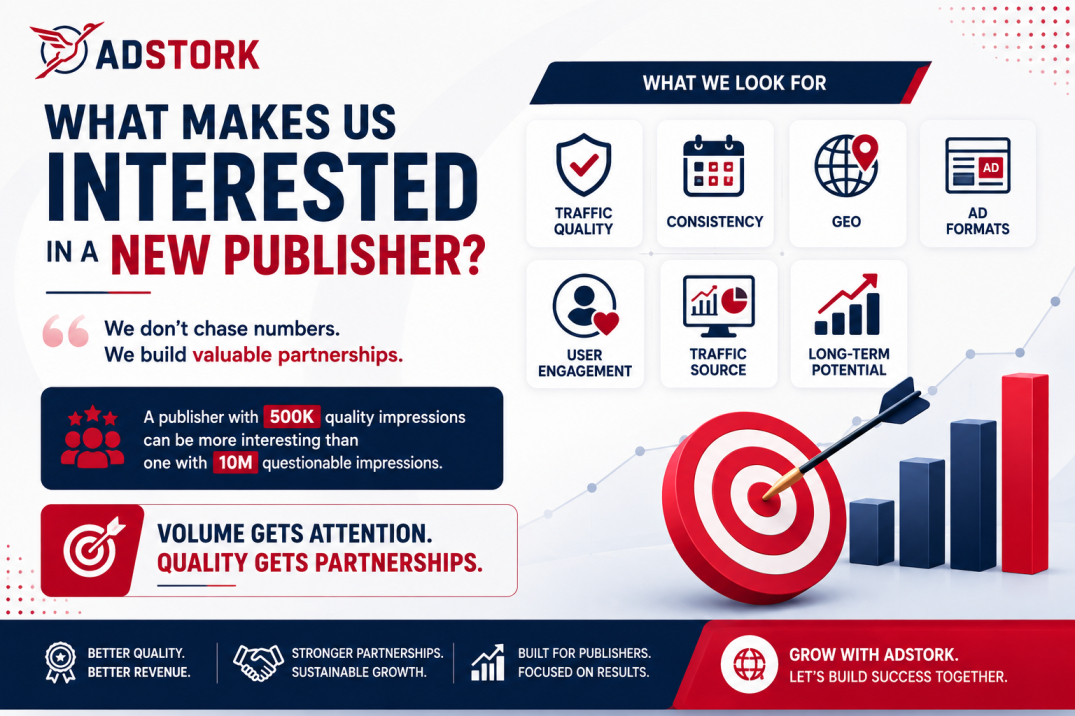
But that is not how Adstork evaluates new publishers. Traffic volume gets attention. But quality gets partnerships.
A publisher with 500,000 quality impressions can be far more interesting than one with 10 million questionable impressions. When advertisers pay for inventory, they are buying audience quality, not just raw volume. High-quality traffic delivers better conversion rates, higher CPMs, and more sustainable revenue for both publishers and the network.
This guide explains exactly what Adstork looks for when evaluating new publishers, why quality matters more than volume, and how you can position your site for a successful partnership.
Key Takeaways
- Traffic volume gets attention, but quality gets partnerships—500K quality impressions beat 10M questionable ones.
- Adstork evaluates seven key factors: traffic quality, consistency, geographic mix, ad format suitability, user engagement, traffic source legitimacy, and long-term potential.
- Quality traffic delivers better conversion rates, higher CPMs, and more sustainable revenue for everyone.
- Low-quality traffic with high bounce rates and poor engagement damages publisher reputation and advertiser confidence.
- Publishers with genuine audience relationships and clean traffic sources will always have a place in our network.
Why Quality Matters More Than Volume
The ad industry has spent years obsessed with scale. More impressions, more clicks, more data. But the landscape has shifted. Advertisers are increasingly focused on quality, not quantity. They want to reach real humans with genuine engagement potential, not bot-driven traffic or passive viewers.
The data tells a clear story. Publishers with high-quality traffic consistently command higher CPMs because advertisers value the trust and engagement that comes with genuine audiences. Low-quality traffic with high bounce rates and minimal user engagement damages publisher reputation and advertiser confidence.
A publisher with 500,000 monthly visitors who actually read content, engage with ads, and return regularly is worth more than a publisher with 10 million visitors who arrive, bounce, and never return. The CPM difference between quality and low-quality traffic can be 2-5x.
Neuromarketing insight: trust is a subconscious heuristic that directly influences purchase decisions. When advertisers perceive a site as low-quality or suspicious, they reduce bids reflexively. This happens automatically, before any logical analysis of the inventory. Publishers with clean, verified traffic sources and genuine user engagement trigger the opposite reaction—higher perceived value and stronger bidding.
The 7 Factors Adstork Evaluates
When we evaluate a new publisher, we look beyond the traffic numbers. Here are the seven key factors we assess before entering into a partnership.
1. Traffic quality. This is the foundation. We assess whether your traffic comes from real, engaged users. Low-quality traffic with high bounce rates, minimal session duration, and questionable engagement patterns is a red flag. We look for sites where users actually read content, navigate between pages, and return over time.
2. Consistency. Is your traffic stable and predictable, or does it spike and crash erratically? Consistent traffic gives advertisers confidence in your inventory. Spikes driven by social media or viral content may look good on paper but often fail to deliver sustained revenue.
3. Geographic diversity. Where does your traffic come from? Advertiser demand and pricing vary dramatically by geography. Publishers with balanced traffic across tier‑1 countries (US, UK, Canada, Australia) typically attract stronger demand and higher CPMs than those heavily reliant on tier‑2 and tier‑3 regions.
4. Ad format suitability. What ad formats work on your site? Different sites naturally perform better with different formats. A news site may excel with native content recommendations, while a gaming site may generate more revenue with video or interstitial ads. We evaluate which formats align with your content and audience.
5. User engagement. How do users interact with your site? Metrics like session duration, pages per visit, and return rates matter. High engagement signals that users find your content valuable, making them more receptive to advertising.
6. Traffic source legitimacy. Where does your audience come from? Organic search, direct navigation, email, and legitimate referrals are valuable. Questionable sources like incentivised traffic, low-quality social media, or automated bots raise concerns. We verify that your traffic acquisition methods align with industry standards.
7. Long-term potential. Beyond your current numbers, what is your trajectory? Are you building a sustainable audience through quality content, SEO, and brand development? Publishers with strong fundamentals and growth potential are the most valuable partners.
Industry Insight: What the Data Shows
The data consistently shows that quality-oriented publishers outperform volume-focused ones. Publishers with high engagement metrics and clean traffic sources earn substantially higher CPMs and build more sustainable revenue models.
Advertisers are increasingly demanding transparency and quality. They want to know where their ads are appearing, who is seeing them, and whether those users are genuine. Publishers who can provide this transparency build trust and attract premium demand.
In a crowded market, quality stands out. Many publishers chase volume, flooding the ecosystem with low-value impressions. The winners are those who focus on building genuine audience relationships, delivering valuable content, and maintaining clean traffic sources.
At Adstork, our top-performing publishers all share one thing in common: they prioritise audience quality over raw scale. They understand that a smaller, engaged audience delivers better returns than a massive, passive one.
If you believe your site delivers quality traffic and you want to partner with a network that values sustainable growth, Adstork offers a transparent, publisher-first approach. We work with you to understand your audience, optimise your ad stack, and build a long-term revenue strategy that rewards quality. Apply to become an Adstork publisher partner and see what happens when quality gets partnerships.
Comparison Table: Quality-Focused vs. Volume-Focused Publishers
Here is how quality-focused and volume-focused publishers compare across the metrics that matter most to sustainable monetisation.
| Metric | Quality-Focused Publisher | Volume-Focused Publisher |
|---|---|---|
| Monthly Traffic | 500,000 | 10,000,000 |
| Bounce Rate | 40-50% | 80-90% |
| Avg. Session Duration | 3+ minutes | 30-60 seconds |
| Pages Per Session | 3-5 | 1-2 |
| Average CPM | $5-$15 | $0.50-$2 |
| Advertiser Confidence | High | Low |
| Long-Term Potential | Strong | Weak |
How to Position Your Site for Partnership
If you want to attract premium advertising partnerships, you need to demonstrate quality. Here is how.
Build genuine audience relationships. Focus on content that matters to your audience. Engage with your community through comments, email, and social media. Build trust through transparency and consistency.
Diversify your traffic sources. Relying on a single traffic source is risky. Build a balanced mix of organic search, direct navigation, social media, email, and referrals. This signals stability and sustainability.
Maintain clean traffic sources. Avoid incentivised traffic, questionable referral sources, or automated bots. These may inflate numbers but damage your reputation and long-term earning potential.
Optimise user engagement. Improve site speed, mobile responsiveness, and content quality. Encourage users to stay longer and explore more pages. Higher engagement signals quality.
Be transparent. Share information about your audience, traffic sources, and content strategy with potential partners. Transparency builds trust.
Future Outlook: Quality Over Volume Will Win
The industry is moving decisively toward quality over volume. Several trends are accelerating this shift.
Cookie deprecation is making audience quality more important than ever. Without third-party cookies, advertisers are relying on contextual signals and first-party data. Publishers with genuine audience relationships are better positioned.
Brand safety concerns are driving advertisers toward trusted, quality publishers. The risk of appearing next to low-quality or questionable content has never been higher.
Privacy regulations are making data collection and use more complex. Publishers who build direct, consent-based relationships with their audiences have a competitive advantage.
AI and automation are making it easier to identify and filter low-quality traffic. Publishers with clean, engaged audiences will benefit from this transparency.
The publishers winning today are not the ones with the most traffic. They are the ones with the best traffic.
Traffic volume gets attention. But quality gets partnerships.
At Adstork, we believe that successful partnerships are built on quality, transparency, and long-term growth. We work with publishers who share our commitment to delivering genuine value to advertisers and audiences alike.
If you are a publisher who prioritises quality over volume, who builds genuine audience relationships, and who wants a partner that values sustainable growth, we want to hear from you. Apply to become an Adstork publisher partner today and discover what happens when quality gets partnerships.
FAQs
What minimum traffic volume does Adstork require? We do not enforce a rigid minimum traffic threshold. We care more about traffic quality than volume. A publisher with 100,000 engaged monthly visitors may be a great fit, while a publisher with 10 million questionable impressions may not.
What makes a publisher "high quality" in Adstork's evaluation? We look for genuine audience engagement, clean traffic sources, consistent growth, geographic diversity, and long-term potential. Metrics like bounce rate, session duration, and return rates matter more than raw traffic numbers.
Does Adstork accept publishers with tier‑2 and tier‑3 traffic? Yes, but we evaluate the quality of that traffic. If you have engaged audiences in tier‑2 and tier‑3 countries, we can work with you. However, fill rates and CPMs will reflect the lower demand in those regions.
How does Adstork verify traffic quality? We use multiple verification tools and signals to assess traffic quality. We look at traffic sources, engagement patterns, suspicious activity, and other indicators to ensure your audience is genuine.
Can a publisher with low traffic but high quality succeed with Adstork? Yes. A smaller but high-quality audience often delivers better CPMs and more sustainable revenue than a larger, low-quality audience. We value publishers who build genuine audience relationships.
What happens if a publisher's traffic quality declines after onboarding? We work with partners to address quality issues before taking action. We provide feedback and recommendations to help you improve. In extreme cases, we may pause or terminate the partnership to protect advertiser confidence.


Leave a Comment