- 26 Aug, 2026
Is Your Highest-Paying Ad Actually Your Best-Performing Ad?
Your dashboard shows one ad unit earning a $12 CPM. You celebrate. You tell your team. You consider shifting all your inventory to that format.
Then you look at your total revenue. It is not moving the way you expected. The headline number looks great. The bottom line does not.
What happened? You confused the highest-paying ad with the best-performing ad. They are not the same thing.
A high CPM ad might look impressive, but it could be cannibalising other revenue streams, reducing fill rates, degrading user experience, or damaging long-term value. The best-performing ad is the one that maximizes your overall yield, not just the individual bid.
This guide explains why the highest-paying ad is often not the best-performing ad, what true yield optimization looks like, and how to evaluate your ad stack for overall performance.
Key Takeaways
- The ad with the highest CPM is not always your best performer, overall yield is what matters.
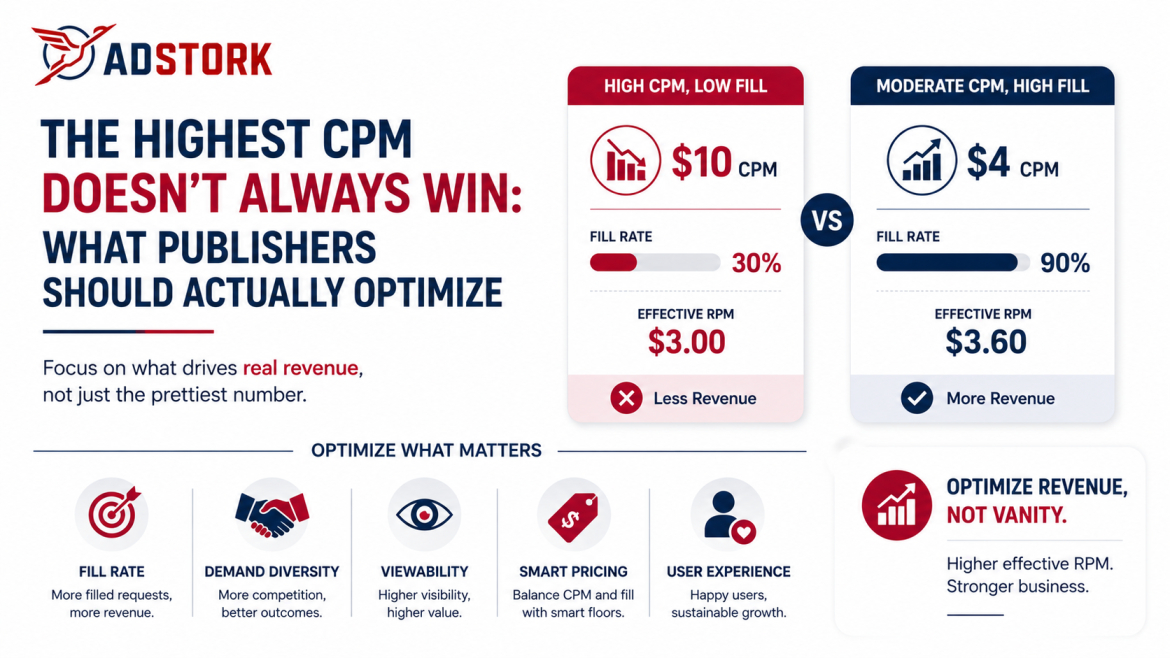
- A $10 CPM ad at 20% fill generates less revenue than a $4 CPM ad at 90% fill.
- High-CPM ads often cannibalise demand from other units, reducing total revenue.
- Viewability, user experience, and impact on adjacent inventory affect overall yield.
- Publishers who optimize for yield—not individual CPM—consistently earn more.
The High CPM Trap, Revisited
The high CPM trap is one of the most persistent misconceptions in publisher monetization. A single ad unit shows a high CPM, and you assume it is your best performer. But CPM is only part of the story.
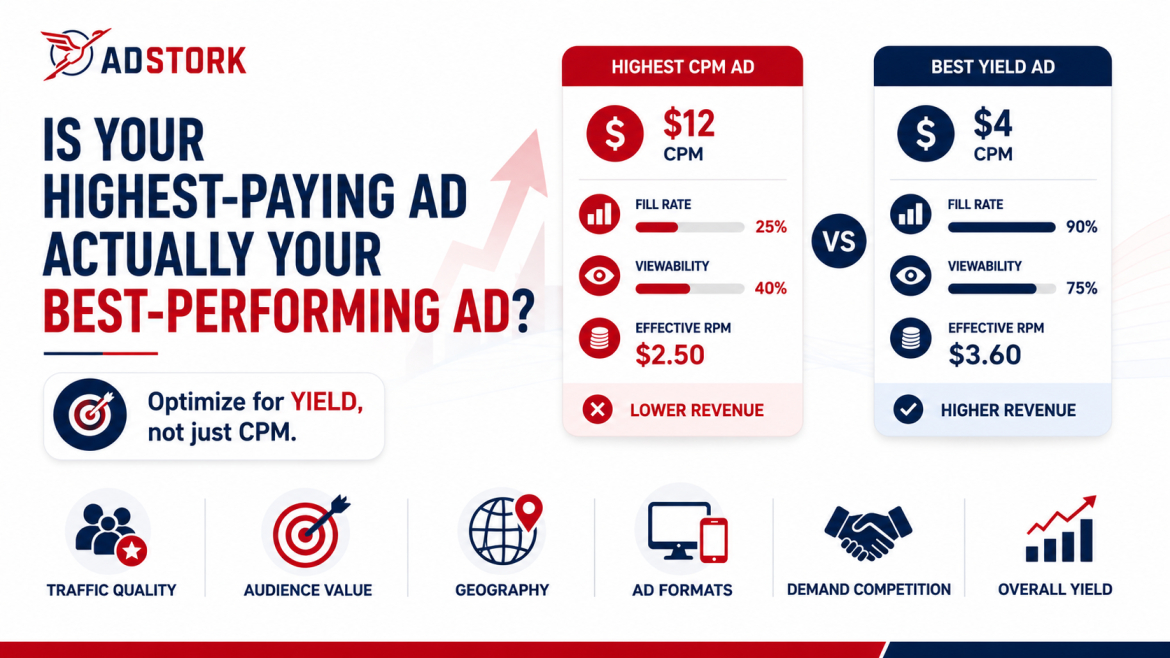
Consider this scenario. Ad Unit A has a $10 CPM but only fills 25% of requests. Ad Unit B has a $4 CPM and fills 90% of requests. Ad Unit A generates $2.50 per 1,000 requests. Ad Unit B generates $3.60 per 1,000 requests. The lower CPM unit is the better performer.
Now add viewability. Ad Unit A has 40% viewability. Ad Unit B has 75% viewability. The effective value of Unit A drops further. Advertisers pay premiums for viewable inventory, and low viewability reduces demand over time.
The high CPM trap is seductive because it focuses on a single, visible number. But that number does not tell you what you actually earn.
Neuromarketing insight: salience bias makes us focus on the most noticeable number. A $12 CPM stands out. A 90% fill rate does not. But the fill rate determines whether you actually see that $12. Publishers who overcome this bias and focus on yield consistently outperform those who chase headline CPMs.
The Truth About Yield
Yield is the total revenue you generate from your inventory. It is the combination of fill rate, CPM, and revenue per session. Optimising for yield requires looking beyond individual ad units to the overall performance of your ad stack.
The highest-paying ad might be hurting your overall yield in several ways.
1. Cannibalisation. A high-CPM unit might be stealing demand from other units. If you have one premium unit that captures all the high-value demand and leaves lower-value demand for other units, your total revenue might be lower than if you spread demand more evenly.
2. Fill rate trade-offs. High CPM units often have lower fill rates. The high price scares off some buyers, leaving impressions unfilled. A moderate CPM unit with higher fill might generate more total revenue.
3. Viewability penalties. Some high-CPM units have poor viewability. Advertisers see this and reduce bids over time. The unit might look good today but degrade in value.
4. User experience damage. Aggressive high-CPM units often degrade user experience. High ad density, intrusive formats, or slow-loading creatives drive users away. Lower session duration and higher bounce rates reduce long-term revenue.
5. Long-term audience value. The best-performing ad is the one that balances short-term revenue with long-term audience retention. A high-CPM unit that drives users away might earn more today but reduce earnings tomorrow.
Industry Insight: The Yield Gap in Practice
Analysis across publisher sites reveals a significant gap between headline CPM and actual yield. Publishers who optimise for yield outperform those who chase high CPMs.
A publisher with a $6 average CPM but 85% fill rate and strong viewability might earn more than a publisher with a $10 CPM but 55% fill rate and weak viewability. The gap is visible in total revenue, not in headline numbers.
The most successful publishers use multiple formats and demand sources, balancing high-CPM units with high-fill units. They prioritise overall yield over individual unit performance. They understand that the best-performing ad is the one that contributes to total revenue, not the one with the highest single bid.
This is particularly true with header bidding. Publishers with 3-5 SSPs see higher overall yields because competition drives up bids across all units, not just the premium ones. The aggregate effect is more important than any single bid.
The takeaway is clear: chasing the highest CPM is a losing strategy. Optimising for yield is the winning approach.
Optimising for yield requires visibility into your entire ad stack—not just individual CPMs. Adstork provides transparent reporting that shows fill rate, viewability, and revenue per session for each ad unit and demand partner. You can see which units are truly performing and which are just chasing headline numbers. Explore Adstork's reporting tools and start optimising for yield, not vanity metrics.
Comparison Table: Highest CPM vs. Best Yield
Here is how a publisher chasing the highest CPM compares to one optimising for overall yield.
| Metric | Chasing Highest CPM | Optimising for Yield |
|---|---|---|
| Highest Unit CPM | $12.00 | $8.00 |
| Overall CPM | $4.50 | $6.00 |
| Fill Rate | 55% | 85% |
| Viewability | 45% | 72% |
| Revenue Per Session | $0.08 | $0.14 |
| Monthly Revenue (1M requests) | $4,500 | $6,000 |
| User Experience | Poor (intrusive units) | Good (balanced approach) |
| Long-Term Sustainability | Weak (drives users away) | Strong (retains audience) |
The publisher optimising for yield earns 33% more revenue, has better viewability, and preserves user experience. The headline CPM is lower. The total revenue is higher.
Future Outlook: Yield Optimisation in 2026 and Beyond
The future of publisher monetisation is yield optimisation, not CPM chasing. Several trends are reinforcing this shift.
AI-powered optimisation is making yield optimisation more sophisticated. Machine learning models analyse the entire ad stack, adjusting floor prices, demand routing, and ad placement to maximise overall yield.
Unified measurement is becoming the standard. Publishers are moving away from fragmented dashboards and toward unified platforms that show the complete picture—fill rate, CPM, viewability, and revenue per session, all in one place.
User experience focus is intensifying. Publishers who prioritise user experience are seeing better long-term retention and higher lifetime value. Intrusive, high-CPM units that degrade experience are becoming less viable.
Privacy regulations are making audience quality more important. Publishers who build trust and engagement with their audiences will command premium yields.
The publishers who thrive will be those who optimise for yield, not CPM. They will balance multiple formats, demand sources, and user experience considerations. They will understand that the highest-paying ad is rarely the best-performing ad.
The highest-paying ad is rarely your best-performing ad. The ad with the highest CPM might look impressive, but it could be cannibalising other revenue streams, reducing fill rates, degrading user experience, or damaging long-term value.
The best-performing ad is the one that maximises your overall yield—the combination of fill rate, CPM, viewability, and revenue per session. Publishers who optimise for yield consistently earn more than those who chase headline CPMs.
Adstork helps publishers optimise for yield with transparent reporting, multi-SSP demand, and optimisation tools that show you the complete picture. Sign up for a free Adstork publisher account and get a complimentary yield analysis that shows you exactly where you are leaving revenue on the table.
Your immediate action plan: Audit your ad stack. Identify your highest-CPM unit. Compare its effective RPM and revenue per session to your other units. Is it actually generating the most revenue? If not, investigate why. Is it cannibalising demand? Hurting viewability of other units? Degrading user experience? Adjust accordingly. Test the impact over two weeks. Share your results with Adstork's optimisation team for a personalised yield improvement plan.
Frequently Asked Questions
Why isn't the highest-paying ad my best-performing ad? Because CPM only shows what an advertiser agrees to pay, not what you actually earn. A high CPM unit might have low fill rate, poor viewability, or cannibalise demand from other units. The best-performing ad is the one that maximises your overall yield.
What is yield optimisation? Yield optimisation is the practice of maximising total revenue from your inventory by balancing fill rate, CPM, viewability, demand diversity, and user experience. It looks beyond individual unit performance to overall revenue outcomes.
How do I know if a high-CPM unit is hurting my yield? Look at its impact on adjacent units. Is it capturing demand that would otherwise go to other units? Does it have low fill rate or viewability? Is it degrading user experience? These factors reduce overall yield even when CPM is high.
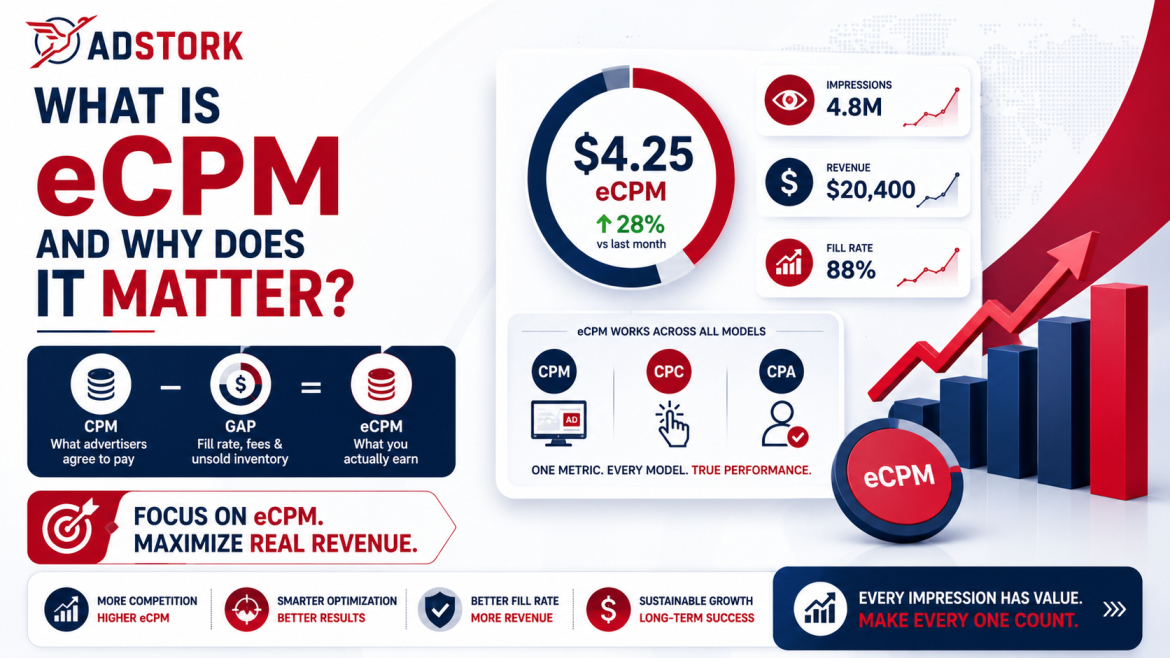
What metrics should I track instead of CPM? Track effective RPM (CPM × Fill Rate), revenue per session, overall fill rate, and viewability. These metrics give you a complete picture of your monetisation performance. Individual CPM is only one piece of the puzzle.
Can a lower CPM unit outperform a higher CPM unit? Yes. A $4 CPM unit with 90% fill and strong viewability often outperforms a $10 CPM unit with 25% fill and poor viewability. The lower CPM unit generates more total revenue.
How do I optimise for overall yield? Start by measuring your yield across all units and demand partners. Identify underperforming segments. Test adjustments—adding demand partners, changing floor prices, adjusting ad placement and measure the impact on overall revenue. Prioritise balance over individual unit performance.

Leave a Comment