- 05 Oct, 2026
What Happens to Ad Revenue During Major Traffic Events (And Why It's Not Always Good)
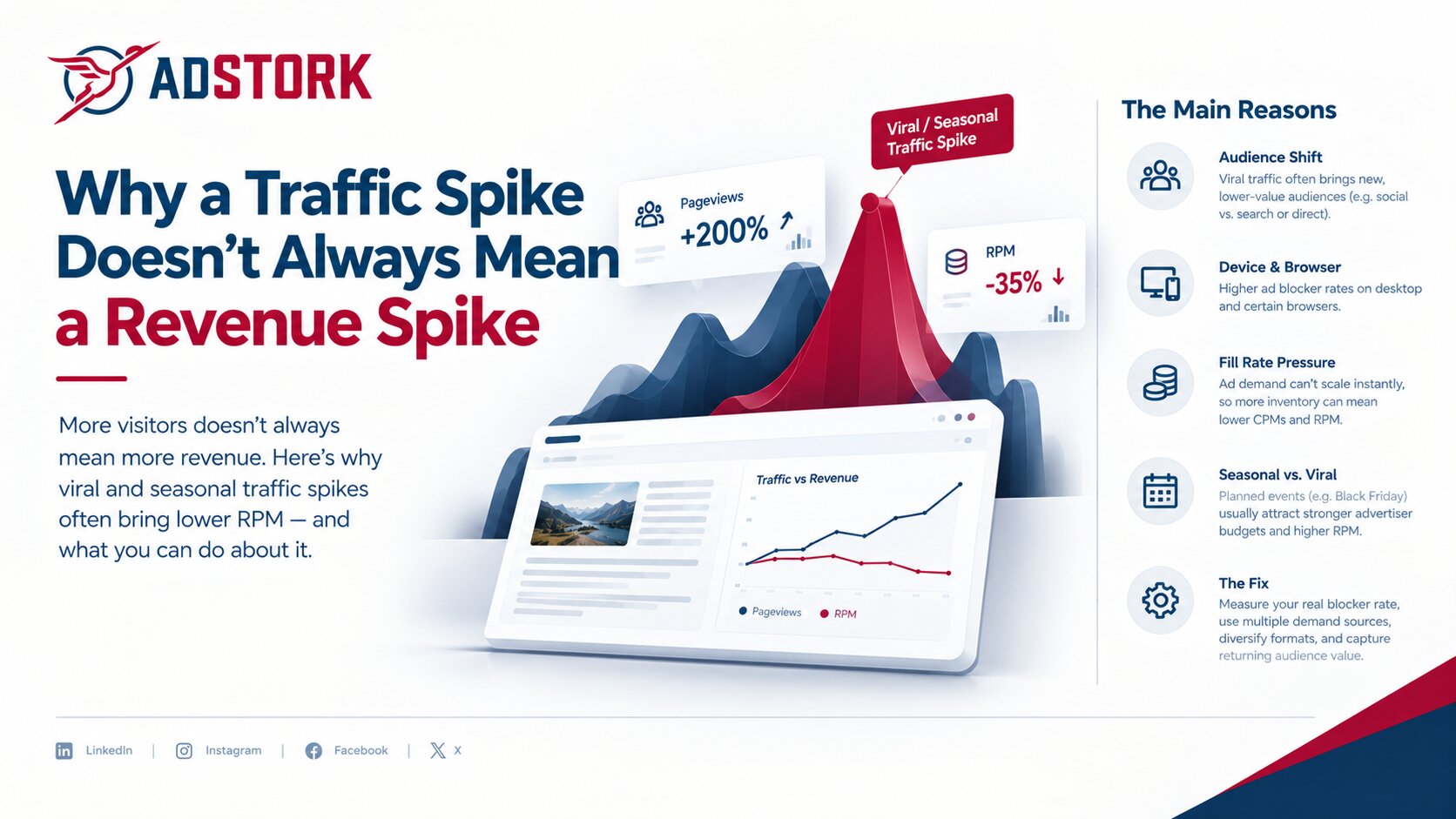
A post goes viral. Traffic triples overnight. The publisher checks their revenue dashboard expecting a matching spike, and instead finds RPM quietly dropping while pageviews climb. The excitement of a traffic surge turns into confusion within a day.
This happens often enough that it deserves an explanation beyond "sometimes that's just how it goes." There are specific, predictable reasons a traffic spike does not translate into a proportional revenue spike, and understanding them changes how a publisher should actually prepare for one.
In short: Sudden traffic surges, whether from viral content, breaking news, or seasonal shopping events, often monetize at a lower RPM than normal traffic because of changes in audience composition, fill rate pressure, and advertiser budget timing. Understanding why prevents publishers from misreading a successful traffic event as a broken ad setup.
Key Takeaways
- Traffic spikes often bring in lower-value audience segments than a site's normal baseline traffic.
- Sudden volume increases can outpace demand, dropping fill rate and effective CPM at exactly the moment a publisher expects the opposite.
- Seasonal events like Black Friday behave differently from viral spikes because advertiser budgets are deliberately concentrated around them.
- A traffic spike is a one-time event unless a publisher has a plan to convert part of it into returning audience.
1. Why Viral Traffic Often Monetizes Worse Than Normal Traffic
A viral spike usually arrives through a different channel than a site's normal traffic, often social sharing rather than search or direct visits. That shift in traffic source matters more than most publishers realize. Social traffic typically converts to ad revenue at a meaningfully lower rate than search or direct traffic, partly because these visitors tend to read one page and leave rather than exploring further, and partly because advertisers assign lower value to audiences arriving through social referral compared to audiences who sought the content out directly.
The visitors are also frequently new to the site, meaning there is no return-visit history, no prior engagement signal, and often a different geographic mix than the site's usual audience, sometimes skewing toward regions that command lower CPMs.
2. The Fill Rate Problem Nobody Warns Publishers About
Ad demand is not infinite and does not scale instantly. A site that triples its traffic overnight also triples its ad requests, but the number of advertisers bidding on that inventory does not triple along with it. The result is a sudden gap between supply and demand, where impressions that would normally fill at a healthy rate go partially unsold or get filled at much lower backup rates.
This is one of the more counterintuitive mechanics in programmatic advertising. More inventory, arriving faster than demand can absorb it, often results in a lower average price per impression, not a higher one.
3. Why Seasonal Events Behave Differently From Viral Spikes
Black Friday, the holiday shopping season, and similar planned events are a different situation entirely. Unlike a random viral spike, advertisers know these events are coming and deliberately concentrate budget around them months in advance. This means demand actually does scale up to meet the seasonal traffic increase, and CPMs during these windows often rise rather than fall, sometimes significantly, because retail and e-commerce advertisers are competing hard for exactly this kind of commercial-intent attention.
The distinction matters: a publisher should expect a viral spike to compress RPM, and a well-timed seasonal spike to expand it, assuming their content and audience are relevant to what advertisers are spending on that season.
4. What Publishers Can Actually Do to Prepare
- Set expectations before the event, not after. Knowing in advance that RPM typically dips during a viral spike prevents a false alarm that leads to unnecessary setup changes mid-surge.
- Use multiple competing demand sources. A setup with several demand sources bidding simultaneously absorbs sudden volume increases far better than a single-buyer setup, since there are more potential bidders to catch the overflow inventory.
- Capture the spike for later, not just now. A newsletter signup prompt or a simple on-page nudge during a traffic surge can convert a fraction of one-time visitors into a returning audience, turning a single event into compounding value.
- Plan seasonal content ahead of the demand curve. For predictable events like Black Friday, publishing relevant content weeks in advance lets it rank and accumulate traffic before the highest-CPM window actually arrives.
5. Where Adstork Fits In
Sudden traffic surges are exactly where a single fixed-rate network setup shows its limits. Adstork connects publishers to multiple competing demand sources simultaneously, which means a sudden volume increase has more places to find a bid rather than overwhelming one buyer's limited demand. For planned seasonal events, this also means publishers are positioned to capture rising advertiser budgets rather than being capped by whatever one network decided to allocate.
6. Being Honest About the Limits
No setup fully eliminates the RPM dip that comes with a sudden, unplanned viral spike. The audience composition problem, new visitors with no engagement history, often arriving from lower-value channels, is structural, not a technical issue a network can fully solve. The realistic goal is softening the dip and capturing lasting value from the event, not preventing the dip entirely.
Viral Spike vs. Seasonal Spike
| Factor | Viral Spike | Seasonal Spike (e.g. Black Friday) |
|---|---|---|
| Advertiser demand | Unprepared, lags behind supply | Pre-planned, scales with traffic |
| Typical RPM impact | Decreases | Often increases |
| Audience quality | Often new, low engagement history | Mix of returning and new, commercial intent |
| Predictability | Low, hard to prepare for | High, can be planned months ahead |
What's Next for Traffic Spike Monetization
As AI-driven traffic patterns continue to shift how and when surges happen, including sudden spikes from being cited in AI answer engines, publishers who already have multiple demand sources and audience-capture mechanisms in place will be far better positioned to monetize unpredictable traffic events than those relying on a single, slower-to-adapt setup.
Final Word
A traffic spike is not automatically a revenue spike, and understanding why prevents a publisher from panicking over a dashboard that is behaving exactly as expected. At Adstork Ad Network, multiple competing demand sources help absorb sudden volume increases and capture rising seasonal budgets, so publishers get the most realistic outcome a given traffic event can actually produce.
Ready for a setup built to handle traffic surges, not just steady-state traffic? Partner with Adstork Ad Network today.
FAQs
Why did my RPM drop when my traffic went viral? Viral traffic often arrives through lower-converting channels like social media, comes from new visitors with no engagement history, and can outpace advertiser demand, all of which push RPM down even as pageviews rise.
Does Black Friday traffic monetize better than normal traffic? Often yes, because advertisers plan and concentrate budget specifically around seasonal shopping events, unlike an unplanned viral spike where demand has not prepared for the surge.
Can I prevent RPM from dropping during a traffic spike? Not entirely, but using multiple competing demand sources and capturing part of the spike into a returning audience, such as through newsletter signups, softens the impact and extends the event's value.
Why does fill rate drop during high-traffic moments? Advertiser demand does not scale instantly. A sudden increase in ad requests can outpace the number of advertisers actively bidding, leaving some inventory unfilled or filled at lower backup rates.
Should I prepare content in advance for seasonal traffic events? Yes. Publishing relevant content weeks ahead of events like Black Friday allows it to rank and build traffic before the highest-demand window arrives.
How does Adstork help during sudden traffic increases? By connecting publishers to multiple competing demand sources simultaneously, which absorbs sudden volume spikes better than relying on a single buyer's limited demand.


Leave a Comment