- 05 Oct, 2026
Why Ad Blockers Aren't the Revenue Killer Publishers Think They Are
Check any publisher forum and you will find the same anxiety repeated in different words: ad blockers are eating revenue, adoption keeps climbing, and there is nothing to do about it except watch the dashboard slowly decline. It is treated as an unstoppable force, something publishers simply absorb.
That framing is mostly wrong. Ad blocker usage is real, but the revenue impact on most sites is smaller than assumed, and a meaningful share of it is recoverable.
In short: Ad blockers affect a real but often overstated share of publisher traffic, typically concentrated in specific audience segments rather than evenly spread across a site. Acceptable ads programs, blocker detection, and format diversification recover a meaningful portion of that lost revenue without requiring an aggressive anti-adblock approach that damages user trust.
Key Takeaways
- Ad blocker usage is not evenly distributed. It concentrates heavily among specific demographics, devices, and content categories.
- Most publishers overestimate their actual blocked-impression percentage because they have never measured it directly.
- Acceptable ads programs recover revenue from blocker users without an aggressive confrontation approach.
- Format choice matters. Some formats are blocked far less often than others.
1. Why the Fear Is Bigger Than the Actual Number
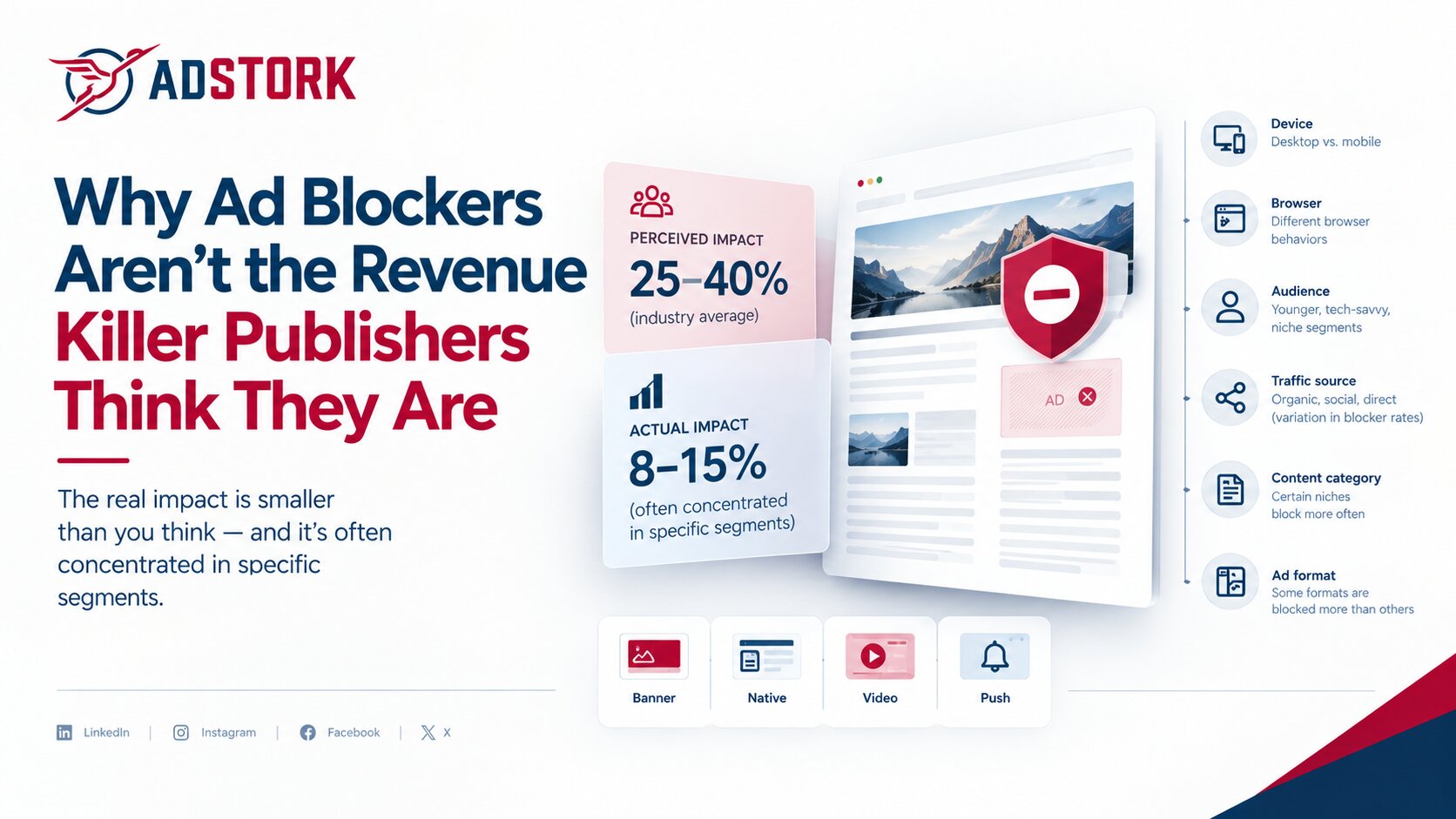
Most publishers have a vague sense that "a lot" of their traffic uses ad blockers, but very few have actually measured it. The number that gets repeated across the industry, often somewhere between 25% and 40% globally, is an average across the entire internet. It is not your number.
Blocker usage varies enormously by audience. Tech-savvy, younger, desktop-heavy audiences block at much higher rates than general consumer audiences on mobile. A finance or lifestyle site with a broad, mobile-majority audience is likely blocking far less than the oft-quoted average. A developer-focused or privacy-conscious niche site is likely blocking far more. The first step to addressing the problem is finding out the actual number instead of assuming the industry average applies.
2. How to Measure Your Real Ad Blocker Rate
- Compare ad requests to pageviews. If your analytics shows significantly more pageviews than your ad server shows ad requests, the gap is a rough proxy for blocked impressions.
- Use blocker detection scripts. A simple detection script can report the percentage of visits where ad slots failed to load, giving a far more accurate number than estimation.
- Segment by device and traffic source. Blocker rates on desktop are typically much higher than mobile, and rates often differ sharply between organic search traffic and direct or social traffic.
Publishers who run this audit are often surprised. A rate assumed to be 30% frequently turns out to be 8-12% once measured directly, concentrated almost entirely in one device or traffic segment rather than spread evenly across the whole audience.
3. What Actually Recovers Revenue From Blocked Traffic
- Acceptable ads programs. Many blocker tools whitelist ads that meet non-intrusive standards (no auto-play sound, no pop-ups, clear labeling). Formats built to these standards often render even for users running a blocker.
- Polite blocker detection. A soft message asking users to consider disabling the blocker, framed around supporting the content they are reading, converts a meaningful share of visitors without feeling hostile.
- Native ad formats. Native ads are structured to blend with page content rather than appear as a distinct, blockable element, which means many are not caught by standard filter lists.
- Push and in-page push formats. These typically run through a separate delivery mechanism from traditional display tags, so standard blocker filter lists frequently miss them entirely.
4. Where Adstork Fits In
This is a specific area where format diversity pays off directly. Publishers running a single banner-only setup lose the entire impression the moment a blocker catches the tag. Adstork gives publishers access to native, push, and video alongside standard banners, so when one format gets filtered, the others frequently still render. Combined with anti-fraud and delivery optimization built into the platform, publishers get a more realistic picture of what their blocker-affected traffic is actually costing them, and a practical way to recover a meaningful share of it.
5. Being Honest About the Limits
None of this recovers 100% of blocked impressions. A portion of any audience will always use a blocker specifically to avoid all advertising, and no format or detection strategy changes that. The goal is not elimination. It is reducing an overestimated problem down to its real, usually much smaller, size, and recovering what is realistically recoverable without resorting to aggressive tactics that damage the reader relationship a site depends on.
Perceived vs. Actual Blocker Impact
| Factor | Commonly Assumed | Typically Measured |
|---|---|---|
| Blocker rate (general audience) | 25-40% | 8-15%, concentrated by segment |
| Distribution | Even across all traffic | Concentrated on desktop, niche audiences |
| Recovery potential | None | Partial, via format mix and detection |
What's Next for Blocker-Affected Revenue
As privacy tools become more mainstream and browser-level blocking features expand, the trend is likely to continue rising gradually rather than spiking. Publishers who build measurement and format diversity into their setup now will be far better positioned than those who keep treating it as an unmeasured, unmanaged assumption.
Final Word
Ad blockers are real, but the revenue story most publishers tell themselves is worse than the data usually supports. Measuring the actual rate, diversifying formats, and using acceptable, non-intrusive ad standards recovers meaningful revenue without an adversarial approach. At Adstork Ad Network, format diversity is built in from day one, so blocked impressions in one format have a real chance of being recovered in another.
Ready to see what your blocker-affected traffic is actually worth? Partner with Adstork Ad Network today.
FAQs
How much revenue do ad blockers actually cost publishers? It varies significantly by audience. Many publishers assume 25-40% based on industry averages, but measured rates are often 8-15%, concentrated in specific traffic segments.
Can native ads really bypass ad blockers? Many native formats are not caught by standard filter lists because they are structured as page content rather than a distinct, recognizable ad element, though this is not guaranteed for every blocker.
What are acceptable ads programs? Industry standards that whitelist non-intrusive ad formats within certain blocker tools, meaning ads meeting those standards can render even for users running a blocker.
Is it worth asking users to disable their ad blocker? A polite, context-framed request can convert a meaningful share of visitors, particularly on content-driven sites, but aggressive or forced detection messages often backfire and increase bounce rate.
How do I measure my site's real ad blocker rate? Compare ad requests to pageviews, use a blocker detection script, and segment the results by device and traffic source rather than relying on industry-wide averages.
How does Adstork help with ad blocker recovery? By giving publishers access to multiple formats, including native and push, so a blocked impression in one format still has a chance of rendering through another.




Leave a Comment