- 27 Aug, 2026
What Makes a Website Valuable to Advertisers? 7 Key Factors
Most publishers believe that more traffic is the answer to everything. More visitors means more ad revenue, right?
Not exactly.
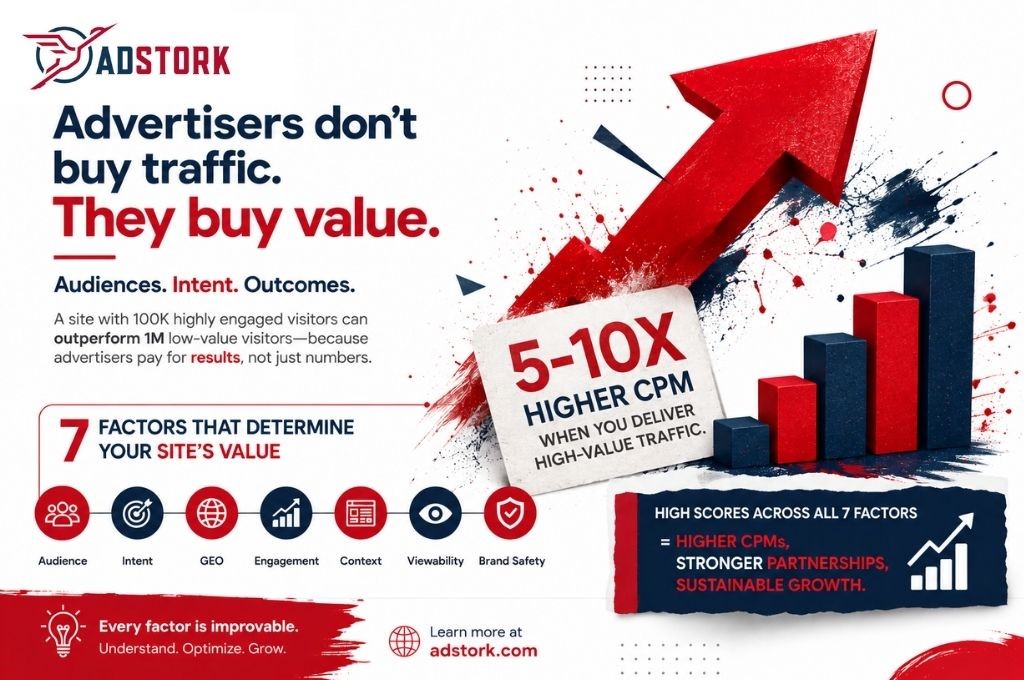
Advertisers do not buy traffic. They buy audiences. They buy outcomes. They buy the likelihood that a person will see their message, engage with their brand, and take action.
A website with 100,000 highly engaged, high-value visitors can be worth more to advertisers than a site with 1,000,000 passive, low-value visitors. The difference is not in the traffic count. It is in the value advertisers assign to that traffic.
Understanding what makes your website valuable to advertisers is the key to unlocking higher CPMs, stronger partnerships, and sustainable revenue growth. This guide breaks down the seven factors that determine your site's value—and how to maximize each one.
Key Takeaways
- Advertisers don't buy traffic—they buy audiences, intent, engagement, and outcomes.
- A site with 100,000 high-value visitors can earn more than one with 1,000,000 low-value visitors.
- Seven factors determine advertiser value: audience, intent, geography, engagement, context, viewability, and brand safety.
- High scores across all seven factors command CPMs 5-10x higher than poor scores.
- Every factor is improvable—understanding them is the first step to increasing your site's value.
1. Audience: Who Is Visiting Your Site?
Audience is the foundation of advertiser value. Advertisers want to know who they are reaching—demographics, purchasing power, lifestyle, and loyalty.
A high-value audience has strong demographics—affluent, educated, decision-makers. They are loyal—returning regularly, engaging deeply with content. They have purchasing power—they buy products and services. They trust your brand—they see you as an authority.
A low-value audience has weak demographics—low income, limited education. They are passive—bouncing quickly, engaging superficially. They have limited purchasing power. They lack trust in your brand.
Advertisers can see these differences. They use sophisticated tools to analyse audience composition. They bid accordingly.
Neuromarketing insight: trust is a subconscious heuristic. When advertisers perceive your audience as high-value, they bid higher automatically. This happens before any logical analysis of the inventory. Build audience trust through quality content and transparent relationships.
How to improve: Build genuine audience relationships through quality content, community engagement, and email capture. Segment your audience and understand who they are. Focus on attracting high-value demographics through targeted content and acquisition strategies.
2. Intent: What Are Your Visitors Looking For?
Intent is the second most important factor. Advertisers pay premium rates for audiences with commercial intent—people who are actively researching, comparing, and buying.
High-intent audiences search for product reviews, compare features, read buying guides, and look for recommendations. They are in the market for something. They are ready to act.
Low-intent audiences are browsing passively. They are not actively seeking products. They are not in the market. They are consuming content for entertainment, not research.
The difference is visible in search queries. Someone searching "best laptop under $1000" is high-intent. Someone searching "funny cat videos" is low-intent.
How to improve: Create content that targets commercial keywords. Write buying guides, product reviews, comparison articles, and "best of" content. This attracts visitors who are actively in the market and commands premium CPMs.
3. GEO: Where Are Your Visitors Located?
Geography is the largest structural factor in advertiser value. Demand and pricing vary dramatically by country.
Tier-1 countries—United States, United Kingdom, Canada, Australia, Western Europe—command the highest CPMs. Advertiser budgets are largest, competition is fiercest, and audience purchasing power is strongest.
Tier-2 countries—Eastern Europe, Latin America, parts of Asia—have lower demand and lower CPMs. Tier-3 countries—Africa, South Asia, parts of Southeast Asia—have the lowest demand and CPMs.
The difference is dramatic. US traffic might earn $5-10 CPM. Indian traffic might earn $0.50-1.50. The volume might be similar. The revenue is not.
How to improve: Accept that geography sets a ceiling on your CPMs. Focus on growing traffic from high-value geos. Create content that appeals to US, UK, and other premium markets. Consider localised content strategies for different regions.
4. Engagement: How Do Visitors Interact With Your Site?
Engagement signals how deeply visitors connect with your content. Advertisers pay more for audiences that are truly engaged.
High engagement means longer session durations—visitors staying 3+ minutes. More pages per visit—exploring 3-5 pages. Lower bounce rates—below 50%. Return visits—coming back regularly. Social sharing—content that resonates.
Low engagement means short sessions—under 60 seconds. Few pages per visit—1-2 pages. High bounce rates—above 80%. No return visits. No social sharing.
Engagement signals are visible to advertisers through analytics and behavioural data. High engagement means more attention, more trust, and more likelihood of conversion.
How to improve: Create compelling, valuable content that keeps visitors reading. Improve site speed and mobile experience. Add internal links to encourage exploration. Build community through comments and social channels.
5. Context: Does Your Content Align With Advertisers' Products?
Contextual relevance is increasingly important to advertisers. They want their ads to appear next to content that aligns with their brand and products.
A finance brand wants to appear on finance sites. A travel brand wants to appear on travel sites. A fitness brand wants to appear on health and wellness sites. Contextual alignment improves ad performance and brand perception.
Context also affects brand safety. Advertisers avoid appearing next to controversial, low-quality, or irrelevant content. The more specific and aligned your content, the more valuable your inventory.
Neuromarketing insight: humans process information contextually. An ad for running shoes on a fitness site feels natural and relevant. The same ad on a politics site feels out of place and jarring. Relevance reduces cognitive resistance and increases ad effectiveness.
How to improve: Build a clear niche and content strategy. Specialise in a specific topic or industry. Use content categories and tags to signal your content type to advertisers. Consider partnerships with brands that align with your audience.
6. Viewability: Are Your Ads Actually Being Seen?
Viewability is the percentage of ad impressions that are actually seen by users. It is one of the strongest signals of inventory quality.
The industry standard for viewability is 50% of pixels visible for at least one second (display) or two seconds (video). Inventory that meets these standards commands premium CPMs. Inventory that does not is discounted or filtered.
Publishers with viewability above 70% see stronger bids. Those above 80% see premium treatment. Below 50%, advertisers often reduce bids or filter entirely.
Viewability also affects demand competition. More bidders compete for viewable inventory, driving CPMs higher. Less viewable inventory faces limited competition and lower bids.
How to improve: Optimise ad placement to maximise viewability. Move ads above the fold. Ensure they load quickly. Avoid placing ads at the bottom of long articles where users rarely scroll. Test different placements and measure viewability.
7. Brand Safety: Is Your Site a Safe Environment for Advertisers?
Brand safety is increasingly important to advertisers. They want their ads to appear in safe, reputable environments. Unsafe or questionable inventory is discounted or avoided.
What signals brand safety concerns? Controversial or sensitive content like politics, violence, or adult content. User-generated content with minimal moderation. Low-quality or spammy content. Piracy or copyright infringement. Misinformation or factually questionable content.
Many advertisers use brand safety filters that exclude inventory flagged as unsafe. Other advertisers simply bid less on inventory they perceive as risky.
The CPM impact of brand safety concerns can be dramatic. A brand-safe site might earn $8 CPM. A questionable site might earn $2-3 CPM. The traffic volume might be similar. The revenue is not.
How to improve: Ensure your content is brand-safe and clearly categorised. Use content classification tools to signal your content type to advertisers. Avoid controversial or low-quality content that might trigger filters. Moderate user-generated content to maintain quality standards.
Understanding your site's value to advertisers is the first step to increasing it. Adstork provides transparent reporting that shows you exactly how advertisers perceive your inventory—audience quality, engagement, viewability, and more. You can see where you score well and where you need improvement. Explore Adstork's publisher analytics and start optimising your site's advertiser value today.
Industry Insight: The Value Gap in Numbers
The gap between high-value and low-value publisher inventory is substantial. Analysis across the Adstork network reveals clear patterns.
Publishers with strong scores across all seven factors command CPMs 5-10x higher than those with weak scores. The difference is visible in fill rates, advertiser demand, and total revenue.
A high-value publisher with engaged US audiences, commercial intent, strong viewability, and brand-safe content might earn $12-20 CPM. A low-value publisher with passive tier-3 traffic, low engagement, and questionable content might earn $1-2 CPM.
The gap is not theoretical. It is visible in real revenue numbers. Publishers who understand and optimise these factors consistently outperform those who focus only on traffic volume.
Comparison Table: High-Value vs. Low-Value Publisher Inventory
A side-by-side comparison of high-value and low-value publisher inventory across the seven factors.
| Factor | High-Value Publisher | Low-Value Publisher |
|---|---|---|
| Audience | Affluent, loyal, decision-makers | Low income, passive, disengaged |
| Intent | Commercial, research, buying | Entertainment, passive browsing |
| GEO | US, UK, Canada, Australia | India, Southeast Asia, Africa |
| Engagement | 3+ min sessions, low bounce, return visits | Under 1 min sessions, high bounce, one-time |
| Context | Clear niche, relevant to advertisers | General, unfocused, irrelevant |
| Viewability | 70%+ | Below 50% |
| Brand Safety | Clean, reputable, trustworthy | Questionable, risky, low-quality |
| Typical CPM | $12 – $20 | $1 – $2 |
Future Outlook: What Advertisers Will Value in 2026 and Beyond
The factors that determine advertiser value are evolving. Several trends are reshaping what advertisers want from publisher inventory.
First-party data is becoming essential. As third-party cookies disappear, publishers who collect and activate first-party audience data will command premium CPMs. Advertisers increasingly value publishers who have direct, consensual relationships with their audiences.
Attention metrics are emerging as a key signal. Advertisers are moving beyond viewability to measure attention and engagement. Publishers who can demonstrate genuine attention will command premium CPMs.
Contextual relevance is becoming more important. With cookie deprecation, advertisers are returning to contextual targeting. Publishers with clear, relevant content will benefit.
Brand safety requirements are becoming stricter. Advertisers are demanding more transparency and control. Publishers who cannot demonstrate brand safety will see reduced demand.
The publishers who succeed will be those who understand and optimise all seven factors. Traffic volume alone is no longer enough.
Advertisers don't buy traffic. They buy audiences, intent, engagement, and outcomes. Understanding what makes your website valuable to advertisers is the key to unlocking higher CPMs, stronger partnerships, and sustainable revenue growth.
The seven factors—audience, intent, geography, engagement, context, viewability, and brand safety—determine how advertisers perceive your inventory. Each factor is improvable. Each improvement increases your site's value.
Adstork helps publishers understand and optimise their advertiser value through transparent reporting, multiple premium demand sources, and optimisation tools. Sign up for a free Adstork publisher account and get a complimentary value assessment that shows you exactly how advertisers perceive your inventory—and where you can improve.
Your immediate action plan: Audit your site against the seven factors. Where do you score well? Where do you have gaps? Focus on improving your weakest factor first. Test one improvement—like optimising ad placement for viewability or creating more commercial intent content—and measure the impact over two weeks. Share your results with Adstork's optimisation team for a personalised value improvement plan.
FAQs
What makes a website valuable to advertisers?
Advertisers value websites based on seven factors: audience quality (demographics, loyalty, purchasing power), user intent (commercial signals), geographic location (tier-1 countries), engagement metrics (time on site, pages per session), contextual relevance (content alignment), viewability (ads actually seen), and brand safety (trustworthy content).
Is traffic volume or audience quality more important to advertisers?
Audience quality is far more important. A site with 100,000 high-value visitors can earn more than one with 1,000,000 low-value visitors. Advertisers buy audiences, not traffic counts.
How does geographic location affect advertiser value?
Geographic location is the largest structural factor. Tier-1 countries (US, UK, Canada, Australia) command the highest CPMs. Tier-2 and tier-3 countries have lower demand and lower CPMs. The difference can be 5-10x.
What is the relationship between viewability and CPM?
Higher viewability leads to higher CPMs. Inventory with viewability above 70% commands premium rates. Below 50%, advertisers often reduce bids or filter entirely. Viewability is one of the strongest signals of inventory quality.
How can I increase my website's value to advertisers?
Improve each of the seven factors: build higher-quality audiences, create commercial intent content, attract tier-1 geography traffic, increase engagement, develop clear content niches, optimise viewability, and ensure brand safety. Even small improvements in each factor compound to significantly higher CPMs.
Does brand safety really affect advertiser bids?
Yes, significantly. Brand safety concerns can reduce CPMs by 50% or more. Advertisers use brand safety filters to exclude unsafe inventory. Sites with clean, reputable content command premium rates.

Leave a Comment