- 03 Sep, 2026
What Makes an Online Audience Valuable to Brands?
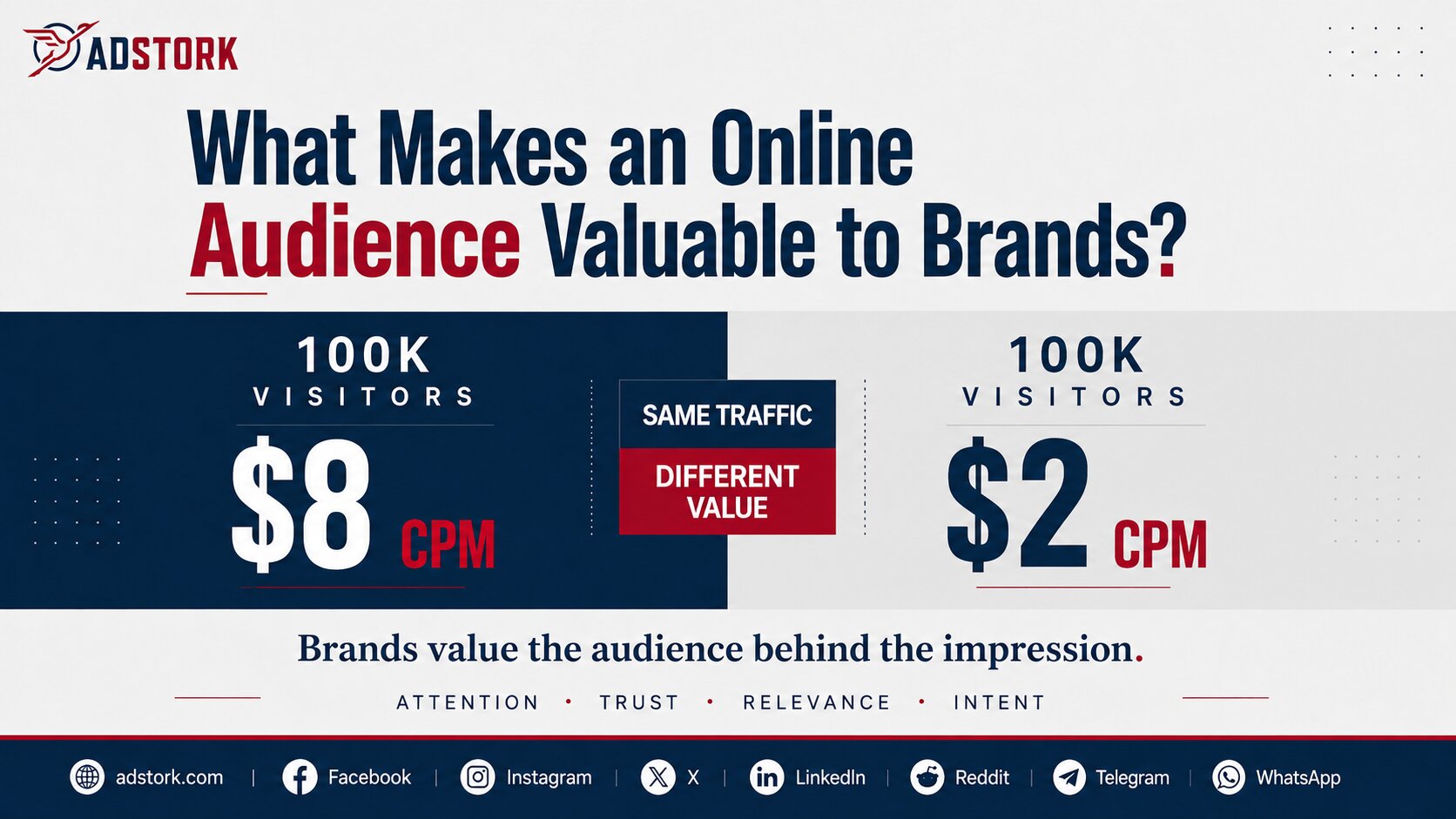
Two publishers have identical traffic volumes. One commands $12 CPM. The other earns $2 CPM. Same traffic. Different revenue.
What makes the difference? It is not the size of the audience. It is the value of the audience.
Brands do not buy traffic. They buy attention, trust, and action. They buy the likelihood that an impression will drive brand recall, shift perception, or generate a conversion. The publishers who understand what makes an audience valuable can capture premium CPMs and build sustainable revenue. Those who do not will compete on commoditised inventory with ever-shrinking margins.
This guide explains the seven factors that determine audience value—and how publishers can strengthen each one.
Key Takeaways
- Brands pay for attention, trust, and action—not traffic volume alone.
- Seven factors determine audience value: attention, first-party data, engagement depth, demographics, brand safety, contextual relevance, and purchase intent.
- Publishers who excel across these factors command premium CPMs and build sustainable revenue.
- First-party data has moved from competitive advantage to competitive necessity—verified, consented audiences are the new premium.
- Direct traffic is 10 times more valuable to advertisers than social traffic and five times more valuable than search traffic.
The Shift: From Reach to Value
For decades, digital advertising operated on a simple equation: more reach equals more value. Brands bought impressions at scale, and publishers maximised volume. But that equation is breaking down.
Brands are increasingly narrowing their media reach, focusing on more active attention rather than passive impressions. One major brand reduced impressions by 25% but increased active attention seconds by 33% and tripled conversions. The lesson is clear: quality of attention matters more than quantity of impressions.
Advertisers are shifting from buying "eyeballs" to buying outcomes. They want audiences that are not just present but engaged, not just reachable but trustworthy, not just numerous but relevant. This shift is reshaping how publishers must think about their audience value proposition.
Neuromarketing insight: when users encounter ads in environments they trust and engage with deeply, their cognitive resistance drops. They process messages with less defensiveness and more openness. This is why a highly engaged reader on a trusted site is worth far more than a passive scroller on a low-quality platform—the ad is processed in a state of receptivity rather than resistance.
1. Attention: The New Currency
Attention has become the most valuable currency in digital advertising. Brands no longer pay simply for impressions—they pay for impressions that are actually seen, processed, and remembered.
Attention Per Mille (APM), which measures attentive seconds per 1,000 impressions, has emerged as a gold standard. Mobile video ads now deliver average attention above 5.5 seconds across more than one billion measured impressions—substantially above the display market benchmark. High-attention environments drive measurably stronger commercial outcomes: ads in premium attention contexts can deliver 38% higher post-view performance.
Brands are increasingly prioritising engagement rate, video watch time, and meaningful dialogue—signals that indicate audiences are not just seeing content but investing attention in it. Viral reach does not necessarily translate into brand value. Sustained attention does.
For publishers, this means designing content and ad experiences that earn attention, not just capture it. Long-form articles, video content, and interactive formats that keep users engaged command premium value.
2. First-Party Data: Trust as the Foundation
In the post-cookie era, first-party data has moved from competitive advantage to competitive necessity. Platforms with verified, logged-in audiences will outperform those without.
Advertisers increasingly rely on precise audiences to drive performance, and nothing is more valuable than an audience they can trust—real people, accurately understood, and reachable across channels. Publishers who can offer verified, consented audience data built on direct relationships command premium CPMs.
The data confirms this shift. First-party data creates verified identities and surfaces behavioural signals and purchase-stage intent that is largely untapped by traditional approaches. Publishers who match first-party registrations against larger co-operative data pools can unlock significant additional value.
News Corp has demonstrated that direct traffic is 10 times more valuable than anything coming from social and five times more valuable than anything coming from search. The implication is clear: audiences who come to you directly—through bookmarks, email, or typing your URL—are significantly more valuable to advertisers.
3. Engagement Depth: Beyond the Click
Engagement depth is how deeply users interact with your content. Brands value audiences that stay, explore, and return.
"Super users"—readers who visit frequently, consume large volumes of content, and often become paying subscribers—generate significant advertising value through the volume of content they consume and the time they spend. They are also more attentive to brand campaigns, more valuable consumers, and more responsive to advertising across a wide variety of consumer categories.
Engaged reach looks beyond total visitor numbers to factor in time spent on site, interactions with multiple pages, and frequency of return visits. It is a metric that more accurately reflects audience value than raw traffic counts.
Publishers who build content architectures that move users from page to page create more valuable inventory. Session depth—how many pages a user visits in a single session—is one of the most underleveraged monetisation levers.
4. Demographic and Behavioural Quality
Not all audiences are created equal. Demographic composition and behavioural signals directly affect advertiser willingness to pay.
High-value audiences have purchasing power, influence, and clear commercial intent. They are decision-makers, affluent consumers, or professionals in high-value categories. Low-value audiences have limited purchasing power, passive consumption patterns, and no clear commercial signals.
Advertisers use sophisticated audience analysis tools to evaluate these signals. They look at income proxies, professional roles, life stage indicators, and behavioural patterns that suggest purchase readiness. Audiences that signal commercial intent command premium CPMs.
The growing importance of first-party data has made demographic and behavioural signals even more valuable. Publishers who can offer verified audience segments with clear commercial characteristics attract stronger demand.
5. Brand Safety: Trust and Reputation
Brand safety is increasingly important to advertisers. They want to appear in safe, reputable environments where their brand will not be associated with controversial or low-quality content.
Smarter contextual analysis helps advertisers keep control of where they appear without blocking valuable opportunities. Publishers who invest in better content categorization and brand safety tools can unlock significant additional inventory value. News UK increased its brand-safe ad inventory by up to 20% through smarter categorization.
Brand-safe environments also command higher CPMs because they attract more advertiser demand. When advertisers value context and quality over fear of association, they gain stronger engagement and help sustain the information ecosystem.
Publishers who can demonstrate clean, reputable content and brand-safe inventory are rewarded with premium demand. Those who cannot are filtered out or discounted.
6. Contextual Relevance: The Right Environment
Context matters. Ads that appear in environments aligned with the brand and product perform better. Advertisers achieve better performance by aligning message and medium.
Premium publishers offer more than just access to an audience—they offer credibility and contextual alignment that enhances the impact of the ad itself. A finance ad on a trusted financial site is more effective than the same ad on a general news site. A fitness ad on a health and wellness site drives stronger engagement.
Enhanced contextual intelligence delivers measurable results. Tests show that enhanced contextual nuance can deliver up to +27.7% increase in CTR and up to +38.9% increase in attention. Publishers who provide clear, well-categorised content that signals relevance to advertisers capture premium demand.
The shift toward contextual targeting is accelerating as third-party cookies disappear. Publishers with strong contextual signals will benefit from this trend.
7. Purchase Intent: Commercial Signals
Purchase intent is the ultimate signal of audience value. Audiences that are actively researching, comparing, or ready to buy command the highest CPMs.
Purchase intent signals include commercial search queries, product reviews, comparison content, and consumption of buying guides. Users who engage with this content are in-market and ready to act. Advertisers pay premium rates to reach them.
First-party data is essential for surfacing these signals. Publishers who can identify and segment users showing purchase-stage intent can offer advertisers highly valuable, targeted inventory.
Publishers who create content that targets commercial keywords—buying guides, product comparisons, reviews—attract high-intent audiences and command premium CPMs.
Understanding your audience's value to brands is the first step to capturing it. Adstork provides transparent reporting that shows you exactly how advertisers perceive your inventory—attention metrics, engagement depth, viewability, and more. You can see where you score well and where you need improvement. Get a free publisher valuation and discover what your audience is really worth to brands.
Industry Insight: The Value of Super Users
The most valuable audience segment for publishers is often the smallest—"super users" who visit frequently, consume large volumes of content, and often become paying subscribers.
The New York Times discovered that their most engaged readers—those who visited most frequently and stayed longest—turned out to be the most valuable, attentive, and responsive to advertisers. They were more attentive to brand campaigns, more valuable consumers, and more responsive to advertising across a wide variety of consumer categories.
This insight has profound implications for publisher strategy. Building loyal, engaged audiences is not just good for subscriptions—it is good for advertising revenue. Publishers who invest in audience development, loyalty programmes, and community building are investing in their most valuable asset.
Comparison Table: High-Value vs. Low-Value Audiences
A side-by-side comparison of high-value and low-value audience characteristics across the seven factors.
| Factor | High-Value Audience | Low-Value Audience |
|---|---|---|
| Attention | Deep, sustained, active engagement | Passive, fleeting, distracted |
| First-Party Data | Verified, consented, direct relationships | Anonymous, unverified, no relationship |
| Engagement | 3+ min sessions, multiple pages, return visits | Under 60 sec sessions, 1 page, one-time |
| Demographics | Affluent, influential, decision-makers | Low income, passive, limited influence |
| Brand Safety | Clean, reputable, trustworthy content | Questionable, low-quality, risky |
| Contextual Relevance | Clear niche, aligned with brand values | General, unfocused, misaligned |
| Purchase Intent | Active research, comparison, buying signals | No commercial signals, passive browsing |
| Typical CPM | $10 – $25+ | $1 – $3 |
Future Outlook: What Brands Will Value in 2026 and Beyond
The factors that determine audience value are evolving. Several trends will reshape what brands value from publisher audiences.
Authenticity and trust are becoming the new performance indicators. Audiences increasingly prioritise real voices, credible stories, and genuine perspectives over polished, artificial content. Brands value publishers who deliver authentic, trustworthy content.
First-party data will move from advantage to necessity. Publishers with verified, logged-in audiences will outperform those without.
Attention metrics will become standard. Four in five industry respondents will focus on attention metrics across connected TV, retail media, and social platforms in 2026.
Contextual relevance will return to prominence. As third-party cookies disappear, advertisers are returning to contextual signals. Publishers with clear, well-categorised content will benefit.
The publishers who succeed will be those who invest in audience relationships, data infrastructure, and content quality. The era of passive, commoditised traffic is ending. The era of valuable, trusted audiences is beginning.
Brands don't buy traffic. They buy attention, trust, and action. Understanding what makes your audience valuable is the key to unlocking premium CPMs and sustainable revenue.
The seven factors—attention, first-party data, engagement depth, demographics, brand safety, contextual relevance, and purchase intent—determine how brands perceive your audience. Publishers who excel across these factors command premium rates. Those who do not compete on commoditised inventory.
Adstork works with publishers to help them understand and communicate their audience value to brands. If you have built a quality audience with engaged, trustworthy users, contact our publisher team for a free audience valuation. Let us show you what your audience is really worth to brands.
Your immediate action plan: Audit your audience against the seven factors. Where do you score well? Where do you have gaps? Consider how you can improve—whether it is building first-party data relationships, deepening engagement, or strengthening brand safety. Then evaluate whether your current monetisation partner is capturing the full value of your audience.
Frequently Asked Questions
What makes an online audience valuable to brands? Brands value audiences that deliver attention, trust, and action—not just traffic volume. The seven key factors are: attention (active engagement), first-party data (verified, consented relationships), engagement depth (time on site, return visits), demographic and behavioural quality, brand safety (reputable environment), contextual relevance (content alignment), and purchase intent (commercial signals).
Is traffic volume or audience quality more important to brands? Audience quality matters significantly more. A publisher with 10,000 engaged, high-value visitors can out-earn one with 100,000 passive, low-value visitors. Brands buy outcomes, not traffic counts.
Why is first-party data so valuable to brands? First-party data provides verified, consented audience information that brands can trust. In the post-cookie era, advertisers increasingly rely on precise audiences to drive performance. Verified, logged-in audiences are the new premium.
How does attention affect audience value? Attention is the new currency of digital advertising. Brands pay more for audiences that actively engage with content rather than passively scroll past. Attention Per Mille (APM) has emerged as a gold standard for measuring audience value.
What is the difference between engaged reach and total reach? Engaged reach looks beyond total visitor numbers to factor in time spent on site, interactions with multiple pages, and frequency of return visits. It provides a more accurate reflection of audience value than raw traffic counts.
How can I increase my audience's value to brands? Improve each of the seven factors: build first-party data relationships, deepen engagement through quality content, strengthen brand safety, develop clear content niches, attract high-value demographics, create content that signals purchase intent, and design experiences that earn attention.
Keep reading:
• What Makes a Publisher Valuable to an Ad Network? The Advertiser's Perspective
• Why Are Advertisers Bidding Less on Your Inventory?
• What Makes a Website Valuable to Advertisers?



Leave a Comment